Home Manufacturing & Production
Canvas Goods Maker
Canvas goods makers measure, cut and stitch heavy fabric into tarpaulins, awnings, swags and covers that keep cargo, equipment and outdoor spaces out of the weather.
- Median salary*
- $62,400
4.0%vs last year, before tax
- People employed
- 370
7.5%vs last year
- Projected growth
- +6%
to 2035
- AI exposure*
- Moderate
- automation risk
- Average hours
- 40/wk
matches all-jobs average
- Shortage status
- Not in shortage
national
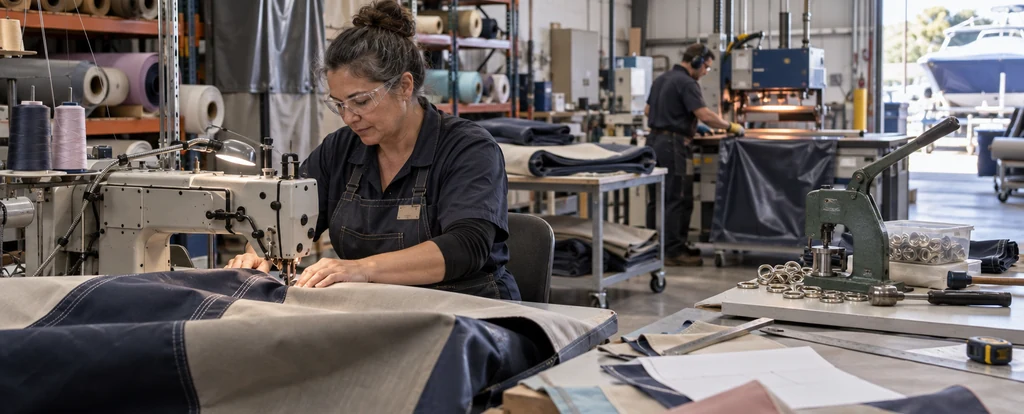
Canvas goods makers work in small workshops, and often on site, making and repairing products from canvas, PVC-coated fabric and shade cloth. They take measurements or work from patterns, cut the fabric, then sew, weld and fit hardware such as grommets, zips and ropes. The trade sits alongside sail making and upholstery, but the material is heavier and the jobs are usually outdoor covers: truck tarps, shade sails, awnings, swags and machinery covers.
How much do canvas goods makers earn?
The median full-time salary for a canvas goods maker is $62,400 per annum, before tax, up $13,000 since 2018.
Pay follows the manufacturing award, so it depends on your classification, the hours you work and whether the workshop pays penalty rates. Made-to-order work is priced by the job, which means earnings improve when you can quote and cut accurately and waste less fabric. Makers who run their own workshop, or who specialise in marine and heavy transport covers, tend to earn more than those doing routine repairs.
What does a canvas goods maker do day to day?
The list below is what fills most weeks; the exact mix shifts with seniority and whatever stage the current work is at.
- Measuring and marking fabric from templates, patterns or the customer's own dimensions
- Cutting canvas, PVC and shade cloth with shears, knives and cutting machines
- Sewing and joining panels on heavy-duty walking-foot machines and welding coated fabric with hot air or RF welders
- Fitting grommets, eyelets, zips, ropes and reinforcing patches
- Repairing, altering and installing finished goods such as awnings, covers and shade sails, often on site
What skills do canvas goods makers need?
Employers look for craft and handmade production, hand and power tool work, plant and equipment operation, backed by Industrial walking-foot sewing machine fluency and strong attention to detail.
Specialist skills
- Craft and handmade production
- Hand and power tool work
- Plant and equipment operation
- Quoting and estimating
Software and tools
- Industrial walking-foot sewing machine
- Hot air plastic welder
- Grommet and eyelet press
- RF welder
- Pattern drafting software
General skills
- Attention to detail
- Customer service
- Problem solving
Is the job growing?
About 370 people work as canvas goods makers in Australia, and employment is projected to grow 6% over the decade to 2035. That's modest growth: demand is steady rather than booming.
How do you become a canvas goods maker?
Here's the path most canvas goods makers take, step by step.
- 1Finish school with the maths to match
Around 59% of people working as canvas goods makers finished school at Year 12 or below, so this trade does not run through university. Being comfortable with millimetres, fractions and simple geometry matters, because a cover that is short by a few centimetres will not fit.
- 2Start as a workshop hand
Many people begin by cutting, folding, fitting grommets and helping on installations before they take on formal training. It is paid work, it shows you whether you like the material and the machines, and workshop owners often hire from the people already in front of them.
- 3Take a traineeship or apprenticeship
A Certificate III traineeship in canvas or textile fabrication, delivered through TAFE or a registered training organisation, covers pattern work, heavy stitching and welding. Traineeships are paid and run over a few years while you work, and the qualification is what lets you take on more complex jobs.
- 4Choose a specialisation
Marine work such as boat covers and sail repair, transport work such as truck tarps and curtains, and shade structures each use different fabrics, hardware and fitting methods. Specialising makes your quoting more reliable and gives you a customer base to build on.
- 5Build towards your own workshop
Once you can quote accurately and run several jobs at a time, opening a workshop or contracting directly to marine and transport customers is a realistic step. It usually means buying or leasing industrial machines and taking on the quoting and ordering yourself.
Ready to apply as a canvas goods maker?
Whether you're working toward becoming a canvas goods maker or already are one and want a hand with the next step (sharpening your resume for ATS screening, tightening your cover letter, or knowing what you'll actually be asked at interview), here are examples grounded in this specific role, not generic templates.
What jobs can a canvas goods maker move to?
Moving into Upholsterer typically comes with the biggest pay rise, worth $17,000 a year more on average.
| Move to | Typical pay change | Overlap | Retraining |
|---|---|---|---|
| Upholsterer Upholstery draws on the same cutting and heavy stitching, with retraining in furniture frames, padding and fabric fitting. | +$17,000 | 52% | reskill |
| Clothing Patternmaker Clothing patternmaking builds on canvas measuring and cutting, though further study is needed in garment drafting, fit and sizing. | +$2,600 | 20% | reskill |
| Leather Goods Maker Leather goods making uses similar cutting and stitching skills, but requires reskilling in leather selection, skiving and edge finishing. | +$2,600 | 33% | reskill |
| Sail Maker Sail making uses the same heavy fabric cutting and stitching, with retraining in sail design, rigging and marine conditions. | −$1,000 | 50% | reskill |
Moves are chosen from Jobs and Skills Australia's Data on Occupation Mobility, which follows income tax records between 2011-12 and 2020-21, together with entry requirements and skill overlap. A known move is one people were seen making in that data. Pay change compares median full-time pay for the two roles.
Who works as a canvas goods maker?
The typical canvas goods maker is 51 years old; 59% are men, 68% work full-time, and full-timers average 40 hours a week.
- 51
- Median age
- 41%
- Female share
- 68%
- Full-time
- +0h
- vs all-jobs avg
What's it like being a canvas goods maker?
Most of the week is bench and machine work in a workshop, broken up by trips to measure a job or fit a finished cover on site. The rhythm follows repair work that cannot wait, such as a torn truck tarp or a storm-damaged awning, alongside longer made-to-order jobs with a fixed delivery date. It suits someone who likes working with their hands, can handle a large piece of fabric on their own, and takes satisfaction in a straight seam.
What people like
- You see the finished thing. A tarp, awning or cover leaves the workshop complete and in use, and much of the work puts an existing item back into service rather than making something from scratch.
- Every job is a different size. One morning it is a small machinery cover, the next it is a full set of truck curtains or a shade sail measured across a car park, so the measuring and cutting rarely become routine.
- The skills carry across the trade. Heavy stitching, cutting and hardware fitting are the same foundations used in sail making and upholstery, which keeps the door open if you want to change direction later.
- Small teams, direct contact with customers. In a small workshop you deal with the person who ordered the job and follow it through, rather than passing it down a production line.
What people find hard
- Heavy fabric is hard on the body. A full truck tarp or shade sail is awkward to lift, spread and feed through a machine, and you spend most of the day on your feet.
- Quiet and frantic stretches. Shade and awning orders cluster before summer, while storm damage and repairs arrive without warning, so the workshop can swing between slack weeks and rushed ones.
- Dust, noise and fumes. Cutting coated fabric creates dust, the machines are loud, and welding PVC needs decent ventilation to be comfortable.
- Quoting is a skill in itself. Fabric is a large part of the cost of a job, so an underquoted cover or shade sail can run at a loss, and learning to estimate accurately takes years.
Based on our synthesis of professional-body surveys and public accounts of the role, not first-person verified reviews.
Which industries employ canvas goods makers?
Manufacturing employs the largest share of canvas goods makers, followed by Other Services.
Top employing industries
- 1Manufacturing
- 2Other Services
Ranked by employment share; the source doesn't publish an exact percentage per industry.
| Year 12 or below | 59.4% | |
|---|---|---|
| Certificate III/IV | 27.8% | |
| Diploma / Advanced Diploma | 5.4% | |
| Bachelor degree | 4.6% | |
| Postgraduate | 1.9% |
Will AI replace canvas goods makers?
AI and automation reach the design and cutting ends of this trade more than the making. Pattern drafting software and automated cutting tables exist in larger workshops and change how quickly a job is laid out, but the fabric still has to be handled, fed through a machine and fitted on site. The stitching, welding and installation that fill most of the week stay with the maker.
Share of typical working time by exposure level
- Stitching and welding panelsHeavy fabric has to be held, fed and turned through a walking-foot machine, and hot air and RF welding need a person watching the seam as it seals.30%low
- Cutting panels to patternAutomated cutting tables can lay out and cut lengths of shade cloth in larger workshops, while a small shop still cuts by hand or with a hand-held machine.25%moderate
- Fitting hardware and installing on siteGrommets, ropes, zips, frames and the final fit on a truck, veranda or shade structure are done by hand in place.25%low
- Measuring up and quoting jobsPattern drafting and quoting software speed up the estimate, but someone still has to climb over a truck or a shade structure and decide where the seams and fixing points go.20%moderate
Moves least exposed to AI
These career moves from canvas goods maker work are rated low for AI exposure:
- Upholsterer
Solid skill overlap (52%), reskill to get there, and a low automation-risk profile.
- Leather Goods Maker
Some skill overlap (33%), reskill to get there, and a low automation-risk profile.
Common questions about becoming a canvas goods maker
Straight answers to the questions people ask most.
How much do canvas goods makers earn?
Canvas goods makers earn a median of $62,400 per year before tax. Pay follows the manufacturing award and varies with your classification, penalty rates and how much of the work is made-to-order rather than repair. Running your own workshop or specialising in marine and heavy transport work is how many makers lift their earnings.
How do you become a canvas goods maker?
Most people start in a workshop and learn on the job, often through a paid traineeship such as a Certificate III in canvas or textile fabrication. A school leaver can begin as a workshop hand doing cutting, folding and grommet work while picking up the machines. No licence is needed to make and repair canvas goods, though installation work on building sites usually requires the site's own safety induction.
Are canvas goods makers in demand?
Canvas goods makers are currently not in shortage. Employment is projected to grow 6% over the decade to 2035, which reflects a small trade where most work is replacing and repairing covers already in use. Because the trade is small, openings often come from workshops short of a pair of hands, so approaching businesses directly is worth doing alongside watching advertised vacancies.
Will AI replace canvas goods makers?
AI and automation reach the design and cutting ends of this trade more than the making. Pattern drafting software and automated cutting tables change how quickly a job can be laid out in larger workshops, and quoting tools speed up estimates, but heavy fabric still has to be handled, fed through a machine and fitted. The stitching, welding and installation that fill most of the week stay with the maker.
What can a canvas goods maker move into?
Canvas goods makers often move into sail making, which uses the same heavy cutting and stitching with retraining in sail design and rigging, or into upholstery, where the cutting and stitching carry over and pay is $17,000 more. Sewing machinists come the other way, though they need to complete a canvas goods apprenticeship before working with heavy textiles. Opening your own workshop, or building a reputation in marine and heavy transport covers, is a common progression and often where earnings grow.
What is the difference between a canvas goods maker and an upholsterer?
Both cut and stitch heavy fabric, but canvas goods makers work with waterproof and coated materials for outdoor use, while upholsterers rebuild furniture frames, padding and covers for indoor use. The machines and hand skills overlap, and some workers move between the two over a career.
Related roles
Not sure this is you? Take the career quiz and get a ranked shortlist of roles that fit how you like to work.