Home Manufacturing & Production
Leather Goods Maker
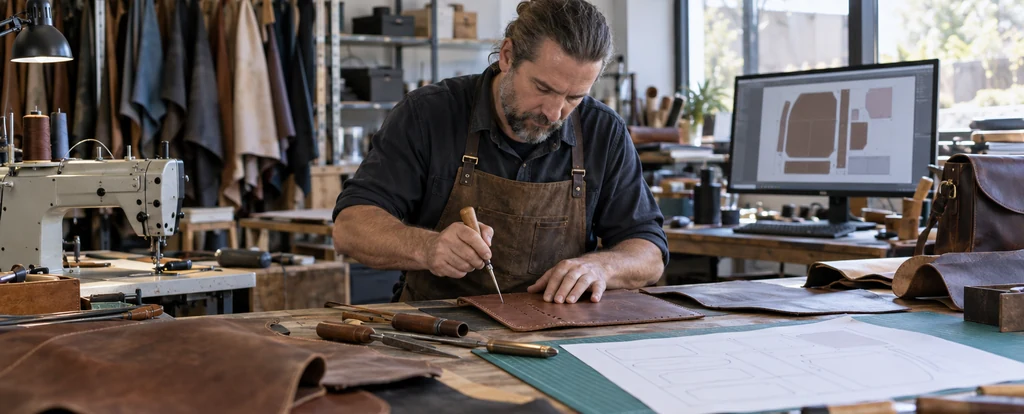
Leather goods makers cut, stitch and finish leather into bags, belts, wallets and other items, often by hand and usually in small runs.
- Median salary*
- $65,000
3.5%vs last year, before tax
- People employed
- 480
4.0%vs last year
- Projected growth
- +6%
to 2035
- AI exposure*
- Low
- automation risk
- Average hours
- 45/wk
+5h vs all jobs
- Shortage status
- Not in shortage
national
Most leather goods makers work at a bench in a small workshop, though some are part of a factory team or run a studio of their own. The trade sits close to shoemaking and canvas goods making, which share the cutting and heavy stitching, but here the material is leather and the finish is the part customers notice first. Many makers produce one-off or short-run pieces for a designer or a retail label, and repairs and restoration often fill part of the week.
How much do leather goods makers earn?
The median full-time salary for a leather goods maker is $65,000 per annum, before tax, up $13,900 since 2018.
What you earn depends on whether you are making volume pieces for a manufacturer or one-off commissions, since custom and luxury work usually pays more per item but brings fewer of them. Workshop and factory roles sit under manufacturing or retail awards, while self-employed makers set their own prices and absorb the cost of hides, hardware and tools. As your portfolio and reputation for a particular product grow, you have more room to negotiate on commission work.
What does a leather goods maker do day to day?
The list below is what fills most weeks; the exact mix shifts with seniority and whatever stage the current work is at.
- Cutting panels from hides by hand or with a die, working around scars, stretch and uneven thickness so each piece uses the best part of the skin
- Stitching components on a leather sewing machine or by hand with a saddle stitch, which is slower but stronger and visible on open edges
- Skiving, burnishing and dyeing edges so they sit flat and take an even finish
- Setting rivets, buckles, snaps and zips, and lining bags so the hardware sits straight
- Checking each finished piece for even stitching, colour match and hardware placement, and reworking anything that fails
What skills do leather goods makers need?
Employers look for craft and handmade production, hand and power tool work, fabrication and finishing, backed by Adobe Illustrator fluency and strong attention to detail.
Specialist skills
- Craft and handmade production
- Hand and power tool work
- Fabrication and finishing
- Visual design
- Inventory management
Software and tools
- Adobe Illustrator
- CAD pattern-making software
- Leather sewing machine
- Hand tools (awls, knives, chisels)
General skills
- Attention to detail
- Customer service
Is the job growing?
About 480 people work as leather goods makers in Australia, and employment is projected to grow 6% over the decade to 2035. That's modest growth: demand is steady rather than booming.
How do you become a leather goods maker?
Here's the path most leather goods makers take, step by step.
- 1Start with a short course in hand leatherwork
TAFE and specialist workshops run beginners courses covering saddle stitching, edge finishing and simple patterns, usually over a few weekends. They cost little and show you quickly whether you enjoy the work.
- 2Look for a certificate III or a traineeship
Some TAFEs offer a certificate III in leather production, and a small number of manufacturers take on trainees. A traineeship is paid, takes about one to two years, and is the main way to learn factory methods and speed.
- 3Build a portfolio of finished pieces
Employers and customers judge what you have made. Bags, belts and small goods you can show, with the pattern and the leather named, carry more weight than a resume on its own.
- 4Add design and pattern software
Roles that produce a range rather than one-offs often expect familiarity with Adobe Illustrator or CAD pattern-making software, and a design qualification helps here more than anywhere else in the trade.
- 5Set up your own studio when you are ready
Many experienced makers leave employment to sell their own work. That needs pricing, stock and customer skills alongside the craft, so it usually comes after a few years of paid making.
Ready to apply as a leather goods maker?
Whether you're working toward becoming a leather goods maker or already are one and want a hand with the next step (sharpening your resume for ATS screening, tightening your cover letter, or knowing what you'll actually be asked at interview), here are examples grounded in this specific role, not generic templates.
What jobs can a leather goods maker move to?
Moving into Upholsterer typically comes with the biggest pay rise, worth $14,400 a year more on average.
| Move to | Typical pay change | Overlap | Retraining |
|---|---|---|---|
| Upholsterer Leather working and hand stitching suit upholstery, but an apprenticeship adds frame building, padding and fabric fitting. | +$14,400 | 70% | requalify |
| Orthotic and Prosthetic Technician Leather shaping, sewing and hand finishing suit orthotic and prosthetic work, with a short course covering clinical fitting and materials. | +$7,800 | 50% | short course |
| Canvas Goods Maker Cutting and heavy stitching transfer to canvas goods, but a separate apprenticeship covers tents, awnings and outdoor finishes. | −$2,600 | 33% | requalify |
| Sail Maker Stitching and reinforcing leather goods transfer to sail making, though an apprenticeship is needed for sail design and rigging. | −$3,600 | 28% | requalify |
| Shoemaker Leather cutting, stitching and finishing carry into shoe making, though a separate apprenticeship is required for footwear construction. | −$5,200 | 70% | requalify |
Moves are chosen from Jobs and Skills Australia's Data on Occupation Mobility, which follows income tax records between 2011-12 and 2020-21, together with entry requirements and skill overlap. A known move is one people were seen making in that data. Pay change compares median full-time pay for the two roles.
Who works as a leather goods maker?
The typical leather goods maker is 50 years old; 63% are men, 59% work full-time, and full-timers average 45 hours a week.
- 50
- Median age
- 37%
- Female share
- 59%
- Full-time
- +5h
- vs all-jobs avg
What's it like being a leather goods maker?
The work has a steady bench rhythm: mark, cut, stitch, finish, then start the next piece. In a small workshop one person often handles design, making, customer contact and stock, so the week mixes craft with admin. It suits someone who likes working with their hands, accepts slow progress on a single item, and can live with the economics of a very small trade.
What people like
- You finish the day with something you made. A bag or a belt exists at the end of the process, and you can see exactly where your stitching and edge work landed.
- Hand skills keep improving. Saddle stitch, skiving and burnishing take years to get clean, and the improvement shows in the work rather than in a job title.
- Small runs keep the week varied. One-off commissions and short production runs mean different hides, colours and hardware instead of the same item for months.
- Quiet, independent work. Much of the day is spent at a bench with tools and material, and experienced makers often work with little supervision.
What people find hard
- One bad cut wastes expensive material. Hides carry scars, stretch and uneven thickness, and a misjudged panel can mean recutting from a piece you cannot replace cheaply.
- Custom commissions are hard to price. Quoting a one-off piece takes unpaid hours, and customers often do not realise how long hand stitching takes.
- Physical strain adds up. Cutting, hammering and stitching by hand load the wrists, shoulders and eyes, especially during long production days before a market or a delivery.
- Openings rarely come through advertised listings. Most jobs arrive through a manufacturer, a repairer or a designer who already knows your work, so timing and contacts matter as much as skill.
Based on our synthesis of professional-body surveys and public accounts of the role, not first-person verified reviews.
Which industries employ leather goods makers?
Manufacturing employs the largest share of leather goods makers, followed by Other Services.
Top employing industries
- 1Manufacturing
- 2Other Services
- 3Retail Trade
Ranked by employment share; the source doesn't publish an exact percentage per industry.
| Year 12 or below | 40.2% | |
|---|---|---|
| Certificate III/IV | 30.1% | |
| Diploma / Advanced Diploma | 9.4% | |
| Bachelor degree | 8.6% | |
| Postgraduate | 3.1% |
Will AI replace leather goods makers?
Leather goods making is lightly exposed to AI and automation, because the parts customers pay for, cutting to the grain, hand stitching and finishing edges, are done by feel at a bench. CAD pattern-making, cutting machines and laser cutters are established in production workshops, and they speed up repeat panels and grading without taking over assembly and finishing. The job is more likely to change in how patterns and quotes are prepared than in how a bag is put together.
Share of typical working time by exposure level
- Stitching componentsA leather sewing machine is already the tool of the trade, and setting tension, guiding curved seams and holding stitch length even through thick edges remains manual.30%low
- Cutting and skiving panelsNesting software and die presses handle repeat production cuts, but judging stretch, scars and grain direction across a hide is still done by eye and hand.25%moderate
- Finishing edges and surfacesBurnishing, dyeing and waxing depend on small adjustments by feel, and an edge that looks even under shop light is hard to check automatically.25%low
- Designing, pattern-making and quotingCAD and Illustrator speed up drafting, grading and cost sheets, while working out what a customer wants and what a one-off piece is worth stays with the maker.20%moderate
Common questions about becoming a leather goods maker
Straight answers to the questions people ask most.
How much do leather goods makers earn?
Leather goods makers earn a median of $65,000 per year before tax, and that figure covers full-time workers only. What moves it is the type of work: repeat production for a manufacturer is usually paid at award rates, while custom and luxury commissions are priced per piece and rise with your reputation. Treat the median as a guide rather than a starting salary, since self-employed makers are not counted in it.
How do you become a leather goods maker?
There is no single required qualification, and most people begin with a short course in hand leatherwork before looking for paid work. A certificate III in leather production or a traineeship with a manufacturer teaches factory methods and speed, and a portfolio of finished pieces usually does more for your chances than a resume alone.
Are leather goods makers in demand?
Leather goods makers are currently not in shortage, and employment is projected to grow 6% over the decade to 2035 over the decade. Because the occupation is small, a couple of retirements or one workshop expanding can change what is available in a city, so it pays to approach manufacturers, repairers and fashion labels directly rather than waiting for an advertisement.
Will AI replace leather goods makers?
Automation reaches the repeatable parts of the trade, where nesting software and die presses cut production panels and CAD speeds up pattern drafting and grading. The work that defines the job, reading a hide, stitching curved seams and finishing edges, depends on feel and small adjustments that are hard to automate. Preparing patterns and quotes is likely to change more than the way a bag is assembled.
What other jobs can a leather goods maker move into?
Cutting, stitching and finishing carry into shoemaking, though footwear construction needs its own apprenticeship, and the pay difference is $5,200 less. Upholstery uses much the same hand stitching and leather work, with a pay difference of $14,400 more. A short course in materials and clinical fitting opens up orthotic and prosthetic technician work, where the pay difference is $7,800 more.
Can leather goods makers run their own business?
Many experienced makers end up running a studio or brand of their own, selling direct or through designers, and this is often where earnings grow. It means carrying material costs, pricing your own work and managing stock and customers alongside the making, so it suits people who are comfortable with uneven income.
Related roles
Not sure this is you? Take the career quiz and get a ranked shortlist of roles that fit how you like to work.