Home Manufacturing & Production
Upholsterer
Upholsterers build and repair the padded, covered surfaces of furniture and vehicle interiors, from sofa frames to car seats.
- Median salary
- $79,400
3.9%vs last year, before tax
- People employed
- 1,900
0.0%vs last year
- Projected growth
- +6%
to 2035
- AI exposure*
- Low
- automation risk
- Average hours
- 42/wk
+2h vs all jobs
- Shortage status
- In shortage
national
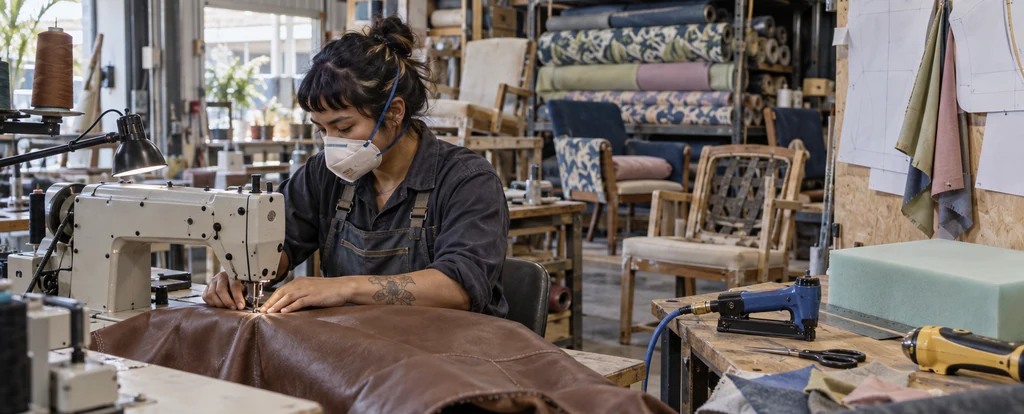
Upholsterers work in small workshops, factory floors and automotive trimming shops, cutting and sewing covers and building the padding underneath them. The trade splits broadly into furniture and automotive work: furniture upholsterers rebuild and restore sofas, chairs and bedheads, while automotive trimmers fit seats, headlinings and door cards. Upholstery sits apart from furniture making because the materials are soft, and apart from sewing machining because the frames, foam and hand fitting are part of the job.
How much do upholsterers earn?
The median full-time salary for an upholsterer is $79,400 per annum, before tax, up $16,500 since 2018.
Most upholsterers are covered by the manufacturing award, so base rates rise with the classification level you reach and with any enterprise agreement in your workplace. Automotive trimming, marine work and antique restoration generally pay more than volume furniture production, and setting your own prices in a small workshop is where earnings can grow furthest. Rates also differ between states and between city and regional workshops.
What does an upholsterer do day to day?
The list below is what fills most weeks; the exact mix shifts with seniority and whatever stage the current work is at.
- Measuring and cutting fabric, leather and foam to fit a frame
- Stripping old covers, webbing and padding before a rebuild
- Sewing covers and seams on an industrial machine
- Fitting covers, padding and springs to furniture frames and vehicle seats
- Quoting a restoration job and sourcing a fabric that matches the original
What skills do upholsterers need?
Employers look for hand and power tool work, fabrication and finishing, craft and handmade production, backed by Industrial sewing machine fluency and strong attention to detail.
Specialist skills
- Hand and power tool work
- Fabrication and finishing
- Craft and handmade production
- Quoting and estimating
- Inventory management
Software and tools
- Industrial sewing machine
- Pneumatic staple gun
- Foam cutter
- Hot knife
- CAD pattern software
General skills
- Attention to detail
- Customer service
Is the job growing?
About 1,900 people work as upholsterers in Australia, and employment is projected to grow 6% over the decade to 2035. That's modest growth: demand is steady rather than booming.
How do you become an upholsterer?
Here's the path most upholsterers take, step by step.
- 1Finish school and find a workshop
You can begin an upholstery apprenticeship after Year 10, and most people enter with no prior trade qualification. Some start as a workshop hand cutting foam and stripping frames before they sign up.
- 2Start a Certificate III in Upholstery
This is the standard trade qualification, delivered at TAFE or a private registered training organisation, and it covers frame construction, cutting, sewing, padding and finishing.
- 3Complete your apprenticeship
Apprenticeships are paid, and you spend most of the week in a workshop learning from a qualified upholsterer while studying off the job. It usually takes around three years.
- 4Choose a specialisation
Marine and caravan upholstery calls for UV-resistant fabrics and corrosion-proof fittings, antique restoration calls for traditional materials such as horsehair and coil springs, and automotive trimming has its own methods for seats and headlinings.
- 5Build a portfolio and go out on your own
Photographs of finished pieces matter when you quote for private restoration work, and many upholsterers eventually run their own workshop or subcontract to furniture retailers and motor trimmers.
Ready to apply as an upholsterer?
Whether you're working toward becoming an upholsterer or already are one and want a hand with the next step (sharpening your resume for ATS screening, tightening your cover letter, or knowing what you'll actually be asked at interview), here are examples grounded in this specific role, not generic templates.
What jobs can an upholsterer move to?
None of the roles upholsterers typically move into pay more than the role itself. Clothing Patternmaker is the closest match. If a bigger salary is the goal, moving up into a senior or principal position within the role is usually the faster route than moving sideways.
| Move to | Typical pay change | Overlap | Retraining |
|---|---|---|---|
| Clothing Patternmaker Upholsterers bring fabric cutting and construction skills to patternmaking, though study in pattern drafting and grading is needed. | −$14,400 | 14% | reskill |
| Leather Goods Maker Leather goods making shares upholstery's cutting, stitching and finishing hand skills, so the move needs little extra training. | −$14,400 | 70% | minimal |
| Canvas Goods Maker Upholsterers can apply heavy fabric cutting and stitching to canvas goods, with trade training in canvas work required. | −$17,000 | 52% | reskill |
| Shoemaker Shoemakers and upholsterers both build padded, stitched products by hand, though footwear training adds specific techniques. | −$19,600 | 100% | reskill |
| Picture Framer Picture framers use the same fine hand skills and material handling, with a short course covering framing methods and mounting. | −$22,200 | 52% | short course |
Moves are chosen from Jobs and Skills Australia's Data on Occupation Mobility, which follows income tax records between 2011-12 and 2020-21, together with entry requirements and skill overlap. A known move is one people were seen making in that data. Pay change compares median full-time pay for the two roles.
Who works as an upholsterer?
The typical upholsterer is 37 years old; 88% are men, 79% work full-time, and full-timers average 42 hours a week.
- 37
- Median age
- 12%
- Female share
- 79%
- Full-time
- +2h
- vs all-jobs avg
What's it like being an upholsterer?
The work runs job to job rather than to a clock: a sofa rebuild might take a day, a set of car seats a week, and a restoration can drag on while you hunt for a fabric that is no longer made. Most of it happens standing or kneeling at a bench, with foam dust, adhesive and staple guns part of the surroundings. People who stay in the trade tend to like seeing a finished piece leave the workshop and prefer working with materials to managing a process.
What people like
- You can see the job finished. A rebuilt chair or a retrimmed seat leaves the workshop looking better than it arrived, and the result of your hands is visible at the end of each job.
- Every piece is a bit different. Curved frames, worn springs and worn fabrics each need their own approach, so the work rarely settles into the same motion all day.
- Repair work keeps coming. People hold on to good furniture and classic cars, and re-covering a sound frame usually costs less than replacing it, which keeps restoration and repair in steady demand.
- It is a trade you can take out on your own. The tools and space needed to run a small upholstery business are modest, and plenty of upholsterers build a client base in restoration or marine work alongside their day job.
What people find hard
- Dust, foam and fumes. Cutting foam and stripping old padding fills the air, and adhesives and finishes have strong smells, so masks, ventilation and regular cleanup are part of the job.
- Hard work on your hands and knees. Frames are heavy, and tacking undersides and fitting covers means kneeling, reaching and gripping tools for long stretches.
- Mistakes show and cost money. Leather and patterned fabric are expensive and a miscut panel can waste a whole hide, so careful measuring and marking carry real consequences.
- Volume production runs to a pace. Factory work can mean the same seat or cushion hundreds of times, with time targets and tight margins cutting into how much care you can take.
Based on our synthesis of professional-body surveys and public accounts of the role, not first-person verified reviews.
Which industries employ upholsterers?
Manufacturing employs the largest share of upholsterers.
Top employing industries
- 1Manufacturing
Ranked by employment share; the source doesn't publish an exact percentage per industry.
| Certificate III/IV | 49.9% | |
|---|---|---|
| Year 12 or below | 37.4% | |
| Bachelor degree | 4% | |
| Diploma / Advanced Diploma | 3.9% | |
| Postgraduate | 1% |
Will AI replace upholsterers?
AI and automation touch this trade lightly. Digital cutting tables, CAD pattern software and computer-controlled foam cutting have taken over some of the marking and cutting of flat panels, and quoting software handles the paperwork around a job. The fitting itself, pulling covers over frames, rebuilding padding and matching a fabric to a worn piece, still depends on hand skill and on seeing how the material behaves on the frame in front of you.
Share of typical working time by exposure level
- Cutting and sewing coversCutting tables and pattern software speed up flat panels, but matching a pattern across a curved cushion or working around flaws in a hide is still done by eye and hand.30%moderate
- Fitting covers and padding to framesStretching a cover tight, adjusting the padding underneath and stapling or tacking it into place has no automated equivalent, because every frame is slightly different.30%low
- Restoring and repairing old piecesRebuilding horsehair padding, repairing a carved frame or finding a fabric close to a 1960s original relies on judgement built up from handling similar pieces.25%low
- Quoting jobs and ordering materialsSoftware can turn measurements into a quote and check fabric stock and delivery times, which trims the administration around each job.15%high
Common questions about becoming an upholsterer
Straight answers to the questions people ask most.
How much do upholsterers earn?
Full-time upholsterers earn a median of $79,400 per year before tax. Where you work shapes that more than the trade itself, with automotive trimming and restoration paying above volume furniture production, and experienced upholsterers who run their own workshop setting their own rates.
How do you become an upholsterer?
Most upholsterers complete a Certificate III in Upholstery (MSF30722) through a paid apprenticeship, which usually takes about three years. You can also come across from related work such as industrial sewing or canvas goods making, but you will still need to learn frames, padding and finishing on the job or through a TAFE course.
Are upholsterers in demand in Australia?
Upholsterers are currently in shortage nationally, and employment is projected to grow 6% over the decade to 2035. The trade is small, at about 1,900 people, so openings tend to come from retirements and from restoration, marine and automotive work rather than from new factory production lines.
Will AI replace upholsterers?
Automation reaches the measuring and cutting end of the trade rather than the fitting. Digital cutting tables, CAD pattern software and computer-controlled foam cutting speed up flat panels and repeats, but pulling a cover tight over a curved frame and finishing it neatly is still done by hand.
What can an upholsterer move into?
Industrial sewing machinists who retrain in upholstery earn around $23,900 more, which makes it a step up for people already working with heavy fabrics. Moves sideways into clothing patternmaking or picture framing tend to pay $14,400 less, and both need study in pattern drafting or framing methods. Many upholsterers instead stay in the trade and run their own workshop, which is often where earnings grow.
Do you need a licence to work as an upholsterer?
No licence or registration is required for upholstery in Australia, though you will need a White Card if you work on construction sites. A trade qualification is not strictly mandatory either, but most employers expect a Certificate III or several years of demonstrated experience.
Related roles
Not sure this is you? Take the career quiz and get a ranked shortlist of roles that fit how you like to work.