Communications Operator
Communications operators answer emergency calls and send police, fire, ambulance and other crews to the incidents that come in.
- Median salary*
- $75,400
3.9%vs last year, before tax
- People employed
- 1,200
0.0%vs last year
- Projected growth
- +6.2%
to 2035
- AI exposure*
- Moderate
- automation risk
- Average hours
- 46/wk
+6h vs all jobs
- Shortage status
- Not in shortage
national
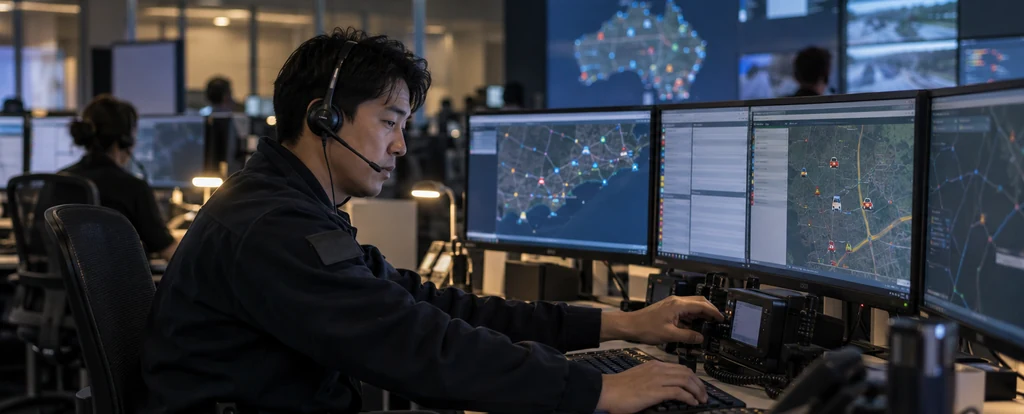
Most communications operators work in a central communications centre, sitting at a console with a headset, a radio and a computer-aided dispatch screen. The work happens entirely through a phone line and a radio, so the operator never sees the scene and relies on what a caller or a crew tells them in the first few minutes. Employers are mainly state and territory police, fire and ambulance services, and the centres run around the clock.
How much do communications operators earn?
The median full-time salary for a communications operator is $75,400 per annum, before tax, up $15,700 since 2018.
Pay is set mainly by the state or territory service that runs the centre, so rates differ between agencies and are usually covered by an enterprise agreement rather than one national award. Shift penalties, weekend and public holiday loadings and overtime add to base rates, because the centres never close. Within an agency, experience on the dispatch system and a move into training, quality assurance or shift supervision is what lifts pay.
What does a communications operator do day to day?
The list below is what fills most weeks; the exact mix shifts with seniority and whatever stage the current work is at.
- Answering emergency and non-emergency calls and working out which ones need a response first
- Recording incident details in a computer-aided dispatch system while the caller is still on the line
- Sending the nearest available police, fire or ambulance crews to an incident
- Keeping radio contact with crews on the ground and passing on new information as it arrives
- Handing unfinished incidents to the next shift and updating records as the situation changes
What skills do communications operators need?
Employers look for operations management, regulatory compliance, backed by Computer-aided dispatch (CAD) software fluency and strong written communication.
Specialist skills
- Operations management
- Regulatory compliance
Software and tools
- Computer-aided dispatch (CAD) software
- P25 radio console systems
- Geographic information systems (GIS)
- Emergency alert and paging systems
- Records management systems
General skills
- Written communication
- Customer service
- Attention to detail
- Problem solving
- Time and deadline management
Is the job growing?
About 1,200 people work as communications operators in Australia, and employment is projected to grow 6.2% over the decade to 2035. That's modest growth: demand is steady rather than booming.
How do you become a communications operator?
Here's the path most communications operators take, step by step.
- 1Meet the entry requirements
Most services ask for Year 12 or equivalent, Australian citizenship or permanent residency, and a national police check, and some also require a security clearance. Recruitment testing usually covers typing speed, spelling and a simulation that checks how you handle several things at once.
- 2Apply to the service that runs the centre
Police, fire, ambulance and state emergency service communications centres are run by state and territory agencies, and each recruits separately through its own careers page. Intakes are often advertised in bulk when a training group is being filled, so it is worth checking those pages regularly rather than waiting for a general job board listing.
- 3Complete the agency's training
Training is paid and runs for several weeks full time, covering call triage, radio procedure, the dispatch system and the protocols for different incident types. New operators then work supervised shifts, usually with a mentor listening in, before taking calls alone. In some agencies this training is recognised as a certificate III in public safety (emergency communications centre operations).
- 4Specialise once you are on the console
Operators generally start on non-emergency calls or a single channel and add emergency call taking, dispatch, or both as they build experience. Training, quality assurance and shift supervision are the usual internal moves from there.
Ready to apply as a communications operator?
Whether you're working toward becoming a communications operator or already are one and want a hand with the next step (sharpening your resume for ATS screening, tightening your cover letter, or knowing what you'll actually be asked at interview), here are examples grounded in this specific role, not generic templates.
What jobs can a communications operator move to?
Moving into Emergency Management Officer typically comes with the biggest pay rise, worth $53,200 a year more on average.
| Move to | Typical pay change | Overlap | Retraining |
|---|---|---|---|
| Emergency Management Officer Communications operators bring incident coordination and emergency protocols, with further study in emergency management.Known move | +$53,200 | 24% | reskill |
| Public Relations Officer Communications operators bring public contact and information handling, though public relations work needs media and writing study.Known move | +$31,000 | 15% | reskill |
| Train Controller Communications operators bring control room monitoring and dispatch skills, with rail-specific training. | +$26,000 | 67% | short course |
| Defence Force Member Communications operators bring emergency call triage and dispatch coordination, though defence service requires military training and security clearance.Known move | +$12,000 | 29% | reskill |
Moves are chosen from Jobs and Skills Australia's Data on Occupation Mobility, which follows income tax records between 2011-12 and 2020-21, together with entry requirements and skill overlap. A known move is one people were seen making in that data. Pay change compares median full-time pay for the two roles.
Who works as a communications operator?
The typical communications operator is 29 years old; 71% are men, 91% work full-time, and full-timers average 46 hours a week.
- 29
- Median age
- 29%
- Female share
- 91%
- Full-time
- +6h
- vs all-jobs avg
What's it like being a communications operator?
The job runs to a roster rather than a working week, because the centres operate around the clock. A shift mixes long quiet stretches with sudden bursts of activity, and the operator has to stay steady through both. People who enjoy the work tend to like its clear procedures, the small team in the room, and the fact that a decision made in seconds has a visible result.
What people like
- You see the result before you go home. An incident comes in, crews go out, and the job is finished, which suits people who like completing a task rather than working on something for months.
- A small team in one room. Control rooms hold a handful of people on each shift, and operators lean on the person beside them when a call goes badly. That closeness is a large part of the job's appeal.
- Clear procedures to work from. Triage cards, dispatch protocols and checklists mean there is usually a defined next step, even on a call that is unfolding quickly.
- Time off in the middle of the week. Because the roster covers nights, weekends and public holidays, days off often fall midweek, which suits errands, study or family commitments that are hard to manage around a Monday to Friday job.
What people find hard
- Rotating rosters that include nights. The centres never close, so night shifts, weekends and public holidays are part of every roster, and the body clock takes time to adjust.
- Calls that stay with you. Some callers are injured, frightened or abusive, and the operator cannot end the call or walk away from the console until it is over.
- Every call is recorded and reviewed. Calls, radio traffic and dispatch decisions are logged, and supervisors review samples for training and quality, so the work is closely measured.
- Long stretches seated at a console. Full-time operators average around 46 hours a week with a headset on, much of it in front of several screens.
Based on our synthesis of professional-body surveys and public accounts of the role, not first-person verified reviews.
Which industries employ communications operators?
Public Administration and Safety employs the largest share of communications operators.
Top employing industries
- 1Public Administration and Safety
Ranked by employment share; the source doesn't publish an exact percentage per industry.
| Year 12 or below | 48.2% | |
|---|---|---|
| Certificate III/IV | 24.8% | |
| Diploma / Advanced Diploma | 11.8% | |
| Bachelor degree | 9.2% | |
| Postgraduate | 3.3% |
Will AI replace communications operators?
The job sits in the middle: parts of it automate well and parts resist it. Call transcription, structured incident forms and dispatch software that ranks the nearest available units already do work operators once did by hand, which speeds up the desk side of a shift. What automation handles less well is a distressed caller, an unclear address or a radio transmission arriving through static, so judgement about priority stays central to the role.
Share of typical working time by exposure level
- Taking emergency calls and setting priorityTranscription and script prompts can capture details automatically, but deciding whether a call is a house fire or a burnt dinner, and how fast help needs to move, is still a human call.30%moderate
- Dispatching crews through the computer-aided dispatch systemThe software already suggests the closest suitable unit and that ranking keeps improving, though the operator decides when to override it for a crew that knows the area.25%moderate
- Talking to crews by radioRadio traffic is clipped, noisy and full of local shorthand, which speech recognition handles poorly, and the operator is also the person who notices when a crew has gone quiet.25%low
- Logging and updating incident recordsSpeech-to-text and structured forms cut most of the typing during a call, and records now update from the field rather than being re-keyed at the console.20%high
Moves least exposed to AI
These career moves from communications operator work are rated low for AI exposure:
- Defence Force Member
Some skill overlap (29%), reskill to get there, and a low automation-risk profile.
Common questions about becoming a communications operator
Straight answers to the questions people ask most.
How much do communications operators earn?
$75,400 per year before tax is the median for full-time communications operators, which means half earn more and half earn less. What you actually take home depends on which service employs you and how much of your roster falls on nights, weekends and public holidays.
How do you become a communications operator?
There is no single national qualification; you apply to a state or territory emergency service and complete its training program. Year 12 or equivalent, a police check and, for some agencies, a security clearance are the usual minimum, and recruitment tests check your typing and your ability to handle several tasks at once.
Are communications operators in demand?
Communications operators are currently not in shortage, and employment is projected to grow 6.2% over the decade to 2035 over the decade to 2035. Openings come mostly from staff turnover and from the recruitment rounds agencies run when they need to fill a training intake, so watching the careers pages of the services in your state is more useful than searching job boards.
Will AI replace communications operators?
AI is changing parts of the job rather than taking it over. Speech-to-text and call transcription already reduce how much typing a call taker does, and dispatch systems suggest which unit to send, but setting priority and settling a distressed caller still fall to the operator.
What can communications operators move into?
Train controllers do similar control room work, and the two roles share about 67% of their skills, with a short course covering rail-specific procedures; pay is $26,000 more. Emergency management officers use the same incident protocols and usually need further study in emergency management, with pay around $53,200 more. Some operators move to the defence force, which involves military training and a security clearance.
What is the difference between a call taker and a dispatcher?
In many centres they are separate roles: call takers gather details from the public, and dispatchers assign crews and stay with them by radio. Smaller centres combine the two, and communications operators often cover both across a roster.
Related roles
- Defence Force Member
- Public Relations Officer
- Emergency Management Officer
- Train Controller
- Dispatcher
- Call Centre Operator
Not sure this is you? Take the career quiz and get a ranked shortlist of roles that fit how you like to work.