Home Manufacturing & Production
Continuous Improvement Manager
A continuous improvement manager finds where a factory or production line is wasting time, materials or money, and leads the changes that fix it.
- Median salary*
- $96,200
3.9%vs last year, before tax
- People employed*
- 2,400
0.0%vs last year
- Projected growth*
- +6.2%
to 2035
- AI exposure*
- Moderate
- automation risk
- Average hours*
- 40/wk
matches all-jobs average
- Shortage status*
- Not in shortage
national
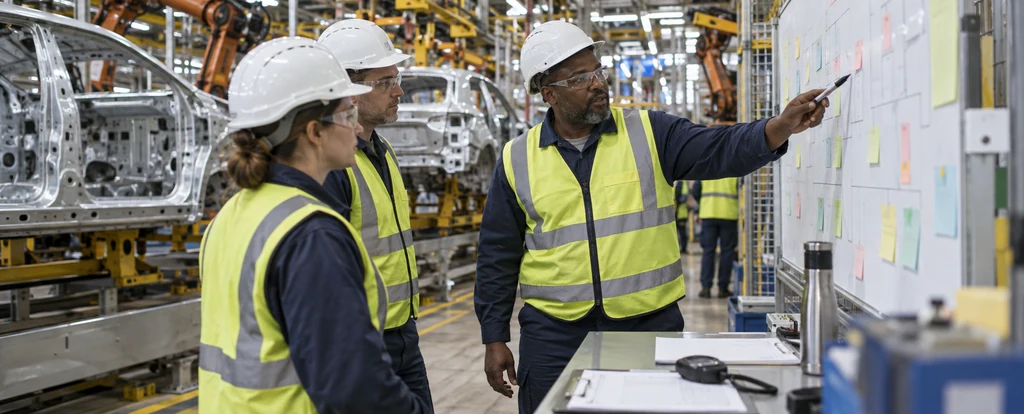
A continuous improvement manager reviews workflows, equipment use and staffing on the production floor, then runs the projects that make them leaner. The role applies structured methods such as Lean and Six Sigma, and usually sits across production, engineering and maintenance teams rather than inside one of them. It differs from a quality engineer, whose focus is compliance and defect control, because a continuous improvement manager looks at cost, speed and waste across the whole process.
How much do continuous improvement managers earn?
The median full-time salary for a continuous improvement manager is $96,200 per annum, before tax, up $19,900 since 2018.
Pay depends heavily on the sector and the site, and pharmaceutical, medical device and metal manufacturers generally pay above food and beverage processors for the same title. A formal Lean Six Sigma black belt, or a package tied to verified savings, pushes it higher again, and larger plants under an enterprise agreement set their own bands. Which industry you work in matters more than which city.
What does a continuous improvement manager do day to day?
The list below is what fills most weeks; the exact mix shifts with seniority and whatever stage the current work is at.
- Analysing production metrics and process data to find where output slows or costs blow out
- Running kaizen workshops and problem-solving sessions with the supervisors and operators who work the line
- Rolling out Lean, Six Sigma or other structured methods and checking they hold once the project team leaves
- Building visual management boards, standard operating procedures and control systems that make a fix stick
- Tracking cost savings and quality gains against each project's targets, and reporting them to plant leadership
What skills do continuous improvement managers need?
Employers look for process improvement, data analysis, project management, backed by Minitab fluency and strong problem solving.
Specialist skills
- Process improvement
- Data analysis
- Project management
- Operations management
Software and tools
- Minitab
- Visio or process mapping software
- Excel or Tableau
- Project management platforms (Asana, Monday.com)
General skills
- Problem solving
- Stakeholder management
- Written communication
- Attention to detail
Is the job growing?
About 2,400 people work as continuous improvement managers in Australia, and employment is projected to grow 6.2% over the decade to 2035. That's modest growth: demand is steady rather than booming.
How do you become a continuous improvement manager?
Here's the path most continuous improvement managers take, step by step.
- 1Get a base qualification
Bachelor degree is what 38% of people currently in the role hold, which describes the existing workforce rather than a hiring rule. A diploma in manufacturing or engineering plus several years on the production floor is a realistic route in as well.
- 2Learn the methods
Lean Six Sigma training, at green belt level and later black belt, is what most employers mean when they ask for continuous improvement experience. Short courses through TAFE, universities and industry bodies cover the same tools, and the certification is what gets noticed in a job ad.
- 3Deliver a project end to end
Employers hire on evidence of a change you led that stuck: the scoping, the data, the people you brought with you and the result. If your current role does not offer that, volunteer for a process review or a waste reduction project alongside your usual work.
- 4Apply from an adjacent role
Production planners and operations analysts move across with minimal retraining because they already work with scheduling, capacity and process flow. Team leaders and supervisors with a green belt and one delivered project are strong candidates too.
Ready to apply as a continuous improvement manager?
Whether you're working toward becoming a continuous improvement manager or already are one and want a hand with the next step (sharpening your resume for ATS screening, tightening your cover letter, or knowing what you'll actually be asked at interview), here are examples grounded in this specific role, not generic templates.
What jobs can a continuous improvement manager move to?
Moving into Quality Manager typically comes with the biggest pay rise, worth $51,700 a year more on average.
| Move to | Typical pay change | Overlap | Retraining |
|---|---|---|---|
| Quality Manager A continuous improvement manager brings process improvement and quality systems knowledge to quality management, though formal quality qualifications require reskilling. | +$51,700 | 36% | reskill |
| Organisational Development Consultant A continuous improvement manager brings change management and process improvement experience to organisational development, but needs reskilling in people and culture practice. | +$30,900 | 60% | reskill |
| Production Manager A continuous improvement manager brings waste reduction and process optimisation skills to production management, with a short course covering production leadership duties. | +$23,300 | 48% | short course |
| Maintenance Planner A continuous improvement manager brings process analysis and scheduling skills to maintenance planning, where asset reliability work needs only minimal retraining. | +$3,600 | 70% | minimal |
Moves are chosen from Jobs and Skills Australia's Data on Occupation Mobility, which follows income tax records between 2011-12 and 2020-21, together with entry requirements and skill overlap. A known move is one people were seen making in that data. Pay change compares median full-time pay for the two roles.
Who works as a continuous improvement manager?
The typical continuous improvement manager is 42 years old; 72% are men, 94% work full-time, and full-timers average 40 hours a week.
- 42
- Median age
- 28%
- Female share
- 94%
- Full-time
- +0h
- vs all-jobs avg
What's it like being a continuous improvement manager?
The work runs in cycles: a diagnostic phase spent in data and on the floor, then months of running a project with supervisors and operators, then a handover that has to hold without you. The pressure comes from delivering measurable savings while the plant keeps producing, and from persuading people who have watched improvement programs arrive and quietly disappear. It suits someone who likes being on the floor as much as at a desk, and who is comfortable being measured on results they rarely deliver alone.
What people like
- Problems you can see and fix. You can stand at a machine, watch a changeover drag, trace why it happens and change the sequence, which makes the work concrete rather than theoretical.
- Work that spans the whole plant. One project can touch scheduling, maintenance, purchasing and the operators on the line, so you end up understanding how the site actually fits together.
- Operators know more than the data does. The best fixes usually come from someone who has run the machine for years, and the job gives you a legitimate reason to ask them.
- Gains that outlast the project. A new standard still being followed a year after handover is the clearest sign the work was done properly.
What people find hard
- Improvement work is a slow sell. The people you need onside have often seen programmes launched and dropped, so enthusiasm is limited until your first project delivers something they can see.
- You rely on managers who do not report to you. Production supervisors own the operators and the schedule, and your project stalls if they decide it is not a priority this month.
- Savings get credited to the line. When a change saves money, the plant and the production team own the result, and your contribution is often invisible outside the improvement function.
- Split between spreadsheets and the floor. Weeks with a diagnostic or a reporting deadline are desk-bound, and it takes effort to protect the floor time the job also needs.
Based on our synthesis of professional-body surveys and public accounts of the role, not first-person verified reviews.
Which industries employ continuous improvement managers?
Motor Vehicle Manufacturing employs the largest share of continuous improvement managers, followed by Basic Metal Manufacturing.
Top employing industries
- 1Motor Vehicle Manufacturing
- 2Basic Metal Manufacturing
- 3Food and Beverage Manufacturing
- 4Machinery and Equipment Manufacturing
- 5Pharmaceutical and Medical Device Manufacturing
Ranked by employment share; the source doesn't publish an exact percentage per industry.
| Bachelor degree | 38% | |
|---|---|---|
| Diploma / Advanced Diploma | 24% | |
| Certificate III/IV | 20% | |
| Postgraduate | 10% | |
| Other | 8% |
Will AI replace continuous improvement managers?
Moderate. A continuous improvement manager spends much of the week in data, process maps and reports, and those are the parts AI tools now handle quickly: Minitab and Tableau surface patterns, and drafting tools turn workshop notes into a first-pass value stream map or standard operating procedure. What stays with the manager is judging which problem is worth solving, persuading a crew to change how they work, and checking the change still holds months later.
Share of typical working time by exposure level
- Mapping processes and writing proceduresProcess mapping software and drafting tools can produce a starting value stream map or standard operating procedure, which you then correct by walking the line and talking to operators.30%moderate
- Pulling and crunching production dataWork that once took a day in Excel now returns a first-pass analysis in minutes, so your time shifts to deciding which signals are real and which are noise.25%high
- Running kaizen workshops and coaching supervisorsGetting a night-shift operator to explain why a changeover takes twice as long is a conversation, and a suggestion only sticks if the people who work to it own it.25%low
- Trialling changes on the line and holding the gainsSomeone has to be at the machine during the trial, adjust the sequence, and come back weeks later to check the new standard is still being followed.20%low
Common questions about becoming a continuous improvement manager
Straight answers to the questions people ask most.
How much does a continuous improvement manager earn?
$96,200 per annum, before tax, for full-time work. Pay is set site by site and depends heavily on sector and certification, so treat the figure as a guide rather than a fixed rate. A black belt in a medical device plant sits well above a green belt in a small food processor.
How do you become a continuous improvement manager?
Most people arrive with a degree or diploma plus several years of production experience, then add Lean Six Sigma training. The step that actually opens the title is a project you led that produced a documented result, because that is what interviewers ask about. Production planners, operations analysts and team leaders are the usual starting points.
Are continuous improvement managers in demand?
Continuous improvement managers are currently not in shortage, and employment is projected to grow 6.2% over the decade to 2035. The occupation is small, with about 2,400 people working in it, so vacancies are advertised in ones and twos rather than in bulk. The openings cluster in larger plants and in food, metal, machinery and pharmaceutical manufacturing.
Will AI replace continuous improvement managers?
Not the job, but it is already reshaping the desk side of it. AI tools and analytics platforms speed up data analysis, process mapping and the first draft of a standard operating procedure, which frees time for the floor. Deciding which problem is worth solving, and getting a crew to change how they work, still depend on a person being there.
What can a continuous improvement manager move into?
Production management is a common move out, where pay is $23,300 more, with a short course covering production leadership duties. Maintenance planning is a closer fit on skills, with pay $3,600 more and minimal retraining, while quality management pays $51,700 more but needs formal quality qualifications. People also come the other way from production planning and operations analysis.
Do you need a Six Sigma certification?
No employer requires it by law, but a green belt or black belt is the clearest shorthand for the methods this job uses, and many job ads name one. Short courses are widely available, and a certification paired with a delivered project carries more weight than the certificate alone.
Related roles
- Production Manager
- Maintenance Planner
- Quality Manager
- Organisational Development Consultant
- Production Planner
- Operations Analyst
Not sure this is you? Take the career quiz and get a ranked shortlist of roles that fit how you like to work.