Cotton Grower
Cotton growers plant, irrigate and harvest a crop that becomes fibre for textiles and seed for stockfeed and oil.
- Median salary*
- $72,800
3.7%vs last year, before tax
- People employed
- 270
10.0%vs last year
- Projected growth
- +4.6%
to 2035
- AI exposure*
- Low
- automation risk
- Average hours
- 52/wk
+12h vs all jobs
- Shortage status*
- Not in shortage
national
Cotton is grown on irrigated and dryland farms in northern New South Wales and southern Queensland, and most growers run the operation themselves as a family business or share farm rather than working for a wage. About 270 people work in the role. A cotton grower manages a long summer crop, ordering water months before it is needed and checking for pests right through the season, which is what separates the job from growing a winter cereal.
How much do cotton growers earn?
The median full-time salary for a cotton grower is $72,800 per annum, before tax, up $15,100 since 2018.
Most cotton growers own or share-farm the land, so annual income moves with the size of the crop, the water available and the world fibre price rather than a set wage. Employees such as farm managers and machinery operators are usually on an annual salary, and larger operations may add housing or a vehicle to the package. Full-time growers average around 52 hours a week, with longer days at planting and harvest.
What does a cotton grower do day to day?
The list below is what fills most weeks; the exact mix shifts with seniority and whatever stage the current work is at.
- Preparing paddocks and sowing when soil temperature and moisture are right
- Scheduling irrigation and ordering water allocations through the season, because the call is made well before the crop is thirsty
- Scouting crops for mirids, whitefly and heliothis and deciding when a spray is warranted
- Applying fertiliser and chemicals under resistance management and spray drift rules
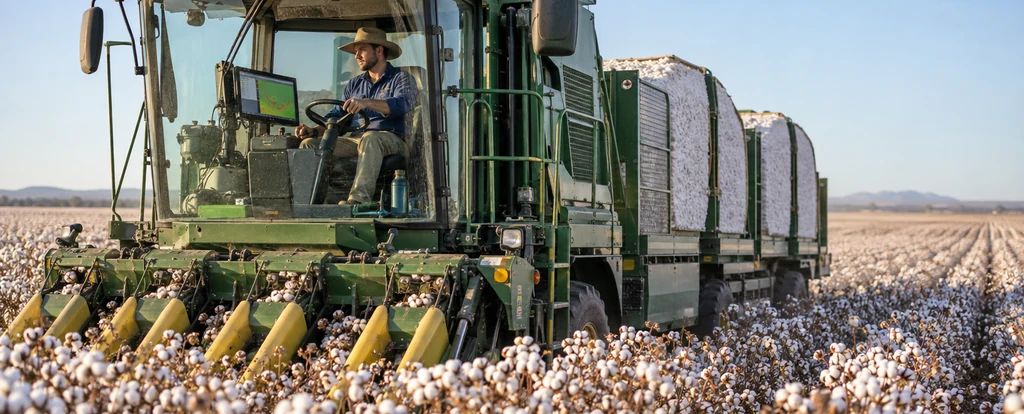
- Running the picker at harvest, building modules and coordinating ginning and haulage
What skills do cotton growers need?
Employers look for operations management, plant and equipment operation, field inspection and testing, backed by John Deere Operations Center fluency and strong problem solving.
Specialist skills
- Operations management
- Plant and equipment operation
- Field inspection and testing
- Supply chain planning
- Budgeting and forecasting
Software and tools
- John Deere Operations Center
- Climate FieldView
- Agworld
- Trimble Ag Software
General skills
- Problem solving
- Attention to detail
Is the job growing?
About 270 people work as cotton growers in Australia, and employment is projected to grow 4.6% over the decade to 2035. That's modest growth: demand is steady rather than booming.
How do you become a cotton grower?
Here's the path most cotton growers take, step by step.
- 1Finish Year 12 or an equivalent
There is no formal entry requirement to start on a cotton farm, but Year 12 is common and maths and science help with chemical rates, water budgets and yield records.
- 2Get a start as a farm hand or machinery operator
This is how most growers learn the crop. Work is advertised through the farms and contracting businesses in the growing regions, and seasonal picking and irrigation work is often the way in, sometimes with accommodation included.
- 3Study agriculture while you work
A Certificate III or IV in Agriculture at TAFE, or a Diploma of Agriculture (AHC50122), covers agronomy, irrigation and farm business, and can be done part time around the season. A university agriculture degree suits anyone aiming at agronomy or farm management roles.
- 4Take on management of a farm's program
Running the irrigation schedule, chemical plan and budget for someone else's property is the step that prepares you to run your own. Cotton Australia's myBMP accreditation covers the compliance side and is often expected of managers.
- 5Buy in or share-farm
Owning or share-farming is how most growers enter the business, and it is usually where earnings grow. Share farming lets you contribute labour and management in return for a share of the crop without buying land first.
Ready to apply as a cotton grower?
Whether you're working toward becoming a cotton grower or already are one and want a hand with the next step (sharpening your resume for ATS screening, tightening your cover letter, or knowing what you'll actually be asked at interview), here are examples grounded in this specific role, not generic templates.
What jobs can a cotton grower move to?
Moving into Sugar Cane Grower typically comes with the biggest pay rise, worth $18,200 a year more on average.
| Move to | Typical pay change | Overlap | Retraining |
|---|---|---|---|
| Sugar Cane Grower Cotton growers bring tropical crop irrigation and harvest experience to sugar cane, with minimal retraining for the new crop. | +$18,200 | 70% | minimal |
| Grain Grower Cotton growers share broadacre cropping, irrigation and machinery skills with grain growing, so the move needs minimal retraining. | +$10,400 | 76% | minimal |
| Vegetable Grower Cotton growers bring row crop management and irrigation skills to vegetable growing, needing a short course in vegetable production. | +$0 | 55% | short course |
| Farmer Cotton growers bring broadacre cropping and irrigation skills to mixed farming, needing only a short course in farm business. | −$18,200 | 48% | short course |
Moves are chosen from Jobs and Skills Australia's Data on Occupation Mobility, which follows income tax records between 2011-12 and 2020-21, together with entry requirements and skill overlap. A known move is one people were seen making in that data. Pay change compares median full-time pay for the two roles.
Who works as a cotton grower?
The typical cotton grower is 45 years old; 87% are men, 92% work full-time, and full-timers average 52 hours a week.
- 45
- Median age
- 13%
- Female share
- 92%
- Full-time
- +12h
- vs all-jobs avg
What's it like being a cotton grower?
The year runs on the crop: sowing in spring, irrigating through summer, then harvest from March to May, when the picker runs late and the whole operation shifts to getting modules to the gin. Between those peaks the work is quieter, but the decisions stay financial, with water and chemical budgets set against a fibre price the grower does not control. It suits someone who likes machinery, outdoor work and running their own show, and who can live with income that changes with the season.
What people like
- You see a season through. Planting, growing and picking a crop over about six months, with the result visible in the paddock rather than on a screen.
- Machinery and technology. GPS autosteer, variable rate application and soil moisture probes make the job more technical than the image of a farmer on a tractor suggests.
- Running your own operation. Most growers make the calls on water, varieties and contractors themselves, which means the decisions and the consequences are yours.
- A specialist crop. Cotton is grown by relatively few people in a handful of regions, so crop knowledge built up over a few seasons is valued across the industry.
What people find hard
- Income follows water and price. Allocations and the world fibre price are set elsewhere, and a dry year or a weak market shows up in the same bank account.
- Harvest days are long. The picker runs while the weather holds, so 12-hour days are normal for several weeks and the schedule can turn on a forecast.
- Records and compliance. Spray diaries, resistance plans and myBMP paperwork take desk time through the season, and errors in them carry real penalties.
- Depending on other people. Harvest leans on contractors, gin bookings and seasonal workers arriving when the crop is ready, and delays there cost the grower.
Based on our synthesis of professional-body surveys and public accounts of the role, not first-person verified reviews.
Which industries employ cotton growers?
Agriculture, Forestry and Fishing employs the largest share of cotton growers.
Top employing industries
- 1Agriculture, Forestry and Fishing
Ranked by employment share; the source doesn't publish an exact percentage per industry.
| Year 12 or below | 47.2% | |
|---|---|---|
| Certificate III/IV | 21.2% | |
| Bachelor degree | 13.2% | |
| Diploma / Advanced Diploma | 11.7% | |
| Postgraduate | 1.5% |
Will AI replace cotton growers?
Cotton growing has low exposure to AI, because the decisions are made in one paddock in one season and most of the work is physical. Autosteer, section control and variable rate application have taken some of the overlap out of planting and spraying, and soil moisture probes and satellite imagery help time irrigation. None of that removes the need to walk the rows, watch the weather and order water.
Share of typical working time by exposure level
- Machinery work through planting, spraying and harvestAutosteer and section control reduce overlap on the boom, but the machine, the mud, the breakdowns and the module building stay hands-on.40%low
- Crop scouting and pest checksSoftware flags likely pressure zones from satellite imagery, but someone still walks the rows to find mirids and whitefly and to check beneficial insects before a spray goes on.25%low
- Irrigation scheduling and water orderingMoisture probes and evapotranspiration models inform the timing, while allocation rules, channel rosters and the condition of the paddock decide what actually happens.20%moderate
- Record keeping and compliance reportingSpray diaries, myBMP records and chemical use reports are increasingly entered once in farm software and reused for audits, which removes much of the duplicate paperwork.15%high
Common questions about becoming a cotton grower
Straight answers to the questions people ask most.
How much do cotton growers earn?
$72,800 per annum, before tax, is the median for full-time cotton growers, and it is a guide rather than a wage most growers receive. Most are owner-operators whose income depends on the size of the crop, the water available and the fibre price.
How do you become a cotton grower?
Most people start as a farm hand or machinery operator on a cotton property and learn the crop over a few seasons. A Certificate III or IV in Agriculture or a Diploma of Agriculture (AHC50122) adds the agronomy, irrigation and farm business side, usually studied part time. From there the path is managing a farm's program, then buying in or share-farming.
Are cotton growers in demand?
Cotton growers are currently not in shortage, and employment in the role is projected to grow 4.6% over the decade to 2035 over the decade to 2035. The occupation is small and concentrated in northern New South Wales and southern Queensland, so work is found through the farms and contracting businesses in those regions.
Will AI and automation replace cotton growers?
Automation is changing how parts of the job are done rather than removing the grower. Autosteer, section control and variable rate application have cut the overlap and guesswork in planting and spraying, and moisture probes and satellite imagery help time irrigation. Someone still has to walk the rows and decide when to water, spray and pick.
What other jobs can a cotton grower move into?
Cotton growing shares broadacre cropping, irrigation and machinery skills with other row crops, so moving across usually needs little retraining. Grain growers earn $10,400 more and sugar cane growers $18,200 more, while vegetable growing takes a short course in that crop. Running your own operation or share farm is the usual long-term path, and it is often where earnings grow.
Do you need a degree to be a cotton grower?
Year 12 or below is the highest qualification for about 47% of cotton growers, which reflects the practical route into the work rather than a hiring requirement. A degree helps for agronomy and management roles, but experience with the crop and a good handle on machinery matter more at the start.
Related roles
- Farmer
- Grain Grower
- Sugar Cane Grower
- Vegetable Grower
- Agricultural Machinery Operator
- Logging Plant Operator
Not sure this is you? Take the career quiz and get a ranked shortlist of roles that fit how you like to work.