Fire Protection Plumber
Fire protection plumbers install and maintain the sprinkler and hydrant systems a building relies on when a fire breaks out.
- Median salary*
- $85,800
4.1%vs last year, before tax
- People employed
- 9,700
1.0%vs last year
- Projected growth*
- +6%
to 2035
- AI exposure*
- Low
- automation risk
- Average hours*
- 40/wk
matches all-jobs average
- Shortage status*
- In shortage
national
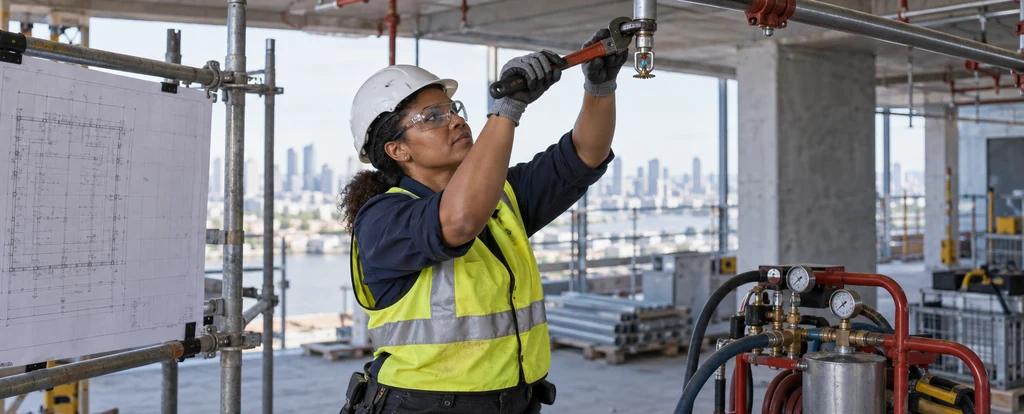
Fire protection plumbers work on commercial, industrial and residential buildings, fitting the sprinkler pipework, hydrants, fire pumps and control valves that make up a fire system. They are plumbers who have specialised, so unlike a general plumber they spend much of the week testing, commissioning and documenting systems against Australian Standards and the National Construction Code. A lot of the work happens in ceilings, risers and plant rooms, alongside other trades on the same site.
How much do fire protection plumbers earn?
The median full-time salary for a fire protection plumber is $85,800 per annum, before tax, up $18,000 since 2018.
Pay follows the plumbing award or the enterprise agreement covering the site, so large commercial projects with site allowances and regular overtime usually pay better than routine service work. Holding the fire protection endorsement or registration your state requires, and being able to test and commission systems unsupervised, both lift what you can ask for. Running your own contracting business is a common route to higher earnings later on.
What does a fire protection plumber do day to day?
The list below is what fills most weeks; the exact mix shifts with seniority and whatever stage the current work is at.
- Installing fire sprinkler piping, heads, valves and hydrant equipment
- Pressure testing and flow testing completed systems against the design figures
- Maintaining and repairing fire pumps, tanks and control valves
- Reading and interpreting hydraulic and fire service drawings
- Commissioning systems and completing compliance documentation
What skills do fire protection plumbers need?
Employers look for installation and maintenance, building codes and standards, worksite safety management, backed by Pipe threading and grooving machines fluency and strong problem solving.
Specialist skills
- Installation and maintenance
- Building codes and standards
- Worksite safety management
- Reading plans and specifications
- Hand and power tool work
- Regulatory compliance
Software and tools
- Pipe threading and grooving machines
- Hydraulic pressure test rigs
- AutoCAD
- Revit MEP
- Fire sprinkler hydraulic calculation software
General skills
- Problem solving
- Attention to detail
Is the job growing?
About 9,700 people work as fire protection plumbers in Australia, and employment is projected to grow 6% over the decade to 2035. That's modest growth: demand is steady rather than booming.
How do you become a fire protection plumber?
Here's the path most fire protection plumbers take, step by step.
- 1Complete a plumbing apprenticeship
The usual entry is a Certificate III in Plumbing (CPC32420) through a four-year apprenticeship, which is paid and mixes on-the-job training with TAFE. You need it before you can specialise, because fire systems work builds on general pipework and fitting skills.
- 2Add fire protection training
A Certificate III in Fire Protection (CPC32820), or the fire protection units within a plumbing qualification, covers sprinkler and hydrant systems, pumps, hydraulic calculations and the Australian Standards that govern them. Some employers put apprentices through this training; others expect you to have it before you apply.
- 3Get licensed in your state or territory
Plumbing is licensed state by state, and fire protection work usually needs a specific endorsement or registration on top of your plumbing licence. Requirements differ between states, so check with your state's plumbing regulator before you take on installations.
- 4Build experience on commercial and industrial sites
Larger projects are where you learn the most, because the sprinkler and hydrant systems are bigger and the testing and commissioning work is more involved. Working under an experienced fire protection plumber is how most people pick up hydraulic calculations and system layout.
- 5Move across if you already hold a plumbing qualification
Licensed plumbers can usually specialise through a short course or additional units rather than a second apprenticeship. Your existing pipefitting and compliance experience counts towards the fire protection side.
Ready to apply as a fire protection plumber?
Whether you're working toward becoming a fire protection plumber or already are one and want a hand with the next step (sharpening your resume for ATS screening, tightening your cover letter, or knowing what you'll actually be asked at interview), here are examples grounded in this specific role, not generic templates.
What jobs can a fire protection plumber move to?
Moving into Plumber typically comes with the biggest pay rise, worth $17,700 a year more on average.
| Move to | Typical pay change | Overlap | Retraining |
|---|---|---|---|
| Plumber Fire protection plumbers bring pipefitting and system installation skills; general plumbing adds broader building, drainage and maintenance work. | +$17,700 | 85% | reskill |
| Mechanical Services Plumber Fire protection plumbers bring pipework and pump skills; mechanical services plumbing adds heating, cooling and ventilation system work. | +$10,400 | 74% | reskill |
| Plumbing Inspector Fire protection plumbers bring hands-on installation knowledge; plumbing inspection adds regulation, compliance and auditing duties. | +$5,200 | 44% | reskill |
| Gasfitter Fire protection plumbers bring pipefitting and safety compliance skills; gasfitting adds gas installation, servicing and certification work. | +$0 | 85% | reskill |
| Fire Protection Technician Fire protection plumbers bring installation and pipework knowledge; technician work adds testing, inspection and maintenance of fire systems. | −$2,600 | 100% | short course |
Moves are chosen from Jobs and Skills Australia's Data on Occupation Mobility, which follows income tax records between 2011-12 and 2020-21, together with entry requirements and skill overlap. A known move is one people were seen making in that data. Pay change compares median full-time pay for the two roles.
Who works as a fire protection plumber?
The typical fire protection plumber is 27 years old; 99% are men, 89% work full-time, and full-timers average 40 hours a week.
- 27
- Median age
- 1%
- Female share
- 89%
- Full-time
- +0h
- vs all-jobs avg
What's it like being a fire protection plumber?
The job has a clear rhythm: install the system, test it, document it, then come back for periodic maintenance. The pressure comes from compliance, because a sprinkler system that fails to perform is a life-safety problem, and from coordinating with other trades in tight ceiling and plant room spaces. It tends to suit people who like precise work with a written standard to check it against.
What people like
- The standard tells you what correct looks like. Australian Standards and the National Construction Code set out exactly how a system should be installed and tested, so quality is measurable rather than a matter of opinion.
- Maintenance work balances out construction. Existing systems need regular testing and servicing, which keeps the work steady when new building projects slow down.
- Every building type is different. Hospitals, warehouses, apartment towers and shopping centres all have their own layouts and fire requirements, so the pipework rarely becomes repetitive.
- A clear path to running your own business. Experienced fire protection plumbers often tender for their own installation and servicing contracts, which is where earnings tend to grow.
What people find hard
- The consequences of a mistake are serious. A missed defect in a sprinkler system is a life-safety issue, so testing and documentation carry more weight than they do in general plumbing.
- The work is physical. Overhead pipefitting, plant room work and long periods on your feet are normal, and some sites call for working at heights or in confined spaces.
- You depend on other trades. Your testing and commissioning window depends on the builder and the other trades keeping to schedule, and delays can push work into a rushed finish.
- Paperwork follows every system. Test results, as-built drawings and maintenance schedules have to be recorded accurately, and that administrative side takes real time on each job.
Based on our synthesis of professional-body surveys and public accounts of the role, not first-person verified reviews.
Which industries employ fire protection plumbers?
Construction employs the largest share of fire protection plumbers, followed by Public Administration and Safety.
Top employing industries
- 1Construction
- 2Public Administration and Safety
- 3Other Services
Ranked by employment share; the source doesn't publish an exact percentage per industry.
| Certificate III/IV | 34% | |
|---|---|---|
| Diploma / Advanced Diploma | 26% | |
| Bachelor degree | 20% | |
| Year 12 or below | 20% |
Will AI replace fire protection plumbers?
Fire protection plumbing rates low for AI exposure because the job is hands-on installation and testing in buildings, and a sprinkler system has to be physically assembled, pressurised and inspected before it counts as compliant. Design software such as AutoCAD and Revit MEP, hydraulic calculation tools and digital compliance platforms change how systems are planned and documented, but they sit alongside the trade rather than replacing it.
Share of typical working time by exposure level
- Installing sprinkler pipework, valves and hydrant equipmentCutting, threading and grooving steel pipe and positioning sprinkler heads happens in ceilings, risers and plant rooms, and that work has to be done by hand on site.40%low
- Pressure and flow testing completed systemsYou fill and pressurise a system, watch for leaks and take flow readings at the test points, and someone still has to walk the line and check each result.25%low
- Reading drawings and planning pipework routesRevit MEP models and clash detection flag conflicts before you start, which reduces rework, but setting the run out on site against the building still falls to you.20%moderate
- Commissioning records and compliance documentationTest certificates, as-built markups and maintenance schedules now go into digital compliance platforms, and software drafts much of that paperwork from the readings you enter.15%high
Common questions about becoming a fire protection plumber
Straight answers to the questions people ask most.
How much do fire protection plumbers earn?
The median for full-time fire protection plumbers is $85,800 per annum, before tax, which means half earn more and half earn less. Pay depends on the enterprise agreement or award covering your site, the endorsements you hold and whether you work on large commercial projects or routine servicing.
How do you become a fire protection plumber?
Start with a Certificate III in Plumbing (CPC32420) through a four-year apprenticeship, then add fire protection training and the licence or endorsement your state requires. Most people specialise after a few years of general plumbing, once they have the pipework skills that fire systems work depends on.
Are fire protection plumbers in demand?
Fire protection plumbers are currently in shortage nationally, and employment is projected to grow 6% over the decade to 2035. Regular testing and servicing of systems already in buildings supports steady work even when new construction slows, so the trade is a reasonable choice for someone entering now.
Will AI replace fire protection plumbers?
No, and the role rates low for AI exposure because the work is physical: pipework has to be assembled, pressurised and inspected inside the building. Software such as AutoCAD, Revit MEP and hydraulic calculation tools speeds up design, and digital compliance platforms automate part of the testing paperwork, but the installation and onsite testing stay with the tradesperson.
What can a fire protection plumber move into?
The pipefitting and compliance skills carry across to nearby trades: fire protection technician work pays $2,600 less and gasfitting pays about the same. Plumbing inspection, which shifts the work towards regulation and auditing, pays $5,200 more. Many experienced plumbers in this field eventually run their own contracting business, which is often where earnings grow.
Do you need to work at heights or in confined spaces?
Both come up regularly, because sprinkler pipework runs through ceilings, risers and plant rooms, and some of that work is at height or in tight spaces. Most employers expect you to hold working at heights and confined space entry training, and to keep those competencies current.
Related roles
- Fire Protection Technician
- Plumber
- Mechanical Services Plumber
- Gasfitter
- Plumbing Inspector
- Plumber's Assistant
Not sure this is you? Take the career quiz and get a ranked shortlist of roles that fit how you like to work.