Mechanical Services Plumber
Mechanical services plumbers install and maintain the heating, cooling and ventilation systems that large buildings rely on.
- Median salary*
- $96,200
3.9%vs last year, before tax
- People employed
- 3,600
0.0%vs last year
- Projected growth*
- +6%
to 2035
- AI exposure*
- Moderate
- automation risk
- Average hours*
- 42/wk
+2h vs all jobs
- Shortage status*
- In shortage
national
Mechanical services plumbers work on the heating, cooling and ventilation systems in commercial and industrial buildings, from new construction through to servicing what is already running. They specialise in the pipework and equipment side of HVAC, which sets them apart from general plumbers who mainly handle domestic fixtures and drainage. Most are licensed through their state or territory plumbing regulator and enter the trade through an apprenticeship.
How much do mechanical services plumbers earn?
The median full-time salary for a mechanical services plumber is $96,200 per annum, before tax, up $20,000 since 2018.
What you earn depends on the sector you work in and the endorsements you hold. Commercial construction projects usually carry site allowances and penalty rates, while maintenance roles trade some of that for steadier hours, and after-hours breakdown work or remote placements push earnings up. Registration with your state or territory regulator is what allows you to work unsupervised, and higher-level endorsements take you into a different pay bracket.
What does a mechanical services plumber do day to day?
The list below is what fills most weeks; the exact mix shifts with seniority and whatever stage the current work is at.
- Installing chilled water, heating and ventilation pipework on commercial and industrial sites
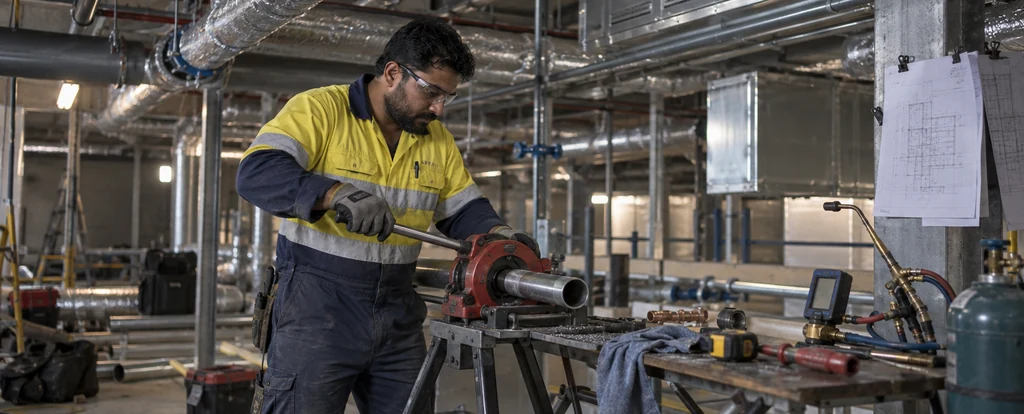
- Fabricating pipe sections with threading machines and brazing equipment before they are lifted into place
- Pressure testing and commissioning systems so flow, temperature and pressure meet the design
- Servicing pumps, valves, air handling units and control equipment, often on breakdown callouts in occupied buildings
- Reading plans and services drawings and coordinating set-out with electricians, fire protection fitters and other trades
What skills do mechanical services plumbers need?
Employers look for installation and maintenance, reading plans and specifications, worksite safety management, backed by Pipe threading machine fluency and strong problem solving.
Specialist skills
- Installation and maintenance
- Reading plans and specifications
- Worksite safety management
- Hand and power tool work
- Building codes and standards
- Plant and equipment operation
Software and tools
- Pipe threading machine
- Press fitting tool
- Brazing equipment
- Manometer
- Autodesk Revit
General skills
- Problem solving
- Attention to detail
Is the job growing?
About 3,600 people work as mechanical services plumbers in Australia, and employment is projected to grow 6% over the decade to 2035. That's modest growth: demand is steady rather than booming.
How do you become a mechanical services plumber?
Here's the path most mechanical services plumbers take, step by step.
- 1Start a Certificate III in Plumbing apprenticeship
It usually runs about four years and is paid, combining TAFE study with on-site training under a licensed plumber. Choose the mechanical services stream or electives where your training provider offers them. A Certificate II pre-apprenticeship or a job as a plumber's assistant is a common way in if you are still finding an employer.
- 2Get registered or licensed in your state or territory
Each state and territory has its own plumbing regulator, fees and exam requirements, so check the rules where you plan to work. Registration is what lets you work unsupervised, and it needs to be maintained with continuing professional development.
- 3Add the endorsements this speciality uses
Backflow prevention, refrigerant handling, medical gas, thermostatic mixing valves and confined space training are the qualifications that widen the work you can take on. Employers often pay for some of these once you are on staff.
- 4Move into supervision, estimating or your own contracting business
After a few years on the tools, experienced mechanical services plumbers commonly move into site supervision, project estimating or running their own plumbing contracting business. Those roles draw on the same technical knowledge, with more responsibility for scheduling, pricing and managing a team.
Ready to apply as a mechanical services plumber?
Whether you're working toward becoming a mechanical services plumber or already are one and want a hand with the next step (sharpening your resume for ATS screening, tightening your cover letter, or knowing what you'll actually be asked at interview), here are examples grounded in this specific role, not generic templates.
What jobs can a mechanical services plumber move to?
Moving into Plumber typically comes with the biggest pay rise, worth $7,300 a year more on average.
| Move to | Typical pay change | Overlap | Retraining |
|---|---|---|---|
| Plumber Mechanical services plumbers bring specialist heating and cooling skills to general plumbing, needing broader registration and study. | +$7,300 | 85% | reskill |
| Roof Plumber Mechanical services plumbers bring plumbing and metalwork skills to roof plumbing, needing training in roof drainage and flashing. | −$5,200 | 58% | reskill |
| Fire Protection Plumber Mechanical services plumbers bring piping and system installation skills to fire protection work, needing additional fire system training. | −$10,400 | 74% | reskill |
| Gasfitter Mechanical services plumbers bring gas heating and pipefitting knowledge to gasfitting, needing further study in gas appliance servicing. | −$10,400 | 61% | reskill |
| Drainer Mechanical services plumbers bring pipe laying and drainage skills to drainer work, needing additional training in below-ground systems. | −$15,600 | 90% | reskill |
Moves are chosen from Jobs and Skills Australia's Data on Occupation Mobility, which follows income tax records between 2011-12 and 2020-21, together with entry requirements and skill overlap. A known move is one people were seen making in that data. Pay change compares median full-time pay for the two roles.
Who works as a mechanical services plumber?
The typical mechanical services plumber is 32 years old; 100% are men, 93% work full-time, and full-timers average 42 hours a week.
- 32
- Median age
- 0%
- Female share
- 93%
- Full-time
- +2h
- vs all-jobs avg
What's it like being a mechanical services plumber?
The work follows a project, so you can spend months on one building and then move to the next site across town. Days start early and involve plenty of standing, climbing and work in plant rooms, risers and on rooftops, and progress often depends on other trades being ready when you are. It suits people who like hands-on problem solving and want technical depth in a specialist trade rather than general domestic work.
What people like
- Commissioning a system you built. There is a clear end point when the plant starts, the flows balance and the building is handed over working as designed.
- Varied sites and problems. Hospitals, shopping centres, data centres and factories all have different systems, so the technical puzzles change from job to job.
- Work that mixes hands and head. You read drawings, work out set-out and then build it, rather than doing one or the other all day.
- A trade that can become a business. The skills and the licence transfer directly into contracting, so self-employment is a realistic long-term route.
What people find hard
- Plant rooms and roofs in bad weather. Mechanical plant often sits in hot, cramped or exposed places, and the work still has to be done in a heatwave or a cold snap.
- Waiting on other trades. Your pipework goes in after the structure and alongside the electrical and fire services, so delays elsewhere can stall your week.
- After-hours breakdown calls. When heating or cooling fails in an occupied building, someone has to attend, and that often falls outside normal hours.
- Compliance and licensing paperwork. Testing records, registration renewals and endorsement requirements add an administrative load that is easy to underestimate.
Based on our synthesis of professional-body surveys and public accounts of the role, not first-person verified reviews.
Which industries employ mechanical services plumbers?
Construction employs the largest share of mechanical services plumbers, followed by Other Services.
Top employing industries
- 1Construction
- 2Other Services
- 3Manufacturing
Ranked by employment share; the source doesn't publish an exact percentage per industry.
| Certificate III/IV | 34% | |
|---|---|---|
| Diploma / Advanced Diploma | 26% | |
| Bachelor degree | 20% | |
| Year 12 or below | 20% |
Will AI replace mechanical services plumbers?
This job sits in the middle: AI and automation reach the design and coordination side far more than the installation. BIM tools such as Revit and prefabrication software now generate shop drawings, spool drawings and cutting lists that were once worked out on site. The physical work of installing, testing and fault-finding in occupied buildings stays with the tradesperson.
Share of typical working time by exposure level
- Installing and commissioning pipeworkSetting out, brazing and pressure testing happen in plant rooms and risers, where the existing building rarely matches the drawing exactly.35%low
- Servicing and fault-finding on running systemsDiagnosing a chilled water fault in a working building means checking flows, pressures and controls on the equipment itself.25%low
- Fabricating and assembling pipe sectionsThreading and brazing still need hands, but machine cutting guided by digital shop drawings moves more of this work into an off-site workshop.20%moderate
- Reading drawings and coordinating with other tradesClash detection and digital models resolve much of the coordination that used to be sorted out on site with a set of paper plans.20%high
Moves least exposed to AI
These career moves from mechanical services plumber work are rated low for AI exposure:
- Fire Protection Plumber
High skill overlap (74%), reskill to get there, and a low automation-risk profile.
- Gasfitter
High skill overlap (61%), reskill to get there, and a low automation-risk profile.
- Drainer
High skill overlap (90%), reskill to get there, and a low automation-risk profile.
- Roof Plumber
Solid skill overlap (58%), reskill to get there, and a low automation-risk profile.
Common questions about becoming a mechanical services plumber
Straight answers to the questions people ask most.
How much do mechanical services plumbers earn?
The median for mechanical services plumbers is $96,200 per year before tax. Pay moves with the sector you work in, the endorsements you hold and how much overtime or after-hours work you take on.
How do you become a mechanical services plumber?
You complete a Certificate III in Plumbing (CPC32420) apprenticeship, which usually takes about four years, then register or license with the plumbing regulator in your state or territory. From there, endorsements in areas like backflow prevention or medical gas let you take on more specialised work.
Are mechanical services plumbers in demand?
Mechanical services plumbers are currently in shortage nationally, and employment is projected to grow 6% over the decade to 2035. Licensing rules and the pipeline of major projects differ between states, so check the market where you plan to work.
Will AI or automation replace mechanical services plumbers?
Not the installation work, and the exposure sits mostly in the design and coordination side of the job. BIM software and prefabrication planning now produce shop drawings and cutting lists that used to be worked out on site with paper plans. Setting out, brazing, testing and fault-finding in a live building still need someone physically there with tools.
What can a mechanical services plumber move into?
Fire protection plumbing uses much the same piping and installation skills, with median pay $10,400 less, and drainage work draws on the pipe laying side of the job, with median pay $15,600 less. Both need extra training in the systems involved. Many mechanical services plumbers eventually run their own contracting business, which is often where earnings grow most.
Is mechanical services plumbing different from general plumbing?
Yes, although the two overlap and people move between them. General plumbers mostly work on domestic water, sanitary and drainage systems, while mechanical services plumbers focus on heating, cooling and ventilation pipework in larger commercial and industrial buildings.
Related roles
Not sure this is you? Take the career quiz and get a ranked shortlist of roles that fit how you like to work.