Orthotic and Prosthetic Technician
Orthotic and prosthetic technicians build the braces, artificial limbs and footwear modifications that clinicians prescribe, turning casts, scans and measurements into devices people wear every day.
- Median salary*
- $72,800
3.6%vs last year, before tax
- People employed*
- 850
6.3%vs last year
- Projected growth*
- +9%
to 2035
- AI exposure*
- Moderate
- automation risk
- Average hours*
- 38/wk
−2h vs all jobs
- Shortage status*
- Not in shortage
national
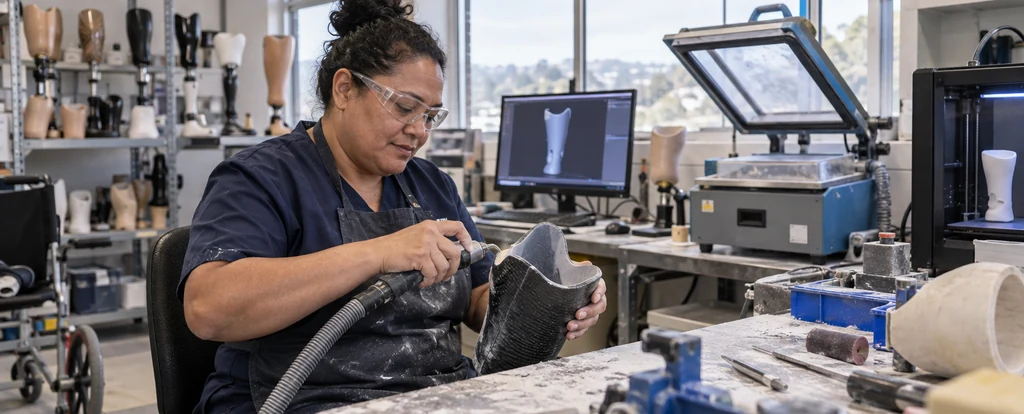
They work in workshops attached to hospitals, rehabilitation services or private practices, making devices to a clinician's specification. The distinction from the clinicians they work alongside matters: a prosthetist or orthotist assesses the patient and decides what is needed, while the technician does the casting, shaping, laminating and finishing. Most technicians end up specialising in either orthoses or prostheses, and the role mixes plaster work and hand tools with scanning and CAD/CAM software.
How much do orthotic and prosthetic technicians earn?
The median full-time salary for an orthotic and prosthetic technician is $72,800 per annum, before tax, up $15,500 since 2018.
Public hospital workshops usually pay under a state health award or enterprise agreement, with set increments and penalty rates, while private prosthetic and orthotic companies set their own rates based on experience and the range of work you can take on. Pay tends to rise as you become able to work independently on complex jobs such as carbon fibre lamination, prosthetic sockets or CAD design. Awards differ between states, so it is worth asking which classification and agreement apply to the job you are considering.
What does an orthotic and prosthetic technician do day to day?
The list below is what fills most weeks; the exact mix shifts with seniority and whatever stage the current work is at.
- Casting and modifying plaster or digital moulds taken from a patient's limb
- Laminating and vacuum forming thermoplastic, resin and carbon fibre components
- Assembling orthoses and prostheses to the specifications a prosthetist or orthotist sets out
- Finishing and adjusting devices with hand and power tools so they fit and sit comfortably
- Carrying out repairs, often at short notice when a patient's shape or needs change
What skills do orthotic and prosthetic technicians need?
Employers look for craft and handmade production, fabrication and finishing, hand and power tool work, backed by Omega Tracer fluency and strong attention to detail.
Specialist skills
- Craft and handmade production
- Fabrication and finishing
- Hand and power tool work
Software and tools
- Omega Tracer
- Rodin4D
- Vorum CAD/CAM
- 3D printers
- Vacuum forming machines
General skills
- Attention to detail
- Problem solving
- Digital literacy
- Written communication
Is the job growing?
About 850 people work as orthotic and prosthetic technicians in Australia, and employment is projected to grow 9% over the decade to 2035. That's modest growth: demand is steady rather than booming.
How do you become an orthotic and prosthetic technician?
Here's the path most orthotic and prosthetic technicians take, step by step.
- 1Finish Year 12 with useful subjects
There is no single prerequisite, but maths, science, design and technology subjects help, and hands-on subjects such as woodwork or metalwork give you a head start in a workshop. Employers look for manual dexterity and attention to detail as much as academic results.
- 2Start a certificate III or IV in orthotic and prosthetic technology
Most technicians enter through a traineeship with a hospital workshop or private company while studying part time at TAFE or a private provider. Course availability varies by state, so check what is running locally before you commit to a location.
- 3Or come across from a related trade
Dental technicians, vehicle trimmers, fibreglass laminators and cabinetmakers already hold the casting, moulding and finishing skills the work needs. A short bridging course covering anatomy, materials and healthcare standards is the usual way in from those trades.
- 4Learn the workshop systems on the job
Scanning, CAD/CAM software, vacuum forming and infection control are learned with supervision over the first year or two. Technicians are responsible for their own quality checking, since a device that does not fit gets sent back and rebuilt.
- 5Study further if you want to assess patients
Becoming a prosthetist and orthotist means a university degree and clinical training, and that is where the clinical decisions, patient contact and higher pay sit. The technician role stays on the fabrication side unless you take that path.
Ready to apply as an orthotic and prosthetic technician?
Whether you're working toward becoming an orthotic and prosthetic technician or already are one and want a hand with the next step (sharpening your resume for ATS screening, tightening your cover letter, or knowing what you'll actually be asked at interview), here are examples grounded in this specific role, not generic templates.
What jobs can an orthotic and prosthetic technician move to?
Moving into Prosthetist and Orthotist typically comes with the biggest pay rise, worth $27,200 a year more on average.
| Move to | Typical pay change | Overlap | Retraining |
|---|---|---|---|
| Prosthetist and Orthotist A technician's device fabrication knowledge underpins clinical assessment, but becoming a prosthetist and orthotist requires a degree and clinical training. | +$27,200 | 24% | requalify |
| Special Effects Technician Casting, moulding and finishing skills carry into making film and television prosthetics, though a short course in effects materials and safety is needed. | +$15,600 | 50% | short course |
| Pedorthist Technicians who understand foot orthoses and footwear can move into pedorthic assessment and fitting, which needs further study in clinical practice. | +$0 | 13% | reskill |
Moves are chosen from Jobs and Skills Australia's Data on Occupation Mobility, which follows income tax records between 2011-12 and 2020-21, together with entry requirements and skill overlap. A known move is one people were seen making in that data. Pay change compares median full-time pay for the two roles.
Who works as an orthotic and prosthetic technician?
The typical orthotic and prosthetic technician is 40 years old; 57% are men, 78% work full-time, and full-timers average 38 hours a week.
- 40
- Median age
- 43%
- Female share
- 78%
- Full-time
- −2h
- vs all-jobs avg
What's it like being an orthotic and prosthetic technician?
The rhythm comes from the clinic: a patient is measured, a job sheet arrives, and the technician casts, shapes, builds and finishes the device before it goes back for fitting. Most of the day is spent standing at a bench or working with machines, and deadlines are set by appointments, so a replacement limb needed before a hospital discharge can put pressure on the week. Accuracy matters throughout, because a device that does not fit comfortably comes back for rework rather than leaving the workshop finished.
What people like
- Hands on from start to finish. You begin with a rough cast or a digital scan and end up with a finished device, and much of the work is done with your own hands rather than at a screen.
- The purpose is visible. Devices go to named patients with specific needs, so the reason for getting the fit and finish right is clear throughout the job.
- A small field with a broad skill set. Plaster work, composites, CAD/CAM and fitting tools all turn up in the same week, which suits people who do not want to repeat one narrow task all day.
- A working environment with room to concentrate. Workshops are usually small teams and reasonably quiet, with the noise coming from machines and extraction rather than a public-facing space.
What people find hard
- Fumes, dust and protective gear. Laminating resins, grinding and sanding mean wearing masks, gloves and eye protection for long stretches, and workshop ventilation has to be maintained properly.
- Rework when a fit is wrong. A device that comes back uncomfortable or misaligned can take longer to correct than it took to build, and the fix is often fiddly.
- Someone else sets the specification. Technicians do not assess patients or choose the device; the clinician does, and the workshop works to that prescription.
- A limited number of employers. Jobs cluster in hospital workshops and a handful of private companies, so career options can narrow if you want to stay in one city.
Based on our synthesis of professional-body surveys and public accounts of the role, not first-person verified reviews.
Which industries employ orthotic and prosthetic technicians?
Hospitals employs the largest share of orthotic and prosthetic technicians, followed by Medical and surgical equipment manufacturing.
Top employing industries
- 1Hospitals
- 2Medical and surgical equipment manufacturing
- 3Allied health services
- 4Rehabilitation and disability support services
Ranked by employment share; the source doesn't publish an exact percentage per industry.
| Certificate III/IV | 34% | |
|---|---|---|
| Diploma / Advanced Diploma | 26% | |
| Bachelor degree | 20% | |
| Year 12 or below | 20% |
Will AI replace orthotic and prosthetic technicians?
Automation reaches parts of this job rather than all of it. Digital scanning, CAD software and 3D printing have replaced a good deal of the plaster casting and model modification, and practice management software handles most job records, but the bench work of laminating, finishing and aligning a device for one patient is still done by hand. That split is why the exposure sits at a moderate level.
Share of typical working time by exposure level
- Laminating and vacuum formingLaying up resin and carbon fibre over a mould and pulling it under vacuum is done by hand, and how the material wets out and sits in the mould still depends on the technician.30%low
- Scanning and modifying modelsA limb can be scanned and reshaped in software such as Rodin4D or Vorum, which does quickly what used to take repeated plaster pours and filing.25%high
- Assembling and aligning devicesJigs and measurement tools help, but setting a prosthetic knee or an ankle joint so it works for one patient is adjusted at the bench and checked at the fitting appointment.25%moderate
- Job sheets, stock and schedulingMaterial inventory, job tracking and clinic scheduling increasingly run through practice software, which cuts the paperwork while still needing someone to log what was used.20%high
Common questions about becoming an orthotic and prosthetic technician
Straight answers to the questions people ask most.
How much does an orthotic and prosthetic technician earn?
The median full-time pay is $72,800 per year before tax. Public hospital roles usually follow a state award with set increments, while private companies can pay more for technicians who can handle prosthetic sockets, carbon fibre lamination or CAD/CAM design on their own.
How do you become an orthotic and prosthetic technician?
Most people start with a traineeship and a certificate III or IV in orthotic and prosthetic technology, which combines paid workshop time with part-time study, though course availability varies by state. Coming across from a related trade such as dental technology, composites or vehicle trimming and adding a short bridging course is the other common route.
Are orthotic and prosthetic technicians in demand?
Employment is projected to grow 9% over the decade to 2035, and orthotic and prosthetic technicians are currently not in shortage. The occupation is small and tied to hospital and clinic funding, so vacancies tend to appear when someone retires or a service expands rather than in steady annual batches.
Will AI replace orthotic and prosthetic technicians?
Part of the work is already automated: digital scanning, CAD software and 3D printing have taken over much of the casting and model modification that was once done in plaster. The bench side remains hands on, because laminating, finishing, aligning and repairing a device made for one person's body still needs a technician in the workshop.
What can an orthotic and prosthetic technician move into?
Technicians with casting and finishing skills can move into special effects work for film and television, where pay is $15,600 more, helped by a short course in effects materials and safety. Becoming a prosthetist and orthotist is the clinical route and means a degree plus clinical training, while pedorthics is a smaller step into foot orthoses and footwear fitting.
Can an orthotic and prosthetic technician run their own business?
Most technicians work for hospitals, rehabilitation services or prosthetic companies. Some experienced technicians later set up a fabrication workshop or take on subcontract work for clinics, which is less common here than in the building trades but does happen.
Related roles
- Prosthetist and Orthotist
- Pedorthist
- Special Effects Technician
- Fibreglass Laminator
- Vehicle Trimmer
- Dental Technician
Not sure this is you? Take the career quiz and get a ranked shortlist of roles that fit how you like to work.