Lift Mechanic
Lift mechanics install, service and repair the lifts and escalators people ride every day, and keep them safe to use.
- Median salary*
- $104,000
4.2%vs last year, before tax
- People employed
- 3,200
0.0%vs last year
- Projected growth*
- +5%
to 2035
- AI exposure*
- Low
- automation risk
- Average hours*
- 40/wk
matches all-jobs average
- Shortage status*
- In shortage
national
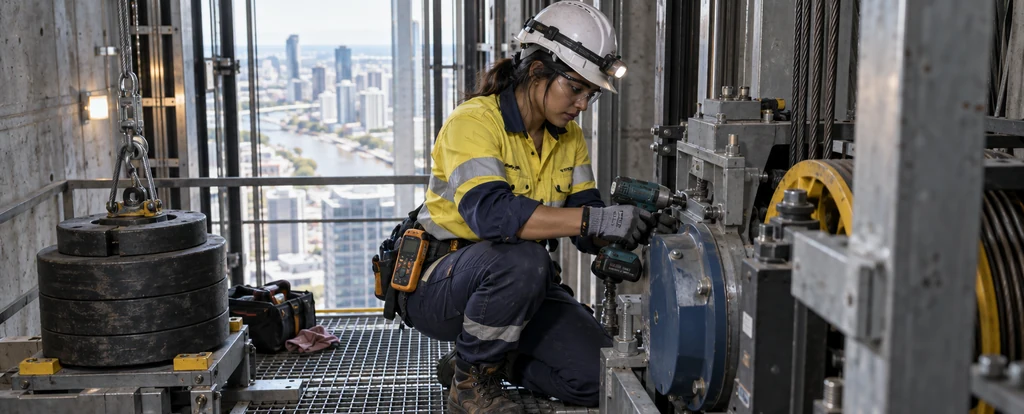
Lift mechanics work on the machinery inside lift shafts, motor rooms and escalator wells, splitting their time between new construction sites and the service rounds of existing buildings. The job sits between two trades: most mechanics hold an electrical licence, but the work is as much about door tracks, ropes and brake adjustments as it is about wiring. Most are employed by the large lift companies that install the equipment and hold the service contracts, so the same buildings come around on a regular round.
How much do lift mechanics earn?
The median full-time salary for a lift mechanic is $104,000 per annum, before tax, up $21,800 since 2018.
Pay is set mainly by the enterprise agreement covering your employer, so the same work can pay differently at a large service company and a small independent. Overtime, after-hours callouts and on-call allowances add to base earnings, because a lift out of service does not wait for business hours. Your licensing level matters too, since a mechanic who can sign off compliance work carries more responsibility than one who assists.
What does a lift mechanic do day to day?
The list below is what fills most weeks; the exact mix shifts with seniority and whatever stage the current work is at.
- Installing lift cars, guide rails and hoisting machinery during a building fitout
- Servicing lifts and escalators on a scheduled round, adjusting doors, levelling and safety devices
- Diagnosing electrical and mechanical faults using circuit diagrams, a multimeter and the controller's diagnostic software
- Load testing and certifying lifts and escalators against Australian Standards
- Replacing worn parts such as ropes, brakes, drive sheaves and door rollers
What skills do lift mechanics need?
Employers look for installation and maintenance, hand and power tool work, reading plans and specifications, backed by Multimeters fluency and strong problem solving.
Specialist skills
- Installation and maintenance
- Hand and power tool work
- Reading plans and specifications
- Worksite safety management
- Regulatory compliance
Software and tools
- Multimeters
- Oscilloscopes
- Proprietary lift diagnostic software
- Hand and power tools
- Load testing equipment
General skills
- Problem solving
- Attention to detail
Is the job growing?
About 3,200 people work as lift mechanics in Australia, and employment is projected to grow 5% over the decade to 2035. That's modest growth: demand is steady rather than booming.
How do you become a lift mechanic?
Here's the path most lift mechanics take, step by step.
- 1Complete an electrical apprenticeship
The Certificate III in Electrotechnology (Electrician) apprenticeship is the usual way in, taking about four years and giving you the electrical licence the work is built on. Some lift companies take on apprentices directly for lift work, covering the same electrical units plus lift-specific training.
- 2Learn the lift systems on the job
Manufacturers run their own training on the controllers, drives and door systems they supply, and this is where most of the trade's real skill is built. Expect several years of supervised work before you handle major repairs alone.
- 3Hold the licence your state requires
You need an electrical licence for the electrical side of the job, and some states require a separate registration or qualified supervisor certificate for lift and escalator work, such as the one SafeWork NSW issues. Licensing rules differ between states, so check with the regulator where you plan to work.
- 4Keep up with the standards and technology
Lifts and escalators are tested against the AS 1735 series, and licences and registrations need renewing. Control systems are increasingly networked and software-driven, so refresher training is part of staying current.
Ready to apply as a lift mechanic?
Whether you're working toward becoming a lift mechanic or already are one and want a hand with the next step (sharpening your resume for ATS screening, tightening your cover letter, or knowing what you'll actually be asked at interview), here are examples grounded in this specific role, not generic templates.
What jobs can a lift mechanic move to?
Moving into Powerline Worker typically comes with the biggest pay rise, worth $38,000 a year more on average.
| Move to | Typical pay change | Overlap | Retraining |
|---|---|---|---|
| Powerline Worker Lift mechanics bring electrical aptitude and safety focus to powerline work, with additional training in high-voltage systems required. | +$38,000 | 85% | reskill |
| Electrician Lift mechanics bring strong electrical and mechanical fault-finding skills to electrician work, though a formal electrical qualification is needed. | +$9,900 | 85% | reskill |
| Air Conditioning Technician Lift mechanics bring electrical and mechanical diagnostic skills to air conditioning work, with refrigerant handling training needed. | +$5,200 | 61% | reskill |
| Electrical Fitter Lift mechanics bring precision assembly and electrical testing skills to electrical fitting, a closely related trade. | −$13,000 | 85% | reskill |
Moves are chosen from Jobs and Skills Australia's Data on Occupation Mobility, which follows income tax records between 2011-12 and 2020-21, together with entry requirements and skill overlap. A known move is one people were seen making in that data. Pay change compares median full-time pay for the two roles.
Who works as a lift mechanic?
The typical lift mechanic is 38 years old; 98% are men, 88% work full-time, and full-timers average 40 hours a week.
- 38
- Median age
- 2%
- Female share
- 88%
- Full-time
- +0h
- vs all-jobs avg
What's it like being a lift mechanic?
The work runs to a routine of scheduled servicing, planned repairs and the breakdown calls that interrupt both. Much of the day is spent alone or in pairs moving between buildings, with testing and paperwork fitted around the physical work. It suits someone who enjoys fault-finding and is comfortable in a shaft, at height, or making the judgement call on whether a lift goes back into service.
What people like
- Faults that make sense once you find them. Many problems come down to a worn contact, a misaligned door or a sensor that has drifted out of adjustment. Tracing the cause through the controller and the wiring is the part many mechanics enjoy most.
- Mechanical and electrical in one job. You are not limited to wiring or to spanners. A single repair can call for a multimeter, a torque wrench and a diagnostic readout.
- A different building every day. A service round moves between apartment towers, hospitals, shopping centres and offices, so the workplace changes through the week.
- Work that has to be right. Lifts carry the public and the testing behind them is strict. A lift either passes its test or it does not, and that clarity suits people who like a definite result.
What people find hard
- Breakdown calls out of hours. Someone stuck in a lift is not a nine-to-five problem, so rosters include nights, weekends and on-call weeks.
- Shafts, pits and heights. Much of the work happens in a lift pit or on top of a car, in tight, hot or dusty spaces, and the machine has to be isolated before you start.
- Travel between sites. A service round can cover a wide area, and the driving between buildings is part of the job rather than time off it.
- Compliance paperwork. Every service and repair has to be recorded and signed off, and the documentation takes real time at the end of each visit.
Based on our synthesis of professional-body surveys and public accounts of the role, not first-person verified reviews.
Which industries employ lift mechanics?
Construction employs the largest share of lift mechanics, followed by Other Services.
Top employing industries
- 1Construction
- 2Other Services
- 3Manufacturing
- 4Professional, Scientific and Technical Services
Ranked by employment share; the source doesn't publish an exact percentage per industry.
| Certificate III/IV | 34% | |
|---|---|---|
| Diploma / Advanced Diploma | 26% | |
| Bachelor degree | 20% | |
| Year 12 or below | 20% |
Will AI replace lift mechanics?
Lift mechanic is a low-exposure trade, because the work happens on physical machinery inside shafts and motor rooms that no software can reach. Diagnostic software in the controllers and remote monitoring already help narrow down faults and flag parts that are due, which saves time on the search. They change how quickly a fault is found, not who adjusts the door, replaces the rope and signs the lift back into service.
Share of typical working time by exposure level
- Scheduled servicing and safety checksWorking through a service schedule on doors, brakes, ropes and levelling, checking and adjusting each item by hand.35%low
- Diagnosing faults on siteThe controller software or remote monitoring often points to the fault, but confirming it means testing circuits with a multimeter and tracing the wiring.30%low
- Installing and commissioning new liftsSetting guide rails, aligning doors and running load tests on a new installation before it carries passengers.20%low
- Service records and compliance documentationWriting up each visit and its test results, work that reporting tools increasingly draft from job notes.15%high
Common questions about becoming a lift mechanic
Straight answers to the questions people ask most.
How much do lift mechanics earn?
Lift mechanics earn $104,000 per annum, before tax, on average for full-time work. That is a median, so half of full-time mechanics earn more and half earn less, and your own figure depends heavily on the enterprise agreement your employer uses and how much overtime and on-call work you take on.
How do you become a lift mechanic?
Most people get there through an electrical apprenticeship, then move into lifts once they hold a licence. Others start as apprentices with a lift company, which combines the electrical units with lift-specific training, though you still need the electrical licence and any state registration to work unsupervised.
Are lift mechanics in demand?
Lift mechanics are currently in shortage nationally, and employment is projected to grow 5% over the decade to 2035 over the decade to 2035. Servicing work continues through construction downturns because existing lifts still need their scheduled maintenance and testing, which is where a lot of the steady work sits.
Will AI replace lift mechanics?
No, and the exposure here is low. Diagnostic software in lift controllers and remote monitoring already help narrow down a fault and flag parts that are due, but the repair itself means isolating the machine, adjusting or replacing parts and testing the result by hand. The technology shortens the search, not the job.
What can lift mechanics move into?
Electrician work uses the electrical licence and fault-finding skill you already hold, and electricians earn $9,900 more than lift mechanics on median pay. Powerline work pays $38,000 more and draws on the same safety and testing discipline, but needs high-voltage training first.
Do lift mechanics work on call?
Yes, most service mechanics take a turn on the on-call roster, because a stalled lift or a trapped passenger needs someone on site quickly. The roster is usually shared across a team, and the callout allowances and overtime are a recognised part of the pay.
Related roles
Not sure this is you? Take the career quiz and get a ranked shortlist of roles that fit how you like to work.