Naval Architect
Naval architects design the hull, structure and stability of ships, submarines and offshore platforms so they perform safely once they are in service.
- Median salary*
- $111,800
4.4%vs last year, before tax
- People employed
- 400
0.0%vs last year
- Projected growth
- +23%
to 2035
- AI exposure*
- Moderate
- automation risk
- Average hours
- 40/wk
matches all-jobs average
- Shortage status
- In shortage
national
Naval architects work on the design and modification of vessels and marine structures, from ferries and patrol boats to submarines and offshore platforms. Their particular expertise is how a vessel sits in the water, covering hull shape, stability, structure and weight, which is what separates them from marine engineers, who focus on the machinery and systems that drive and run a ship. Most work in design offices with shipbuilders, engineering consultancies or defence programs, with time in yards and on trials once a project reaches construction.
How much do naval architects earn?
The median full-time salary for a naval architect is $111,800 per annum, before tax, up $23,600 since 2018.
What moves pay most is the sector and the employer, along with chartership and whether the work needs a security clearance. Defence and offshore programmes are salaried and rarely pay penalty rates, though site and sea trial travel can attract allowances. Location matters mainly because the employers are concentrated around the major shipyards and design offices.
What does a naval architect do day to day?
The list below is what fills most weeks; the exact mix shifts with seniority and whatever stage the current work is at.
- Developing hull forms and general arrangements in modelling software such as Maxsurf, then testing how a design behaves in a seaway
- Running stability, hydrostatic and load capacity calculations for intact and damaged conditions
- Designing and checking the structural scantlings of hull, deck and superstructure against classification society rules
- Preparing drawings, specifications and technical reports for the yard, and answering queries during construction
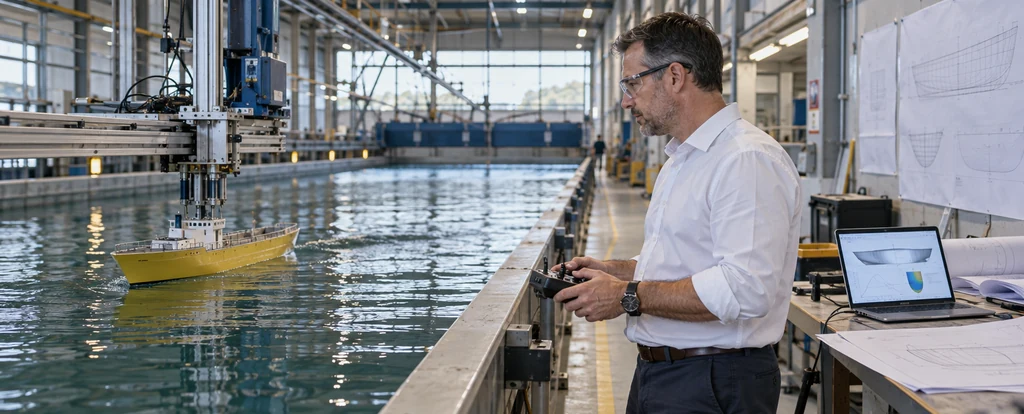
- Taking part in model tests in a towing tank and in sea trials, then comparing the results with the predictions
What skills do naval architects need?
Employers look for engineering design and analysis, cAD and technical drawing, project engineering and delivery, backed by Maxsurf fluency and strong problem solving.
Specialist skills
- Engineering design and analysis
- CAD and technical drawing
- Project engineering and delivery
- Data analysis
- Project management
Software and tools
- Maxsurf
- Rhino 3D
- AutoCAD
- ANSYS
- Siemens NX
General skills
- Problem solving
- Attention to detail
- Written communication
Is the job growing?
About 400 people work as naval architects in Australia, and employment is projected to grow 23% over the decade to 2035. That's very strong growth. Few roles in Australia are expanding this fast, and it points to solid demand for years to come.
How do you become a naval architect?
Here's the path most naval architects take, step by step.
- 1Start with an engineering degree that majors in naval architecture
The Australian Maritime College at the University of Tasmania runs the main Australian program, a four-year engineering honours degree accredited by Engineers Australia. It covers hydrodynamics, structures and vessel design, and the accreditation matters because it is the fastest route to chartership later on.
- 2Or move across from another engineering discipline
Mechanical, civil and structural engineering graduates are common entrants. They either take a postgraduate qualification in naval architecture or start in a graduate role with a shipbuilder or consultancy and pick up the marine knowledge on the job, which usually takes a year or two on real projects.
- 3Learn the rules the industry runs on
A large part of the job is demonstrating that a design meets classification society rules and Australian Maritime Safety Authority requirements. Familiarity with bodies such as Lloyd's Register, DNV or Bureau Veritas is what employers look for beyond the degree.
- 4Get time in a yard or at sea
Placements, graduate rotations and trials show how a design behaves once it is built, and they teach the things calculations do not cover, such as how a hull handles in a following sea or how a yard actually builds what was drawn.
- 5Work towards chartership with Engineers Australia
Chartered status comes after a period of supervised professional practice and an assessment of your experience. It signals to clients and defence programs that you can take responsibility for a design, and it generally widens the roles open to you.
Ready to apply as a naval architect?
Whether you're working toward becoming a naval architect or already are one and want a hand with the next step (sharpening your resume for ATS screening, tightening your cover letter, or knowing what you'll actually be asked at interview), here are examples grounded in this specific role, not generic templates.
What jobs can a naval architect move to?
Moving into Mechanical Engineer typically comes with the biggest pay rise, worth $24,100 a year more on average.
| Move to | Typical pay change | Overlap | Retraining |
|---|---|---|---|
| Mechanical Engineer Naval architects bring ship structures, hydrodynamics and systems design, which mechanical engineers use in marine machinery and offshore equipment. | +$24,100 | 79% | minimal |
| Civil Engineer Naval architects bring structural analysis and large-project design, letting civil engineers apply these skills to ports, coastal works and infrastructure. | +$3,500 | 52% | short course |
| Structural Engineer Naval architects bring hull and offshore structural analysis, which structural engineers apply to buildings and bridges, with retraining in land codes. | +$3,500 | 67% | minimal |
| Marine Engineer Naval architects understand vessel design and stability, giving marine engineers a design background for machinery and operations, with reskilling in ship systems.Known move | +$0 | 33% | reskill |
Moves are chosen from Jobs and Skills Australia's Data on Occupation Mobility, which follows income tax records between 2011-12 and 2020-21, together with entry requirements and skill overlap. A known move is one people were seen making in that data. Pay change compares median full-time pay for the two roles.
Who works as a naval architect?
The typical naval architect is 40 years old; 91% are men, 88% work full-time, and full-timers average 40 hours a week.
- 40
- Median age
- 9%
- Female share
- 88%
- Full-time
- +0h
- vs all-jobs avg
What's it like being a naval architect?
The rhythm follows project phases: concept and feasibility work is quiet and analytical, detail design adds meetings with the yard and the class society, and trials bring the pressure of a deadline at sea. The field suits people who enjoy the mix of physics and practical compromise, and who are comfortable defending a calculation to engineers from other disciplines. Much of the week goes into modelling and documentation, so patience with detail counts as much as flair for design.
What people like
- You follow a design from model to water. Few engineering jobs end with watching the thing you calculated take to the water for the first time. Sea trials and the handover of a finished vessel are the moments naval architects tend to remember.
- The problems are physical and varied. Stability, structure, weight, seakeeping and layout all compete on the same drawing. No two vessels resolve those tensions the same way, which keeps the work from settling into routine.
- A small field where reputation travels. The profession in Australia is small enough that people know each other across yards, consultancies and the regulator. That makes specialist knowledge valuable and referrals common.
- Programmes that run for years. Defence and offshore projects give you a long stretch on one vessel or class, so you see decisions through to construction rather than handing them on.
What people find hard
- Long programmes mean slow feedback. A design decision may not reach the water for years, and by then the team has moved on to the next project. Anyone who needs quick results finds the timeline hard.
- Compliance takes a big share of the week. Rule checks, submissions and documentation for the class society and the regulator are unavoidable, and they rarely feel like design work even though they decide whether a vessel can be built.
- Every design is a set of compromises. Weight, speed, capacity, cost and stability pull against each other, and something always has to give. Clients and yards then ask for changes after the budget is set.
- Employers are concentrated. Shipbuilders, design offices and defence programs cluster around a few ports and hubs, so changing jobs often means relocating or working remotely for a firm based elsewhere.
Based on our synthesis of professional-body surveys and public accounts of the role, not first-person verified reviews.
Which industries employ naval architects?
Professional, Scientific and Technical Services employs the largest share of naval architects, followed by Manufacturing.
Top employing industries
- 1Professional, Scientific and Technical Services
- 2Manufacturing
- 3Public Administration and Safety
Ranked by employment share; the source doesn't publish an exact percentage per industry.
| Bachelor degree | 61.9% | |
|---|---|---|
| Postgraduate | 20.8% | |
| Diploma / Advanced Diploma | 6.3% | |
| Certificate III/IV | 5% | |
| Year 12 or below | 0.8% |
Will AI replace naval architects?
Naval architecture is moderately exposed: tools such as Maxsurf, computational fluid dynamics and finite element analysis already carry much of the calculation, and producing drawings from a 3D model takes far fewer hands than it once did. What keeps the exposure from being high is that the output has to satisfy a classification society and the maritime safety regulator, and a person has to sign off on how a vessel will behave in conditions a simulation only approximates.
Share of typical working time by exposure level
- Hull form and general arrangement designGenerative and parametric tools can churn through hull variants quickly, but choosing between them means weighing seakeeping, capacity and how the yard will build it, which stays with the architect.30%moderate
- Stability and hydrostatic calculationsLoad cases, intact and damage stability runs and trim tables are largely parameterised now, so the work shifts to setting up the model correctly and questioning the assumptions behind it.25%high
- Sea trials, model testing and yard liaisonReading how a vessel behaves alongside a wharf or in a seaway, and resolving what a yard can physically build, depends on being there and on experience that is not written down anywhere.25%low
- Structural analysis and scantling checksFinite element models and class rule software handle most of the number crunching on a hull, while deciding which connections and load cases actually matter still takes an engineer.20%high
Moves least exposed to AI
These career moves from naval architect work are rated low for AI exposure:
- Civil Engineer
Solid skill overlap (52%), short course to get there, and a low automation-risk profile.
Common questions about becoming a naval architect
Straight answers to the questions people ask most.
How much do naval architects earn?
Full-time naval architects earn a median of $111,800 per annum, before tax. Pay moves with the sector and the employer more than with years in the role, and chartership or a security clearance opens up the work that pays at the upper end.
How do you become a naval architect?
The standard route is a four-year engineering degree majoring in naval architecture, which in Australia is offered at the Australian Maritime College at the University of Tasmania, followed by supervised practice towards chartership. Engineers from mechanical, civil or structural backgrounds also move in, either through postgraduate study or a graduate role with a shipbuilder or design consultancy.
Are naval architects in demand in Australia?
Naval architects are currently in shortage nationally, which reflects how few people qualify in the field each year. Employment is projected to grow 23% over the decade to 2035, and the work follows defence shipbuilding and offshore programmes that run over years, so the openings tend to come in waves tied to those contracts rather than with the wider economy.
Will AI replace naval architects?
AI and automation reach a moderate part of the job: standard stability runs, drawing production and parts of structural analysis are already software-driven, and hull-form optimisation tools are improving. What stays with a person is the work that carries a regulatory or safety signature, such as classification submissions, sea trial assessment and the judgement about how a design will behave in conditions a simulation only approximates.
What can a naval architect move into?
Mechanical engineering draws on ship structures, hydrodynamics and systems design, with 79% skill overlap, and median pay there is $24,100 more. Structural engineering suits those who want land-based work, because hull and offshore structural analysis transfers and median pay is $3,500 more. Moving into civil engineering takes longer and usually needs a short course in land-based codes, though coastal and port projects draw on the same analysis.
Do naval architects go to sea?
Not as a rule, but most spend some time on the water. Sea trials, model tests and yard visits put you on board or alongside during a build, and the travel that comes with them is part of the job rather than a permanent posting.
Related roles
- Civil Engineer
- Mechanical Engineer
- Marine Engineer
- Structural Engineer
- Mechatronics Engineer
- Transport Engineer
Not sure this is you? Take the career quiz and get a ranked shortlist of roles that fit how you like to work.