Marine Engineer
Marine engineers design, install and maintain the propulsion and machinery systems that keep ships, submarines and offshore structures running.
- Median salary*
- $111,800
4.1%vs last year, before tax
- People employed
- 1,900
0.0%vs last year
- Projected growth
- +12%
to 2035
- AI exposure*
- Moderate
- automation risk
- Average hours
- 55/wk
+15h vs all jobs
- Shortage status
- In shortage
national
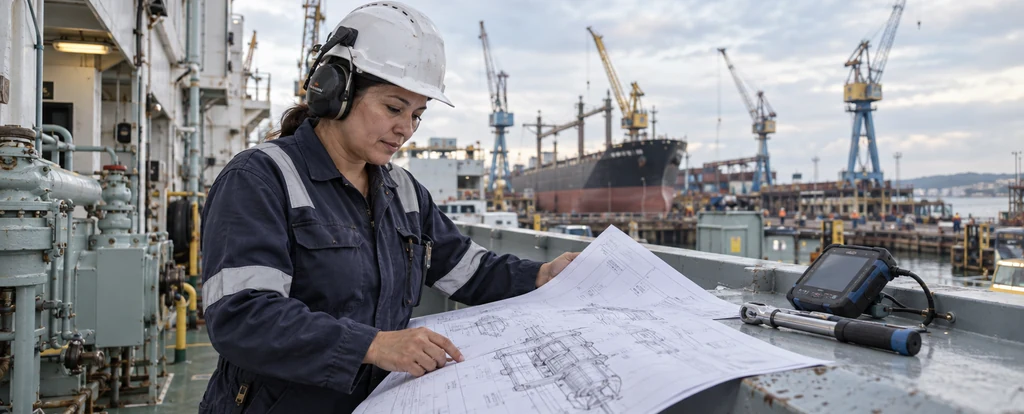
Marine engineers follow a vessel from the drawing board through sea trials and years of maintenance, working in design offices, shipyards, dry docks and engine rooms. They answer to the operator, but also to the classification society and flag state that set the safety and environmental rules. The role is often confused with naval architecture: naval architects shape the hull and its stability, while marine engineers look after everything that goes inside it.
How much do marine engineers earn?
The median full-time salary for a marine engineer is $111,800 per annum, before tax, up $23,400 since 2018.
What you earn depends more on the sector and the certificate you hold than on the city you work in. Seagoing officer roles carry sea rotations and allowances that shore-based design offices do not, and offshore oil and gas and defence projects tend to pay above commercial shipping. Class 3, Class 2 and Class 1 certificates from the Australian Maritime Safety Authority each open up different roles and rates, and chartered status with Engineers Australia matters more for consultancy work on land.
What does a marine engineer do day to day?
The list below is what fills most weeks; the exact mix shifts with seniority and whatever stage the current work is at.
- Designing propulsion, steering and auxiliary systems for vessels, submarines and offshore platforms
- Preparing drawings, calculations and specifications for new builds and refits
- Supervising installation, testing and commissioning of machinery alongside the shipyard
- Running inspections, sea trials and fault diagnosis against classification and statutory requirements
- Planning maintenance and coordinating repairs with operators, dry docks and equipment suppliers
What skills do marine engineers need?
Employers look for engineering design and analysis, cAD and technical drawing, project engineering and delivery, backed by AutoCAD fluency and strong problem solving.
Specialist skills
- Engineering design and analysis
- CAD and technical drawing
- Project engineering and delivery
- Installation and maintenance
- Field inspection and testing
- Worksite safety management
- Regulatory compliance
Software and tools
- AutoCAD
- SolidWorks
- AVEVA E3D Design
- MATLAB
- Maxsurf
General skills
- Problem solving
Is the job growing?
About 1,900 people work as marine engineers in Australia, and employment is projected to grow 12% over the decade to 2035. That's healthy, above-average growth, and the role should stay in solid demand.
How do you become a marine engineer?
Here's the path most marine engineers take, step by step.
- 1Choose maths and physics in Year 12
Engineering degrees expect both subjects, and a TAFE engineering or marine mechanical qualification is a workable entry point if you leave school early.
- 2Complete an engineering degree
A four-year bachelor degree in marine engineering, marine and offshore engineering or a related discipline covers thermodynamics, fluid mechanics and ship systems, and many programs include a period of sea time or an industry placement.
- 3Build sea service and an AMSA certificate of competency
Officer roles on commercial vessels require a certificate of competency from the Australian Maritime Safety Authority, granted on approved sea service, training and an oral examination; Class 3 is the starting level, with Class 2 and Class 1 following as sea time accumulates.
- 4Gain experience in the sector you want
Shipyards, defence programs, offshore operators, towage and ferry companies all hire marine engineers, and the machinery you work on shapes which certificate and specialisation you build next.
- 5Consider chartered status for shore-based design work
Engineers Australia chartered status is not needed to work on board, but it is often asked for in consultancy, classification society and project engineering roles.
Ready to apply as a marine engineer?
Whether you're working toward becoming a marine engineer or already are one and want a hand with the next step (sharpening your resume for ATS screening, tightening your cover letter, or knowing what you'll actually be asked at interview), here are examples grounded in this specific role, not generic templates.
What jobs can a marine engineer move to?
Moving into Mechanical Engineer typically comes with the biggest pay rise, worth $24,100 a year more on average.
| Move to | Typical pay change | Overlap | Retraining |
|---|---|---|---|
| Mechanical Engineer Marine engineers bring vessel machinery and systems experience, but moving into mechanical engineering requires a degree qualification.Known move | +$24,100 | 36% | requalify |
| Marine Surveyor Marine engineers bring vessel machinery and safety knowledge to survey work, with additional survey certification needed.Known move | +$2,600 | 25% | reskill |
Moves are chosen from Jobs and Skills Australia's Data on Occupation Mobility, which follows income tax records between 2011-12 and 2020-21, together with entry requirements and skill overlap. A known move is one people were seen making in that data. Pay change compares median full-time pay for the two roles.
Who works as a marine engineer?
The typical marine engineer is 45 years old; 96% are men, 92% work full-time, and full-timers average 55 hours a week.
- 45
- Median age
- 4%
- Female share
- 92%
- Full-time
- +15h
- vs all-jobs avg
What's it like being a marine engineer?
The job moves between a screen and a machine space: design and project work happens in an office with drawings, calculations and supplier documents, and the same engineer later stands in an engine room for commissioning or a sea trial. Full-time marine engineers average 55 hours a week, which reflects sea rotations, dry dock periods and project deadlines rather than a standard office week. It tends to suit people who like machinery they can hear and touch, and who are comfortable with time away from home.
What people like
- You see the plant run. A system you specified or designed gets tested, started and handed over, and the result is immediate and audible.
- Office work and hands-on work in the same job. Few engineering roles put you in front of the actual machinery this often, and the two halves keep the work varied.
- A small field where contacts carry. Shipyards, operators and classification societies know each other, so a good reputation travels with you between contracts.
- Work that takes you to ports and yards. Vessels are built, dry-docked and repaired around the Australian coast and overseas, which brings travel and time on the water into the job.
What people find hard
- Long stretches away from home. Sea trials, commissioning and breakdowns do not schedule themselves around family life, and a vessel can keep you at sea or interstate for weeks.
- Engine rooms are hot, loud and tight. Fault finding often means confined spaces, running machinery and heavy components in a compartment that was not designed for someone to stand in comfortably.
- Regulation and documentation. Class rules, flag state requirements and safety management systems generate a lot of survey evidence for every change you make.
- Programs depend on yards and docks. Docking slots, spare parts and shipyard schedules shift, and the delays usually land on the engineering team.
Based on our synthesis of professional-body surveys and public accounts of the role, not first-person verified reviews.
Which industries employ marine engineers?
Transport, Postal and Warehousing employs the largest share of marine engineers, followed by Public Administration and Safety.
Top employing industries
- 1Transport, Postal and Warehousing
- 2Public Administration and Safety
- 3Manufacturing
Ranked by employment share; the source doesn't publish an exact percentage per industry.
| Diploma / Advanced Diploma | 34.9% | |
|---|---|---|
| Certificate III/IV | 23.7% | |
| Bachelor degree | 23.6% | |
| Postgraduate | 7.3% | |
| Year 12 or below | 4.3% |
Will AI replace marine engineers?
Marine engineering sits in the middle: much of the design and documentation work is already software-driven, while the physical side of the job is far harder to automate. Modelling and analysis tools have taken over a large share of calculation and drawing production, and sensor data from machinery is shifting fault finding towards prediction. Installation, alignment, sea trials and the final sign-off still happen on board, with someone standing at the machine.
Share of typical working time by exposure level
- System design and engineering calculationsSoftware handles most of the thermodynamic, piping and structural analysis, but choosing a system that suits the vessel and satisfies the class rules is still an engineer's call.30%moderate
- Drawings, specifications and documentation3D modelling and automated drawing production have cut drafting hours sharply, and much of a specification is now assembled from suppliers' digital data.25%high
- Installation, commissioning and sea trialsAligning a shaft, running a machinery trial and proving a system at sea depend on the physical state of the vessel and the people in the space.25%low
- Condition monitoring, fault finding and maintenance planningVibration and performance data flag problems earlier, but confirming the fault and arranging the repair still means opening the machine or the compartment.20%moderate
Common questions about becoming a marine engineer
Straight answers to the questions people ask most.
How much do marine engineers earn?
Marine engineers earn a median of $111,800 per year before tax, working full-time hours that run longer than the standard week. Pay rises with the certificate of competency you hold, and seagoing roles with sea allowances plus offshore and defence project work generally sit above shore-based design office salaries.
How do you become a marine engineer?
The usual route is a four-year engineering degree in marine engineering or a related discipline, followed by sea service and an AMSA certificate of competency if you want to work as an officer on a commercial vessel. People already in engine rooms, or working as motor mechanics, can enter through further study and count their hands-on experience towards the sea time.
Are marine engineers in demand?
Marine engineers are currently in shortage nationally, and employment is projected to grow 12% over the decade to 2035. Certification takes years of sea service to complete, so it is worth checking hiring in the sector you are aiming at, whether that is defence, offshore or commercial shipping, before you commit.
Will AI replace marine engineers?
Not the whole job. Software now handles much of the stress analysis, piping and system modelling, and sensor data flags machinery faults earlier than a routine inspection would catch them. The physical work stays with people: installing, aligning, testing and repairing machinery on board, and confirming a system is safe to run.
What can marine engineers move into?
Mechanical engineering is an established move, paying $24,100 more for marine engineers who make it, though it usually requires a mechanical engineering degree qualification. Marine surveying pays $2,600 more and builds directly on vessel machinery and safety knowledge, with survey certification on top.
What is the difference between a marine engineer and a naval architect?
Naval architects design the hull, its shape and its stability, while marine engineers design and maintain everything inside it, including propulsion, power generation, pumps, steering and ventilation. On large projects the two sit in the same team, one focused on how the vessel floats and moves and the other on the machinery that drives it.
Related roles
Not sure this is you? Take the career quiz and get a ranked shortlist of roles that fit how you like to work.