Office Equipment Technician
Office equipment technicians keep the printers, copiers and multifunction devices in a workplace running, installing new machines and repairing them when they fail.
- Median salary*
- $70,200
3.8%vs last year, before tax
- People employed
- 2,000
0.0%vs last year
- Projected growth
- +6.2%
to 2035
- AI exposure*
- Moderate
- automation risk
- Average hours
- 39/wk
−1h vs all jobs
- Shortage status
- Not in shortage
national
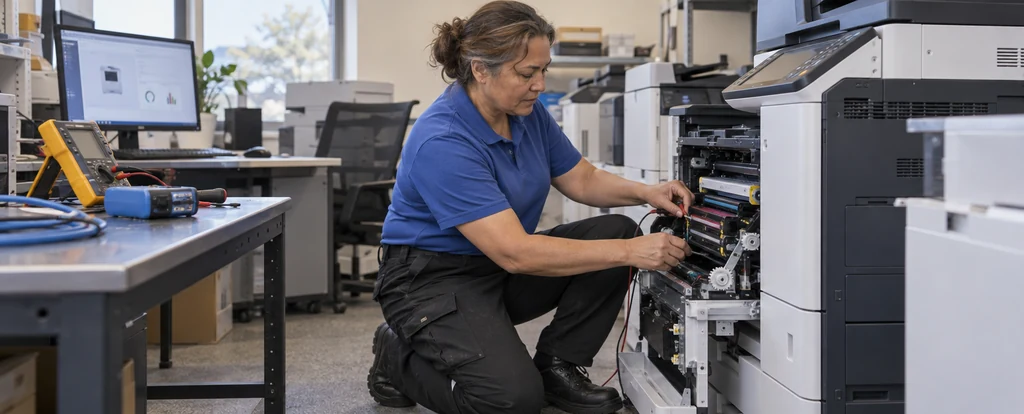
The work happens on customer sites, at a workshop bench or in a van moving between service calls, and it mixes electronic fault-finding with network configuration. It is often confused with IT support, but this job centres on the machine itself rather than the user's accounts and software. Most technicians work for equipment suppliers, managed print providers or repair firms, and a paid Certificate III traineeship is the usual way in.
How much do office equipment technicians earn?
The median full-time salary for an office equipment technician is $70,200 per annum, before tax, up $14,500 since 2018.
Pay follows the award or enterprise agreement covering the employer you work for, and manufacturer certifications in production print equipment tend to lift it further. On-call rosters, a service vehicle and travel between sites can add allowances, while an in-house role looking after one organisation's fleet usually pays less than field work for a managed print provider.
What does an office equipment technician do day to day?
The list below is what fills most weeks; the exact mix shifts with seniority and whatever stage the current work is at.
- Diagnosing faults in printers, copiers and multifunction devices, often using the manufacturer's diagnostic software to narrow down the cause
- Replacing worn parts such as rollers, fusers and imaging units, then running test pages to confirm the machine is printing to spec
- Setting up new machines on a customer's network, including print queues, scan-to-email and user access
- Working through scheduled service calls, cleaning and calibrating equipment so faults are caught before they stop a print run
- Logging the repair, the parts used and the meter readings so the supplier can bill accurately and spot machines that fail repeatedly
What skills do office equipment technicians need?
Employers look for installation and maintenance, technical support and troubleshooting, networks and systems administration, backed by Multimeter fluency and strong problem solving.
Specialist skills
- Installation and maintenance
- Technical support and troubleshooting
- Networks and systems administration
- Software testing and QA
Software and tools
- Multimeter
- Manufacturer diagnostic software
- Network cable tester
- Hand tools and specialist jigs
- Print management software
General skills
- Problem solving
- Attention to detail
- Customer service
Is the job growing?
About 2,000 people work as office equipment technicians in Australia, and employment is projected to grow 6.2% over the decade to 2035. That's modest growth: demand is steady rather than booming.
How do you become an office equipment technician?
Here's the path most office equipment technicians take, step by step.
- 1Start with a Certificate III traineeship
A Certificate III in electronics and communications (UEE30920), or a related electrical qualification, is the standard entry point, and it is usually done as a paid traineeship with an equipment supplier or repair firm so you earn while you learn.
- 2Learn the hardware on the job
Trainees shadow experienced technicians on service calls, learning to read wiring diagrams, use a multimeter and replace the assemblies that fail most often, such as fusers and paper feed rollers.
- 3Add manufacturer certifications
Printer and copier vendors run their own training for their machines, and employers value it because a certified technician can carry out warranty work without escalating the job.
- 4Build network and software skills
Modern devices are networked, so a short course in networks or operating systems widens the range of faults you can resolve on the spot rather than handing over to an IT team.
- 5Move into specialised equipment or coordination
Experienced technicians often shift into production print, managed print services or field service scheduling, where the machines are larger and the technical demands higher.
Ready to apply as an office equipment technician?
Whether you're working toward becoming an office equipment technician or already are one and want a hand with the next step (sharpening your resume for ATS screening, tightening your cover letter, or knowing what you'll actually be asked at interview), here are examples grounded in this specific role, not generic templates.
What jobs can an office equipment technician move to?
Moving into Electrician typically comes with the biggest pay rise, worth $43,700 a year more on average.
| Move to | Typical pay change | Overlap | Retraining |
|---|---|---|---|
| Electrician Office equipment technicians bring electronic fault-finding and wiring skills, but becoming an electrician requires an electrical apprenticeship and licence.Known move | +$43,700 | 17% | requalify |
| Electronic Engineering Technician Electronic engineering technicians use deeper circuit and systems knowledge, with a diploma building on the repair and calibration background.Known move | +$41,200 | 36% | reskill |
| Instrumentation Technician Instrumentation technicians apply calibration and diagnostic skills to control systems, though entry needs a separate instrumentation qualification.Known move | +$28,600 | 19% | requalify |
| Electrical Engineering Technician Electrical engineering technicians apply electrical and electronic skills to power and control systems, with a diploma adding to the repair background.Known move | +$21,300 | 26% | reskill |
| Computer Hardware Technician Computer hardware technicians repair and support physical devices, a natural shift for office equipment technicians with basic IT certification. | +$5,200 | 63% | short course |
Moves are chosen from Jobs and Skills Australia's Data on Occupation Mobility, which follows income tax records between 2011-12 and 2020-21, together with entry requirements and skill overlap. A known move is one people were seen making in that data. Pay change compares median full-time pay for the two roles.
Who works as an office equipment technician?
The typical office equipment technician is 48 years old; 97% are men, 84% work full-time, and full-timers average 39 hours a week.
- 48
- Median age
- 3%
- Female share
- 84%
- Full-time
- −1h
- vs all-jobs avg
What's it like being an office equipment technician?
The job has a clear rhythm: a run of service calls, then the workshop bench for machines too large or too damaged to fix on site. Much of the day is spent alone in a van or beside a customer's printer, working out why a machine jams, streaks or refuses to connect, so it suits someone who likes a problem with a definite answer and a fix they can test. Customer sites set the pace, and there is little slack when an office is waiting on a print run.
What people like
- A fault you can trace. Printers fail in physical, followable ways, so a methodical technician can work from a jam or an error code back to the worn roller causing it.
- A different workplace most days. Field technicians move between offices, schools, clinics and print rooms, which keeps the surroundings and the people varied.
- Knowledge that carries across machines. Once you understand how a paper path, fuser and imaging unit work together, the same reasoning applies to most machines on the market.
- Working without supervision. Field roles hand you a run of jobs and the judgement to order them, with nobody checking each call as you make it.
What people find hard
- Tight service windows. Customers book repairs around their own business hours, so a late arrival or a part that has to be ordered puts pressure on the rest of the day.
- Heavy machines in awkward spots. Copiers and production printers are heavy, and reaching a fuser or paper feed often means kneeling under a desk or working in a cramped print room.
- The same fault coming back. Machines that fail repeatedly because of dusty paper or an overloaded tray keep returning to the schedule, and explaining the same fix again is part of the job.
- First-time fix targets. Service contracts are often measured on response time and how many jobs are closed in one visit, which can push the pace when a diagnosis genuinely needs longer.
Based on our synthesis of professional-body surveys and public accounts of the role, not first-person verified reviews.
Which industries employ office equipment technicians?
Wholesale Trade employs the largest share of office equipment technicians, followed by Other Services.
Top employing industries
- 1Wholesale Trade
- 2Other Services
- 3Manufacturing
Ranked by employment share; the source doesn't publish an exact percentage per industry.
| Certificate III/IV | 37.9% | |
|---|---|---|
| Year 12 or below | 27.2% | |
| Diploma / Advanced Diploma | 16.7% | |
| Bachelor degree | 10.4% | |
| Postgraduate | 2.6% |
Will AI replace office equipment technicians?
This job sits in the middle. Remote monitoring and diagnostic software handle more of the routine every year, but a machine still needs someone with tools and hands to fix it. What is changing is where the job starts: a fault often arrives already logged by service software, which shifts the technician's time towards repair, calibration and configuration rather than hunting for the cause.
Share of typical working time by exposure level
- On-site repair and parts replacementFusers, rollers and imaging units have to be pulled out, fitted, aligned and tested by hand, usually in a cramped print room under time pressure.40%low
- Network setup and device configurationAddressing, print queues and scan profiles follow manufacturer wizards, but matching a customer's network, security settings and user permissions still takes judgement.25%moderate
- Remote diagnostics and error-code triageMonitoring software reports faults, page counts and toner levels from a customer's fleet, so part of the diagnosis happens before anyone leaves the workshop, though the technician still decides what the reading means.20%moderate
- Scheduled servicing and job recordsCleaning, calibration and meter reads are logged in service software that schedules visits and bills automatically, leaving the physical servicing to the technician.15%low
Moves least exposed to AI
These career moves from office equipment technician work are rated low for AI exposure:
- Electrician
Some skill overlap (17%), requalify to get there, and a low automation-risk profile.
Common questions about becoming an office equipment technician
Straight answers to the questions people ask most.
How much do office equipment technicians earn?
Office equipment technicians earn a median of $70,200 per year before tax. What moves that figure is the award or enterprise agreement you work under, the manufacturer certifications you hold, and whether the role includes on-call work, a service vehicle and travel allowances.
How do you become an office equipment technician?
Most people enter through a paid traineeship that combines work with a Certificate III in electronics and communications or an equivalent qualification. About 38% of the current workforce holds Certificate III/IV, and employers generally look for practical fault-finding ability built up on real service calls.
Are office equipment technicians in demand?
Office equipment technicians are currently not in shortage, and employment is projected to grow 6.2% over the decade to 2035. About 2,000 people work in the occupation nationally, and the work is tilting towards networked multifunction devices and managed service contracts rather than standalone copiers.
Will AI replace office equipment technicians?
Not entirely, and remote monitoring has already changed how the job starts rather than whether it exists. Managed print software reports page counts, toner levels and error codes back to a service desk, so some faults are diagnosed before a technician arrives and the right part goes in the van first time. Faults that involve paper, fusers and calibration still need someone at the machine with tools.
What can office equipment technicians move into?
Computer hardware technician work draws on the same repair and support skills, and pays $5,200 more. Electronic engineering technicians earn $41,200 more and electricians $43,700 more, but both routes need further study or an apprenticeship and a licence. Some experienced technicians build a client base and go out on their own as independent service agents, which is often where earnings grow.
Where do office equipment technicians work?
Most work for equipment suppliers, managed print providers and repair firms, travelling between customer sites, with workshop time for machines that come in for bench repair. A smaller number work in-house for a large organisation, looking after its own fleet of printers and copiers across several buildings.
Related roles
- Electrician
- Electronic Engineering Technician
- Instrumentation Technician
- Computer Hardware Technician
- Electrical Engineering Technician
- Security Technician
Not sure this is you? Take the career quiz and get a ranked shortlist of roles that fit how you like to work.