Security Technician
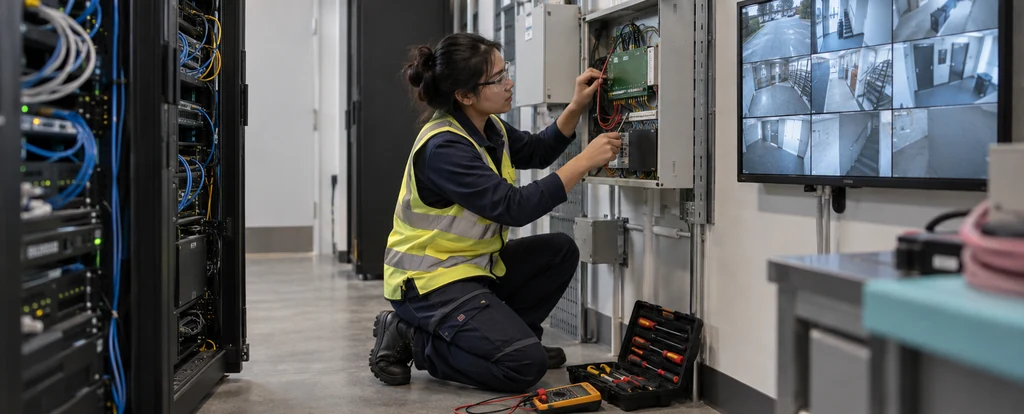
Security technicians install, service and repair the alarm, CCTV and access control systems that protect homes, shops and workplaces.
- Median salary*
- $80,600
3.7%vs last year, before tax
- People employed*
- 9,500
0.0%vs last year
- Projected growth*
- +7%
to 2035
- AI exposure*
- Low
- automation risk
- Average hours*
- 40/wk
matches all-jobs average
- Shortage status*
- In shortage
national
Security technicians work on site in houses, shops, offices, warehouses and industrial premises, running cables, mounting cameras and detectors, and programming the panels that tie a system together. The job sits between the electrical trades and IT, because a growing share of it is networked: cameras and door readers now share infrastructure with the client's data. Most technicians hold a Certificate III in security equipment, an open cabling registration and a state or territory security installer licence.
How much do security technicians earn?
The median full-time salary for a security technician is $80,600 per annum, before tax, up $16,600 since 2018.
The award or enterprise agreement sets a base rate, and above that pay moves with the licences and registrations you hold, the sectors you work in and how much of your week is on call. Government, defence and resources sites usually pay more because of the clearance and compliance requirements attached to them. Technicians who move into their own installation business or take on subcontract work set their own rates.
What does a security technician do day to day?
The list below is what fills most weeks; the exact mix shifts with seniority and whatever stage the current work is at.
- Running cabling and mounting cameras, detectors and access control readers
- Testing and commissioning a system before handover to the client
- Diagnosing faults on site, from a camera that has dropped out to a panel that will not arm
- Programming control panels and linking them to the client's network and monitoring centre
- Servicing installed systems on scheduled maintenance visits
What skills do security technicians need?
Employers look for installation and maintenance, security operations, networks and systems administration, backed by Milestone XProtect fluency and strong problem solving.
Specialist skills
- Installation and maintenance
- Security operations
- Networks and systems administration
Software and tools
- Milestone XProtect
- Hikvision iVMS-4200
- Inner Range Integriti
- Axis Camera Station
- Bosch BVMS
General skills
- Problem solving
- Attention to detail
- Customer service
- Digital literacy
- Safety and compliance awareness
Is the job growing?
About 9,500 people work as security technicians in Australia, and employment is projected to grow 7% over the decade to 2035. That's modest growth: demand is steady rather than booming.
How do you become a security technician?
Here's the path most security technicians take, step by step.
- 1Finish Year 12 or a pre-vocational course
There is no degree requirement, but Year 12 maths and digital literacy help because the work involves networks, IP addressing and reading plans. A school-based traineeship with an installation firm is a common way to start while you finish school.
- 2Complete a Certificate III in security equipment
This is the standard qualification, usually done as a paid traineeship or apprenticeship over about two to three years with an installation company. You learn on site and attend TAFE, and you finish with the trade skills employers expect.
- 3Get your cabling registration
Installing structured cabling legally requires registration through an ACMA-accredited Registrar, either open or restricted to security and communications cabling. It is a short course plus an exam, and it is what lets you run and terminate cable yourself rather than waiting on another trade.
- 4Apply for a security installer licence
Each state and territory licenses security installers through its own regulator, and applications generally need a national police check and sometimes fingerprinting. The requirements and the licence classes differ between jurisdictions, so check the rules where you intend to work.
- 5Add manufacturer and vendor certifications
Platforms such as Milestone XProtect, Inner Range Integriti and the major camera brands all run their own training and accreditation. Employers look for these when hiring for larger commercial and government sites, and they need refreshing as versions change.
Ready to apply as a security technician?
Whether you're working toward becoming a security technician or already are one and want a hand with the next step (sharpening your resume for ATS screening, tightening your cover letter, or knowing what you'll actually be asked at interview), here are examples grounded in this specific role, not generic templates.
What jobs can a security technician move to?
Moving into Telecommunications Technician typically comes with the biggest pay rise, worth $10,400 a year more on average.
| Move to | Typical pay change | Overlap | Retraining |
|---|---|---|---|
| Telecommunications Technician Security technicians already install low-voltage cabling and networked devices, so telecommunications work builds on that base with a full apprenticeship. | +$10,400 | 45% | requalify |
| Data Centre Technician Security technicians install and maintain cabling and hardware, skills that transfer to server rooms with further study in infrastructure. | +$10,400 | 45% | reskill |
| Data Cabler Security technicians run structured cabling for cameras and access control, so network cabling is a related specialism needing cabling registration. | +$0 | 19% | reskill |
| Computer Hardware Technician Security technicians diagnose and repair electronic equipment, so computer hardware work is a related move with additional training in computing systems. | −$5,200 | 43% | reskill |
| Vehicle Accessories Fitter Security technicians fit alarms, cameras and wiring, skills that carry into vehicle electronics with further training in automotive systems. | −$15,600 | 39% | reskill |
Moves are chosen from Jobs and Skills Australia's Data on Occupation Mobility, which follows income tax records between 2011-12 and 2020-21, together with entry requirements and skill overlap. A known move is one people were seen making in that data. Pay change compares median full-time pay for the two roles.
Who works as a security technician?
The typical security technician is 37 years old; 95% are men, 86% work full-time, and full-timers average 40 hours a week.
- 37
- Median age
- 5%
- Female share
- 86%
- Full-time
- +0h
- vs all-jobs avg
What's it like being a security technician?
The week moves between installation jobs and service calls, so you are on different sites with different people most days rather than in one place. Work comes in waves: cabling has to be roughed in before the walls close up, and a failed alarm or camera can pull you back out after hours. It suits someone who likes solving practical problems on their feet and is comfortable working alone or in a small crew.
What people like
- You see the system working. At the end of a job you test cameras, arm the panel and watch it do what it was installed to do. That handover, with the client standing next to you, is the clear finish that a lot of trades work does not have.
- No two sites are the same. A four-camera house, a warehouse with sixty cameras and a hospital with locked wards each need a different design and a different day. The problem solving changes with the building, so the work rarely becomes a set routine.
- The technology keeps moving. Analogue gear has largely given way to IP cameras, network video recorders and cloud monitoring, so there is always a new platform or firmware to learn. Technicians who keep up with it tend to be the ones employers chase.
- A fair amount of independence. Once you are licensed, you often run jobs on your own, set your own order of work and deal directly with the client. Not everyone wants a supervisor looking over their shoulder, and this role mostly does not have one.
What people find hard
- Time in ceilings and roof spaces. Cable runs mean crawling through roof voids and under floors, often in summer heat and often covered in insulation or dust. It is the part of the job that wears people down physically.
- Faults do not keep office hours. A dead alarm or a camera feed that matters to a business gets attention the same day, which can mean after-hours callouts on a roster. Some employers pay penalties for that, and some simply expect it.
- Waiting on other trades. Your cabling has to go in before the walls close up, so a delayed plasterer or electrician can leave you standing around. Rescheduling a whole day because a site is not ready is a familiar frustration.
- Paperwork and compliance. Every job carries as-built drawings, test results, licence records and client sign-off, and larger sites bring inductions and clearances. It takes real time, and it is not the reason most people chose the trade.
Based on our synthesis of professional-body surveys and public accounts of the role, not first-person verified reviews.
Which industries employ security technicians?
Building installation services employs the largest share of security technicians, followed by Investigation and security services.
Top employing industries
- 1Building installation services
- 2Investigation and security services
- 3Telecommunications services
- 4Property operations and facilities management
- 5Public administration and safety
Ranked by employment share; the source doesn't publish an exact percentage per industry.
| Certificate III/IV | 34% | |
|---|---|---|
| Diploma / Advanced Diploma | 26% | |
| Bachelor degree | 20% | |
| Year 12 or below | 20% |
Will AI replace security technicians?
AI reaches the paperwork and parts of the diagnosis in this job, not the installation. Vendor platforms can flag a camera that is dropping frames or suggest a configuration, and video analytics now filter many false alarms before anyone is called, but somebody still has to run the cable, mount the reader and work out why a detector is triggering. That keeps the overall exposure low.
Share of typical working time by exposure level
- Running cable and mounting equipmentPulling cable through a roof void, drilling a wall for a camera or fitting a reader at a door is physical work on an unfamiliar site, and no tool does it for you.40%low
- Diagnosing faults on siteA panel that will not arm or an intercom with no audio usually comes down to a loose termination, a failed power supply or a network problem that has to be traced by hand.25%low
- Programming panels and integrating systemsConfiguration wizards and health dashboards in platforms such as Milestone XProtect speed up routine setup, but mapping doors, zones and user permissions to how a site actually runs still needs a person who knows the building.20%moderate
- Advising clients and completing job recordsTemplate reports and quoting tools cut the admin, though explaining camera coverage, maintenance schedules and compliance to a client in plain terms is still a conversation.15%moderate
Common questions about becoming a security technician
Straight answers to the questions people ask most.
How much does a security technician earn?
Full-time security technicians earn a median of $80,600 per year before tax. Pay rises with the licences you hold, the sectors you work in and how much on-call or after-hours work you take on, and technicians who move into their own installation business can earn more again.
How do I become a security technician?
The usual route is a paid traineeship or apprenticeship in a Certificate III in security equipment, which takes about two to three years and combines site work with TAFE. Alongside it you need cabling registration and a security installer licence from your state or territory regulator, both of which involve a police check.
Are security technicians in demand?
Security technicians are currently in shortage nationally, and employment is projected to grow 7% over the decade to 2035 over the decade to 2035. Ongoing demand comes from new commercial buildings and upgrades of older analogue systems to networked cameras and access control, so there is work in both installation and servicing.
Will AI replace security technicians?
No, and the exposure is low because the job is largely physical and on site. Software already helps by flagging a failing camera on a health dashboard or suggesting a configuration, and analytics can filter out false alarms before they reach a monitoring centre, but a person still runs the cable, mounts the hardware and works out why a detector is triggering at 3am.
What can a security technician move into?
Telecommunications technician builds on the low-voltage cabling and networked hardware you already handle, and it pays $10,400 more. Data centre technician takes similar skills into server rooms, while computer hardware technician pays $5,200 less and suits someone who prefers bench repair to site work. Many experienced technicians also start their own installation business, which is often where earnings grow.
What is the difference between a security technician and a security monitoring operator?
A security technician installs and repairs the equipment, while a monitoring operator watches the alarms and camera feeds it produces from a control room. The two roles overlap in what they know about alarm and CCTV systems, and monitoring operators can move across into technician work with a short course and the required licences.
Related roles
- Telecommunications Technician
- Data Cabler
- Data Centre Technician
- Computer Hardware Technician
- Vehicle Accessories Fitter
- Security Monitoring Operator
Not sure this is you? Take the career quiz and get a ranked shortlist of roles that fit how you like to work.