Oral Surgeon
Oral surgeons operate on the mouth, jaws and face to relieve pain, remove disease and rebuild function after injury or decay.
- Median salary*
- $218,400
4.0%vs last year, before tax
- People employed*
- 520
4.0%vs last year
- Projected growth
- +35.8%
to 2035
- AI exposure*
- Low
- automation risk
- Average hours*
- 44/wk
+4h vs all jobs
- Shortage status
- In shortage
national
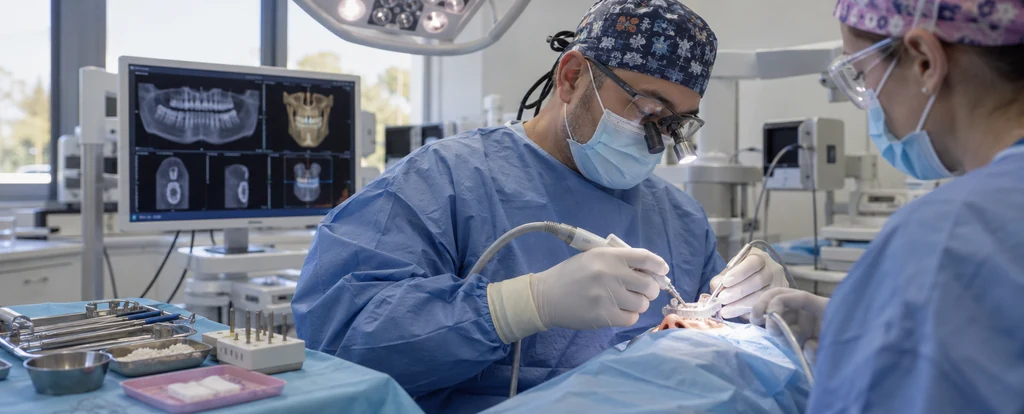
Oral surgeons are dental specialists who work in hospital oral surgery units, private specialist rooms and day surgery centres, treating impacted teeth, cysts, jaw problems, facial injuries and spreading infections. They hold specialist registration in oral surgery with AHPRA, which separates them from general dentists and from the broader maxillofacial specialty, where practitioners hold both dental and medical degrees and take on more extensive surgery of the face and neck. A typical week mixes consulting clinics, operating theatre lists and a share of emergency calls that cannot wait.
How much do oral surgeons earn?
The median full-time salary for an oral surgeon is $218,400 per annum, before tax, up $45,600 since 2018.
Where you work shapes earnings more than anything else. Salaried specialist positions in public hospital dental and maxillofacial units sit on state health service enterprise agreements with set bands, while private practice pays fee for service, so income follows the number and complexity of procedures you take on. Specialists who own their rooms or hold visiting rights at day surgery units carry practice costs but also keep more of what they bill.
What does an oral surgeon do day to day?
The list below is what fills most weeks; the exact mix shifts with seniority and whatever stage the current work is at.
- Assessing patients with impacted teeth, jaw pain, cysts and facial injuries
- Removing difficult and impacted teeth under local or general anaesthesia
- Placing dental implants and grafting bone where there is not enough to hold them
- Taking emergency referrals for facial trauma and infections spreading from teeth
- Reviewing patients after surgery and coordinating care with referring dentists and orthodontists
What skills do oral surgeons need?
Employers look for clinical assessment and treatment, patient care and support, infection control and hygiene, backed by Cone beam CT (CBCT) imaging software fluency and strong attention to detail.
Specialist skills
- Clinical assessment and treatment
- Patient care and support
- Infection control and hygiene
- Medication management
Software and tools
- Cone beam CT (CBCT) imaging software
- Implant planning software
- Surgical navigation systems
- Dental practice management software
General skills
- Attention to detail
- Problem solving
- Written communication
Is the job growing?
About 520 people work as oral surgeons in Australia, and employment is projected to grow 35.8% over the decade to 2035. That's very strong growth. Few roles in Australia are expanding this fast, and it points to solid demand for years to come.
How do you become an oral surgeon?
Here's the path most oral surgeons take, step by step.
- 1Complete a dental degree
A Bachelor of Dental Surgery or Doctor of Dental Medicine takes about five years and must be accredited by the Australian Dental Council. You then register as a dentist with AHPRA's Dental Board before you can treat patients.
- 2Work as a dentist first
Specialist training programs expect general experience, usually a few years in private practice or a hospital dental role where you build skills in surgical extractions and minor oral surgery.
- 3Enter specialist training in oral surgery
The Royal Australasian College of Dental Surgeons runs a hospital based training program in oral surgery that is paid and takes several years of supervised clinics and theatre lists.
- 4Register as a specialist
Fellowship leads to specialist registration in oral surgery with AHPRA's Dental Board. That registration is what allows you to use the specialist title and bill as a specialist rather than a general dentist.
- 5Consider the wider surgical route
If you want to operate on the broader face and neck, the oral and maxillofacial pathway requires a medical degree as well as a dental one and several more years of training.
Ready to apply as an oral surgeon?
Whether you're working toward becoming an oral surgeon or already are one and want a hand with the next step (sharpening your resume for ATS screening, tightening your cover letter, or knowing what you'll actually be asked at interview), here are examples grounded in this specific role, not generic templates.
What jobs can an oral surgeon move to?
Moving into Oral and Maxillofacial Surgeon typically comes with the biggest pay rise, worth $15,600 a year more on average.
| Move to | Typical pay change | Overlap | Retraining |
|---|---|---|---|
| Oral and Maxillofacial Surgeon Oral surgeons build on their surgical and dental foundations to train further as oral and maxillofacial surgeons. | +$15,600 | 53% | requalify |
Moves are chosen from Jobs and Skills Australia's Data on Occupation Mobility, which follows income tax records between 2011-12 and 2020-21, together with entry requirements and skill overlap. A known move is one people were seen making in that data. Pay change compares median full-time pay for the two roles.
Who works as an oral surgeon?
The typical oral surgeon is 49 years old; 73% are men, 84% work full-time, and full-timers average 44 hours a week.
- 49
- Median age
- 27%
- Female share
- 84%
- Full-time
- +4h
- vs all-jobs avg
What's it like being an oral surgeon?
The job runs on lists and clinics: theatre days for surgery under general anaesthetic, consulting days for assessment and follow-up, and a steady share of emergency work for facial injuries and infections that cannot wait. It suits people who like precise, hands-on work and are comfortable carrying the responsibility that comes with operating near the airway, nerves and blood vessels. Full-time oral surgeons average 44 hours a week, and running private rooms adds administrative work on top of clinical time.
What people like
- Fixing a problem patients can feel. Removing a painful impacted wisdom tooth or rebuilding a jaw after an accident gives immediate relief and a visible result, which is a large part of why people stay in the specialty.
- Anatomy that demands precision. The work sits close to nerves, sinuses and the airway, so planning each case carefully and getting the anatomy right is a satisfaction in itself.
- Complex referrals and continuity. Dentists, emergency departments and orthodontists send you cases they cannot manage, and you often follow those patients from first assessment through to recovery.
- Autonomy in private practice. Many specialists eventually own their rooms or hold visiting rights at day surgery units, which gives them control over the mix of cases they take and how their week is shaped.
What people find hard
- A long road to the title. Specialist registration comes after a dental degree, years of general practice and several more years of hospital training, so you may be well into your thirties before you are billing as a specialist.
- Complications carry weight. Bleeding, infection, nerve injury and airway problems can appear during or after surgery, and the consequences of a poor outcome are serious for the patient and for you.
- Emergency and after-hours work. Facial trauma and spreading dental infections do not keep office hours, so on-call rosters and theatre lists interrupt evenings and weekends.
- The business side of practice. Running rooms brings billing, sterilisation compliance, staffing and record keeping, and much of that lands on the owner rather than an employer.
Based on our synthesis of professional-body surveys and public accounts of the role, not first-person verified reviews.
Which industries employ oral surgeons?
Hospitals employs the largest share of oral surgeons, followed by Dental services.
Top employing industries
- 1Hospitals
- 2Dental services
- 3Specialist medical services
- 4Day surgery services
Ranked by employment share; the source doesn't publish an exact percentage per industry.
| Bachelor degree | 52% | |
|---|---|---|
| Postgraduate | 26% | |
| Diploma / Advanced Diploma | 13% | |
| Other | 9% |
Will AI replace oral surgeons?
This is a hands-on surgical specialty, so AI's reach is limited and the role's exposure is rated low. Cone beam CT, implant planning software and surgical navigation already shape how operations are planned, improving accuracy around nerves and sinuses. What they do not do is make the incision, manage an anaesthetised patient or handle a complication in theatre.
Share of typical working time by exposure level
- Operating on teeth, jaws and facial injuriesRaising a flap, sectioning a wisdom tooth or wiring a fractured jaw is physical work done by hand inside a small, awkward space.40%low
- Surgical planning and imaging reviewSoftware can trace a nerve canal or map bone density on a scan, but the surgeon still decides whether an implant goes in, comes out or waits.25%moderate
- Managing infections, trauma and complicationsA patient who starts bleeding heavily mid-procedure or whose airway is swelling needs a decision and a pair of hands within minutes.20%low
- Records, referral letters and follow-upDictation, procedure notes and letters back to the referring dentist are text tasks that software can already draft from a template.15%high
Common questions about becoming an oral surgeon
Straight answers to the questions people ask most.
How much do oral surgeons earn?
Oral surgeons earn $218,400 per year before tax, based on median full-time earnings. The figure blends salaried hospital specialists with practice owners, so your own income depends on your appointment, the procedures you do and whether you run the business.
How do you become an oral surgeon?
You complete a dental degree, register as a dentist with AHPRA and gain general experience before applying for the specialist oral surgery training program run by the Royal Australasian College of Dental Surgeons. Fellowship and specialist registration then allow you to practise and bill as an oral surgeon.
Are oral surgeons in demand in Australia?
Oral surgeons are currently in shortage nationally, and employment is projected to grow 35.8% over the decade to 2035 over the decade to 2035. The workforce is small, about 520 people, so a handful of new training places or retirements shifts the percentage noticeably, and it is worth checking whether hospitals and day surgery units in your state are recruiting specialists.
Will AI replace oral surgeons?
AI has limited reach into this job because the core of it is physical work: cutting, suturing and managing an anaesthetised patient. Cone beam CT, implant planning software and surgical navigation already help map bone and locate nerves before an operation, but they inform the surgeon rather than act. The parts most exposed are imaging review, records and referral letters.
What roles can oral surgery lead to?
Some specialists train further in oral and maxillofacial surgery, which adds a medical degree and several more years of study, and median pay there is $15,600 more than in oral surgery. Others return to general dental practice, where median pay is $50,300 more, often for a lighter schedule or a different setting. Many stay in oral surgery and build a private practice, which is often where earnings grow.
Do you need a medical degree to be an oral surgeon?
No. In Australia oral surgery is a dental specialty, so you need a dental degree and specialist registration with AHPRA's Dental Board. A medical degree is required only for the separate oral and maxillofacial specialty, which covers more extensive surgery of the face, jaws and neck.
Specialisation of
Related roles
Not sure this is you? Take the career quiz and get a ranked shortlist of roles that fit how you like to work.