Pipelayer
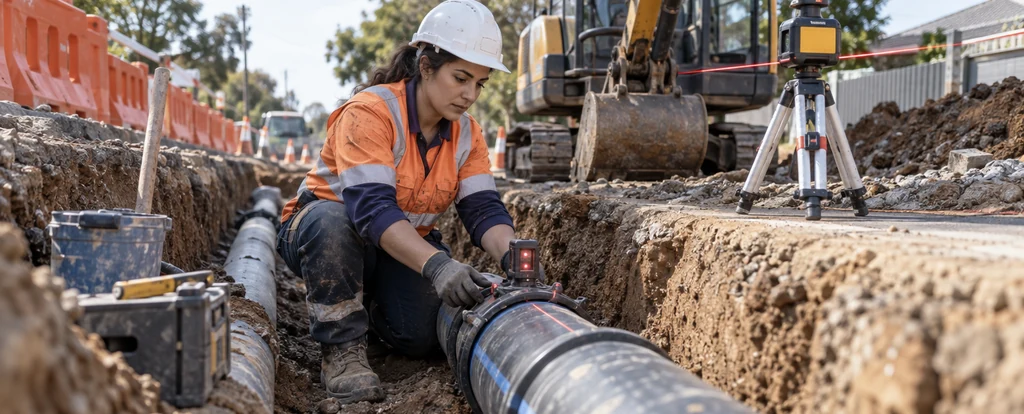
Pipelayers lay the underground pipes that carry water, sewage and stormwater, working in trenches on new subdivisions, road projects and utility upgrades.
- Median salary*
- $78,000
4.1%vs last year, before tax
- People employed
- 3,300
0.0%vs last year
- Projected growth
- +6.4%
to 2035
- AI exposure*
- Low
- automation risk
- Average hours
- 43/wk
+3h vs all jobs
- Shortage status*
- In shortage (regional)
national
Pipelayers install water mains, sewer lines, stormwater drains and culverts on civil construction sites. Most work for civil contractors, councils or water authorities, and the pipe runs they build sit outside buildings, which is what separates the job from plumbing: a pipelayer does not need a plumbing licence and rarely works inside a home. The workplace is a trench, and the crew moves from one project to the next as each finishes.
How much do pipelayers earn?
The median full-time salary for a pipelayer is $78,000 per annum, before tax, up $16,400 since 2018.
Pay is set by the award or enterprise agreement covering the project, so civil contractors, councils and water authorities often pay differently for the same work. Overtime and penalty rates make a real difference on jobs running to a deadline, and qualifications to operate an excavator or other plant let you take on higher-paid duties. Regional and remote projects often pay above city rates to attract crews.
What does a pipelayer do day to day?
The list below is what fills most weeks; the exact mix shifts with seniority and whatever stage the current work is at.
- Digging and preparing trenches to the right depth and fall
- Setting out pipe runs with a pipe laser or level
- Cutting and joining pipe sections in concrete, PVC or clay
- Working around live services and existing pipes
- Pressure testing lines for leaks, then backfilling and compacting
What skills do pipelayers need?
Employers look for hand and power tool work, reading plans and specifications, worksite safety management, backed by Pipe laser fluency and strong physical stamina and dexterity.
Specialist skills
- Hand and power tool work
- Reading plans and specifications
- Worksite safety management
- Installation and maintenance
- Plant and equipment operation
Software and tools
- Pipe laser
- Laser level
- Total station
- Excavator
- GPS survey equipment
General skills
- Physical stamina and dexterity
- Attention to detail
Is the job growing?
About 3,300 people work as pipelayers in Australia, and employment is projected to grow 6.4% over the decade to 2035. That's modest growth: demand is steady rather than booming.
How do you become a pipelayer?
Here's the path most pipelayers take, step by step.
- 1Get a White Card and a driver's licence
The White Card is the general construction induction training required before you can set foot on a site anywhere in Australia, and it takes about a day. A car licence matters more than it sounds, because sites are often in new suburbs or regional areas that public transport does not reach.
- 2Start as a labourer or in a traineeship
Many pipelayers begin as civil construction labourers or plumber's assistants, learning trenching, pipe handling and levels on the job. A traineeship with a civil contractor combines paid work with study and is the most direct way in.
- 3Complete a Certificate III in Civil Construction (Pipe Laying)
This is the trade-level qualification, delivered through TAFE or a private registered training organisation over roughly two to three years while you work. It covers trenching, pipe installation, drainage, plan reading and testing.
- 4Add plant qualifications
Competencies to operate an excavator, skid steer or loader let you do more of the job yourself and are often what employers look for when appointing a leading hand. Training is short and usually arranged by the employer.
- 5Choose between specialising and supervising
With experience you can move into leading hand or supervisory roles, or take up a plumbing apprenticeship if you want to work on private drainage, which requires registration. Some pipelayers eventually subcontract their own small crew to civil contractors.
Ready to apply as a pipelayer?
Whether you're working toward becoming a pipelayer or already are one and want a hand with the next step (sharpening your resume for ATS screening, tightening your cover letter, or knowing what you'll actually be asked at interview), here are examples grounded in this specific role, not generic templates.
What jobs can a pipelayer move to?
Moving into Concreter typically comes with the biggest pay rise, worth $36,900 a year more on average.
| Move to | Typical pay change | Overlap | Retraining |
|---|---|---|---|
| Concreter Skill in setting pipe levels and preparing trenches translates to concrete placement and finishing work.Known move | +$36,900 | 67% | minimal |
| Plumber Pipelaying experience with drainage and pipe installation carries into plumbing, though an apprenticeship is required for registration.Known move | +$25,500 | 62% | requalify |
| Earthmoving Plant Operator Trenching and site experience transfers to operating earthmoving plant, with a short course for the required tickets.Known move | +$25,000 | 58% | short course |
| Water Treatment Operator Knowledge of water and sewer networks supports a move into treatment operations, requiring substantial retraining.Known move | +$18,200 | 18% | reskill |
| Site Supervisor Experience coordinating pipe crews and reading drainage plans can lead to supervising construction sites, with further study.Known move | +$7,800 | 14% | reskill |
Moves are chosen from Jobs and Skills Australia's Data on Occupation Mobility, which follows income tax records between 2011-12 and 2020-21, together with entry requirements and skill overlap. A known move is one people were seen making in that data. Pay change compares median full-time pay for the two roles.
Who works as a pipelayer?
The typical pipelayer is 44 years old; 95% are men, 92% work full-time, and full-timers average 43 hours a week.
- 44
- Median age
- 5%
- Female share
- 92%
- Full-time
- +3h
- vs all-jobs avg
What's it like being a pipelayer?
The job is built around projects: a subdivision, a road upgrade, a water main replacement, and then on to the next one. Days start early and are mostly spent outdoors in a trench, with the pace set by the machinery and by whatever the ground turns up. It suits people who like working with their hands, can see the progress at the end of a shift and are comfortable with the physical side of the work.
What people like
- The result is easy to see. By the end of a project there is a working line in the ground that a suburb depends on, which is a more concrete result than many jobs offer.
- The crew is small and close. Pipelaying crews are usually a handful of people, so you know everyone you work with and the day moves as a group.
- The work changes with the site. One week is a new subdivision, the next a sewer replacement in an older street, so the ground, the access and the people around you keep changing.
- Levels give the job its craft. Getting a pipe to fall at the right grade over a long run is a skill you build over years, and other trades notice when the line is right.
What people find hard
- Weather is part of the job. Trenches fill with water in heavy rain and heat slows everyone down, so wet days can mean waiting on pumps or a call about whether work goes ahead.
- The physical toll is real. Digging, lifting pipe and standing in a trench all day loads the back, knees and shoulders, which is why good crews rotate tasks and use machinery where they can.
- Ground conditions can wreck a plan. Rock, unmarked services or groundwater can turn a day of laying into a day of problem solving, and the programme rarely moves to allow for it.
- Projects end. Work is tied to a project, so there is often travel to the next site and gaps between jobs, and steady work depends on the contractor winning the next contract.
Based on our synthesis of professional-body surveys and public accounts of the role, not first-person verified reviews.
Which industries employ pipelayers?
Electricity, Gas, Water and Waste Services employs the largest share of pipelayers, followed by Public Administration and Safety.
Top employing industries
- 1Electricity, Gas, Water and Waste Services
- 2Public Administration and Safety
- 3Construction
Ranked by employment share; the source doesn't publish an exact percentage per industry.
| Certificate III/IV | 45.6% | |
|---|---|---|
| Year 12 or below | 40.1% | |
| Diploma / Advanced Diploma | 4.9% | |
| Bachelor degree | 4.1% | |
| Postgraduate | 1.4% |
Will AI replace pipelayers?
Pipelaying is rated low for AI exposure because almost all of the work happens in a trench, on ground that is different on every site. Machine guidance on excavators, GPS survey equipment and pipe lasers have changed how levels are set and trenches are dug, but they still leave a person to lay, join, test and backfill the pipe, and to deal with the services, rock and water the ground throws up.
Share of typical working time by exposure level
- Laying, cutting and joining pipe sectionsJoining a concrete or PVC line means handling pipe, checking the seal and bedding it correctly, and no machine has taken over that part of a pipelayer's day.35%low
- Excavating and preparing trenchesGPS-guided excavators cut trench to grade more accurately, but someone still has to watch for live services, batter the walls and get in with a shovel where the machine cannot fit.25%low
- Reading plans and setting out pipe runsSoftware now works out levels and grades from the design model, and a pipe laser or total station puts them on the ground, so the calculating side has largely moved to the tools.20%high
- Testing lines and reinstating the surfacePressure and CCTV testing can be partly automated, but finding a leak or a damaged section and putting the trench back to a compacted, usable surface is still manual work.20%moderate
Common questions about becoming a pipelayer
Straight answers to the questions people ask most.
How much do pipelayers earn in Australia?
Pipelayers earn a median of $78,000 per year before tax. Rates move with the award or enterprise agreement on the project, and overtime, shift work and plant qualifications push earnings higher.
How do you become a pipelayer?
Most people start with a White Card, then learn on the job as a civil construction labourer or through a traineeship with a civil contractor. A Certificate III in Civil Construction (RII30926) (Pipe Laying) is the trade qualification employers recognise, and it is usually completed while you work.
Are pipelayers in demand?
Pipelayers are currently in shortage in regional areas, and employment is projected to grow 6.4% over the decade to 2035. The work follows spending on water, sewer and road infrastructure, so opportunities tend to cluster where those projects are being built.
Will AI or automation replace pipelayers?
Not in the near term. Machine guidance on excavators, GPS survey gear and pipe lasers have taken over some setting out and digging, but the pipe still has to be laid, joined, tested and backfilled by hand, and ground conditions change the plan on most sites.
What is the difference between a pipelayer and a plumber?
A pipelayer works on the mains and networks in the ground, such as water mains, sewer lines and stormwater drains, while a plumber connects and maintains the pipes inside and around buildings. Plumbing requires an apprenticeship and registration, whereas pipelaying does not.
What can a pipelayer move into?
Concreting is a common move, since the level and trench skills transfer, and concreters typically earn $36,900 more. Operating earthmoving plant is another, with a short course for the qualifications, and experienced pipelayers also step up to supervising crews or subcontracting their own small crew, which is often where earnings grow.
Related roles
Not sure this is you? Take the career quiz and get a ranked shortlist of roles that fit how you like to work.