Water Treatment Operator
Water treatment operators run the plants that turn raw water into drinking water and clean wastewater before it goes back to the environment.
- Median salary*
- $96,200
4.3%vs last year, before tax
- People employed
- 5,200
0.0%vs last year
- Projected growth
- +6.9%
to 2035
- AI exposure*
- Moderate
- automation risk
- Average hours
- 45/wk
+5h vs all jobs
- Shortage status
- Not in shortage
national
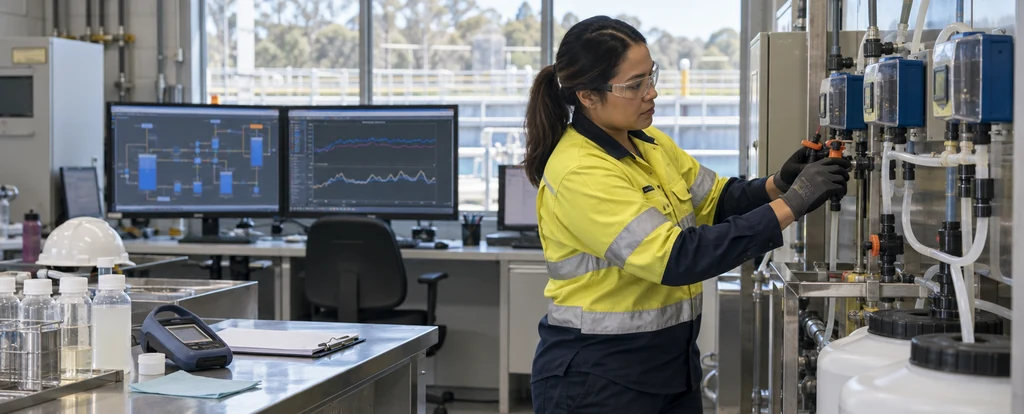
Water treatment operators work at plants and pump stations run by water utilities, local councils, mine sites and industrial facilities, on rosters that usually cover nights, weekends and public holidays. The job is the hands-on running of the process, adjusting dosing, filtration and disinfection as conditions change, while compliance staff check the results separately. Most people come into it through a traineeship and a Certificate III rather than a degree.
How much do water treatment operators earn?
The median full-time salary for a water treatment operator is $96,200 per annum, before tax, up $20,300 since 2018.
Rates are set mainly by the enterprise agreement covering the utility, council or site, so two operators doing similar work can be paid differently. Shift rosters, penalty rates, on-call allowances and remote or mine-site placements all push earnings above the base rate. Qualifications move pay as well, since a Certificate IV or diploma opens higher plant operator and coordinator classifications.
What does a water treatment operator do day to day?
The list below is what fills most weeks; the exact mix shifts with seniority and whatever stage the current work is at.
- Monitoring plant processes, flows and water quality readings through SCADA and control panels
- Adjusting chemical dosing, filtration and disinfection settings as demand and raw water quality change
- Collecting water and wastewater samples and running field and bench tests
- Operating, cleaning and maintaining pumps, valves, filters and dosing equipment
- Logging operational data and reporting faults or out-of-spec results to the shift supervisor
What skills do water treatment operators need?
Employers look for operations management, plant and equipment operation, worksite safety management, backed by SCADA fluency and strong problem solving.
Specialist skills
- Operations management
- Plant and equipment operation
- Worksite safety management
- Laboratory analysis
- Regulatory compliance
- Process improvement
- Data analysis
Software and tools
- SCADA
- HMI control systems
- Computerised maintenance management system (CMMS)
- Laboratory information management system (LIMS)
- Water quality testing instruments
General skills
- Problem solving
Is the job growing?
About 5,200 people work as water treatment operators in Australia, and employment is projected to grow 6.9% over the decade to 2035. That's modest growth: demand is steady rather than booming.
How do you become a water treatment operator?
Here's the path most water treatment operators take, step by step.
- 1Start as a trainee or plant assistant
Most operators learn the job on site, so utilities, councils and mine sites take on trainees and assistants who do rounds and sampling under supervision while working towards their qualification.
- 2Complete a Certificate III in Water Operations
This is the standard entry qualification, covering treatment processes, basic chemistry, disinfection and safety, and it usually takes one to two years part time while you are employed. About 54% of people working as water treatment operators hold a Certificate III or IV.
- 3Gather the licences and qualifications your site requires
Confined space entry, working at heights, chemical handling and a forklift licence are common requirements, and some states require specific certification before you can operate chlorination or fluoridation plant.
- 4Add a Certificate IV or diploma for senior roles
Further study in water operations or water industry operations leads to team leader, plant coordinator and process specialist positions, and many employers fund part of the cost.
Ready to apply as a water treatment operator?
Whether you're working toward becoming a water treatment operator or already are one and want a hand with the next step (sharpening your resume for ATS screening, tightening your cover letter, or knowing what you'll actually be asked at interview), here are examples grounded in this specific role, not generic templates.
What jobs can a water treatment operator move to?
Moving into Refinery Operator typically comes with the biggest pay rise, worth $87,500 a year more on average.
| Move to | Typical pay change | Overlap | Retraining |
|---|---|---|---|
| Refinery Operator Water treatment operators bring process control and plant monitoring skills to refinery operations, with short training in refinery-specific systems and safety.Known move | +$87,500 | 50% | short course |
| Gas Plant Operator Water treatment operators bring process control and plant monitoring skills to gas plant operations, with short training in gas-specific systems and safety.Known move | +$87,500 | 50% | short course |
| Power Station Operator Water treatment operators bring process control, monitoring and safety skills directly to power station operations, needing only familiarisation with different plant systems. | +$7,800 | 70% | minimal |
| Water Inspector Water treatment operators bring hands-on knowledge of treatment processes and water quality standards to inspection roles, though formal compliance training is needed.Known move | −$5,200 | 30% | reskill |
Moves are chosen from Jobs and Skills Australia's Data on Occupation Mobility, which follows income tax records between 2011-12 and 2020-21, together with entry requirements and skill overlap. A known move is one people were seen making in that data. Pay change compares median full-time pay for the two roles.
Who works as a water treatment operator?
The typical water treatment operator is 46 years old; 92% are men, 93% work full-time, and full-timers average 45 hours a week.
- 46
- Median age
- 8%
- Female share
- 93%
- Full-time
- +5h
- vs all-jobs avg
What's it like being a water treatment operator?
The work runs on a roster because plants operate around the clock and someone has to watch the readings overnight. Full-time operators average 45 hours a week, and a shift mixes routine rounds and testing with the occasional alarm or plant upset that needs a quick decision on dosing and flow. It suits people who are methodical, comfortable with machinery and basic chemistry, and happy to spend part of the day outdoors in a small crew.
What people like
- You can see the result. The water leaving the plant either meets the standard or it doesn't, and test results tell you within hours whether the adjustment you made worked.
- Technical variety. A week can take in chemistry, pumps and pipework, control systems and record keeping, so the job rarely stays in one lane.
- Training is usually paid for. Employers commonly fund further certificates and the site licences you need, which means you can build qualifications without leaving the job.
- Small crews, clear roles. Plants are staffed by small teams, so you know who is doing what and get to run your own section of the process rather than passing work along a chain.
What people find hard
- Shift work and public holidays. Rotating rosters include nights, weekends and Christmas, and the body clock takes time to settle into the pattern.
- Weather and confined spaces. Sample points, wet wells and filter galleries mean working outdoors in heat or rain, and sometimes in tight spaces with the associated safety controls.
- Compliance paperwork. Every adjustment, test and fault has to be logged, and audits expect the records to be complete and consistent.
- The consequences are public. If dosing drifts or a pump fails, the result is a water quality incident that reaches customers, so the job carries a real weight of care.
Based on our synthesis of professional-body surveys and public accounts of the role, not first-person verified reviews.
Which industries employ water treatment operators?
Electricity, Gas, Water and Waste Services employs the largest share of water treatment operators, followed by Public Administration and Safety.
Top employing industries
- 1Electricity, Gas, Water and Waste Services
- 2Public Administration and Safety
- 3Mining
Ranked by employment share; the source doesn't publish an exact percentage per industry.
| Certificate III/IV | 54.4% | |
|---|---|---|
| Year 12 or below | 22.6% | |
| Diploma / Advanced Diploma | 8.2% | |
| Bachelor degree | 8% | |
| Postgraduate | 3.1% |
Will AI replace water treatment operators?
Automation reaches this job through the control systems operators already use: SCADA, remote telemetry and increasingly predictive alarms do more of the watching than they used to. That shifts the work towards interpreting what the system reports and stepping in when it cannot respond, rather than turning valves for every adjustment. The physical side of sampling, maintenance and site work keeps the overall exposure moderate.
Share of typical working time by exposure level
- Plant monitoring and alarm responseTelemetry and SCADA flag most changes in flow and quality automatically, but an operator still decides whether a chlorine residual dip is a faulty sensor or a real drop.30%moderate
- Chemical dosing and process adjustmentsDosing is increasingly automated and tuned by software, though the operator sets the targets and takes manual control after heavy rain stirs up raw water quality.25%moderate
- Sampling and laboratory testingGrab samples, field meters and bench tests still need a person on site, especially to confirm a result when a control reading looks wrong.25%low
- Maintenance and plant roundsPumps, valves and filters need physical inspection, cleaning and repair, and no amount of monitoring replaces hands on the equipment.20%low
Common questions about becoming a water treatment operator
Straight answers to the questions people ask most.
How much does a water treatment operator earn?
Water treatment operators earn a median of $96,200 per year before tax. Shift penalties, on-call allowances and the enterprise agreement covering your site move that figure, and it is a full-time median, so part-time and entry-level roles can sit below it.
How do you become a water treatment operator?
The usual route is to get hired as a trainee or plant assistant and complete a Certificate III in Water Operations while you work. Employers look for reliability, comfort with machinery and enough maths and science to handle dosing calculations, and they pay for much of the training.
Are water treatment operators in demand?
Water treatment operators are currently not in shortage, and employment is projected to grow 6.9% over the decade to 2035. Plants run continuously and exist in almost every town, so vacancies come up across utilities, councils, mines and industrial sites rather than being concentrated in a few large employers.
Will AI and automation replace water treatment operators?
Parts of the job are already automated: SCADA and remote telemetry watch flows and quality continuously, and alarm systems are getting better at flagging unusual patterns. The physical work of sampling, calibrating instruments, cleaning filters and repairing pumps still needs someone on site, and so do the judgement calls when readings and reality don't match.
What other jobs can a water treatment operator move into?
Power station operation is a close match, since process control and monitoring carry across almost directly and median pay there is $7,800 more. Refinery and gas plant operations also suit operators willing to do a short course in site-specific systems and safety. Water inspector is another option for those who prefer the compliance side, though pay sits $5,200 less.
Do you need a degree to work in water treatment?
No. A Certificate III or IV is the standard qualification, and a bachelor degree is not usually asked for outside engineering or scientific roles. University study becomes relevant mainly if you later move into process engineering, water quality science or management.
Related roles
Not sure this is you? Take the career quiz and get a ranked shortlist of roles that fit how you like to work.