Power Station Operator
Power station operators run the boilers, turbines and generators that produce electricity, keeping supply steady for homes and businesses.
- Median salary*
- $104,000
3.8%vs last year, before tax
- People employed
- 2,200
0.0%vs last year
- Projected growth*
- −2%
to 2035
- AI exposure*
- Moderate
- automation risk
- Average hours*
- 42/wk
+2h vs all jobs
- Shortage status*
- Not in shortage
national
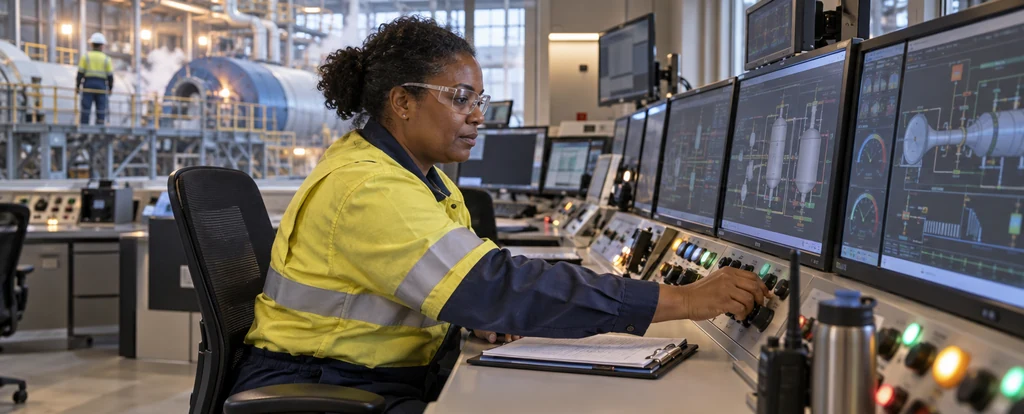
Power station operators work in a control room and out on the plant floor, running generating units through the day and night. They are the people who start units, match output to demand and work out what to do when an alarm goes off, which is a different job from the maintenance crews who service the equipment. Most work for electricity generators at coal, gas, hydro or battery sites, and shift rosters are the norm.
How much do power station operators earn?
The median full-time salary for a power station operator is $104,000 per annum, before tax, up $21,500 since 2018.
Pay is set mainly by enterprise agreements, which differ from one generator to the next, and shift loadings add a substantial amount on top of the base rate because so much of the work is outside ordinary hours. Operators at large coal, gas and hydro stations often earn more than those at smaller or newer renewable sites, and overtime during outages lifts earnings further.
What does a power station operator do day to day?
The list below is what fills most weeks; the exact mix shifts with seniority and whatever stage the current work is at.
- Monitoring boilers, turbines and generators from a central control room
- Adjusting controls to hold voltage, frequency and output within limits
- Starting up and shutting down plant, including bringing units back online after outages
- Walking plant rounds to check for leaks, vibration, hot bearings and unusual noise
- Isolating equipment, writing permits and handing plant safely to maintenance crews
What skills do power station operators need?
Employers look for operations management, plant and equipment operation, worksite safety management, backed by Distributed control systems (DCS) fluency and strong problem solving.
Specialist skills
- Operations management
- Plant and equipment operation
- Worksite safety management
- Regulatory compliance
- Process improvement
Software and tools
- Distributed control systems (DCS)
- SCADA
- Honeywell Experion
- Emerson DeltaV
- Siemens PLCs
General skills
- Problem solving
- Attention to detail
Is the job growing?
About 2,200 people work as power station operators in Australia, and employment is projected to decline 2% over the decade to 2035. That's a real decline, worth weighing carefully before training into the role.
How do you become a power station operator?
Here's the path most power station operators take, step by step.
- 1Finish Year 12 with maths and a science subject
Most entrants come through an apprenticeship or traineeship that assumes Year 12 maths, and physics or chemistry helps when you start learning the thermodynamics behind a boiler and turbine.
- 2Complete an engineering trade or a process plant qualification
A Certificate III in an electrical or mechanical trade, or a Certificate IV in process plant technology, is the usual base. Many operators also hold a diploma, which is useful later for shift supervision.
- 3Apply for a traineeship or cadetship with a generator
These are paid, on-the-job pathways of around two to four years and include training on the site's distributed control system and SCADA. Intakes are small, so applications often open well before the start date.
- 4Complete site competency assessments before operating unsupervised
Each plant requires you to demonstrate competence on its own equipment, and some tasks need a high risk work licence. Requirements vary by state and by site, so check with the employer.
Ready to apply as a power station operator?
Whether you're working toward becoming a power station operator or already are one and want a hand with the next step (sharpening your resume for ATS screening, tightening your cover letter, or knowing what you'll actually be asked at interview), here are examples grounded in this specific role, not generic templates.
What jobs can a power station operator move to?
Moving into Gas Plant Operator typically comes with the biggest pay rise, worth $79,700 a year more on average.
| Move to | Typical pay change | Overlap | Retraining |
|---|---|---|---|
| Gas Plant Operator Power station operators bring boiler, turbine and process control skills to gas plant operations, with minimal retraining. | +$79,700 | 70% | minimal |
| Refinery Operator Power station operators can apply process control and safety skills to refinery operations, though a short course is needed. | +$79,700 | 48% | short course |
| Chemical Plant Operator Power station operators can move into chemical plant operations, using process control skills and completing a short course. | +$2,600 | 58% | short course |
| Water Treatment Operator Power station operators bring water and steam system knowledge to water treatment, with minimal retraining. | −$7,800 | 70% | minimal |
Moves are chosen from Jobs and Skills Australia's Data on Occupation Mobility, which follows income tax records between 2011-12 and 2020-21, together with entry requirements and skill overlap. A known move is one people were seen making in that data. Pay change compares median full-time pay for the two roles.
Who works as a power station operator?
The typical power station operator is 49 years old; 97% are men, 94% work full-time, and full-timers average 42 hours a week.
- 49
- Median age
- 3%
- Female share
- 94%
- Full-time
- +2h
- vs all-jobs avg
What's it like being a power station operator?
The job runs on a roster, usually twelve-hour shifts covering days, nights, weekends and public holidays, with blocks of days off in between. Long stretches of steady monitoring are broken by load changes, outages and faults that need quick, careful decisions, and a mistake with an isolation can hurt someone. It suits people who like technical systems, are comfortable working nights, and would rather understand a plant deeply than move between projects.
What people like
- You can see what your shift produced. Output, efficiency and emissions are measured continuously, so the end of a shift gives you a clear read on how the unit ran and what you did about the problems that came up.
- The control room rewards calm judgement. You learn the plant as a system, and much of the skill is noticing a slow drift in a reading before it becomes a trip, then explaining to the next shift what changed.
- The work is both technical and hands-on. A shift can move from reading trends on a screen to walking the plant with a torch, which suits people who don't want to spend the whole day at a desk.
- The roster buys whole days off. Twelve-hour shifts compress the working week, so a rotating roster usually delivers consecutive days off that a standard Monday to Friday job doesn't.
What people find hard
- Shift work wears on ordinary life. Nights, weekends, public holidays and rotating rosters make regular commitments hard, and the first day after a run of night shifts is mostly lost to sleep.
- The generation mix is changing. Coal closures mean some operators face relocation, retraining or a move into gas, hydro, batteries or water treatment, and that uncertainty sits over the job even when your own plant has years left.
- Long shifts leave little room for error. Twelve hours of monitoring plant that runs at high pressure and temperature means the consequences of a missed isolation or a wrong valve are serious.
- Quiet hours can turn in seconds. Much of a shift is routine reading and logging, then an alarm or a unit trip demands immediate action and a clear handover to the incoming crew.
Based on our synthesis of professional-body surveys and public accounts of the role, not first-person verified reviews.
Which industries employ power station operators?
Electricity, Gas, Water and Waste Services employs the largest share of power station operators, followed by Manufacturing.
Top employing industries
- 1Electricity, Gas, Water and Waste Services
- 2Manufacturing
- 3Mining
- 4Construction
- 5Professional, Scientific and Technical Services
Ranked by employment share; the source doesn't publish an exact percentage per industry.
| Certificate III/IV | 34% | |
|---|---|---|
| Diploma / Advanced Diploma | 26% | |
| Bachelor degree | 20% | |
| Year 12 or below | 20% |
Will AI replace power station operators?
This is a moderately exposed job. The control systems that run a modern station already handle routine load following, and plant analytics pick up failing bearings and drifting temperatures earlier than an operator on rounds would. What holds the exposure back is that the equipment is physical: stopping, isolating and restarting it, and judging whether an odd reading is a sensor fault or a real problem, still comes down to the person on shift.
Share of typical working time by exposure level
- Control room monitoring and alarm responseSystems such as Honeywell Experion and Emerson DeltaV flag deviations and suggest setpoints, but the operator still decides whether a high temperature is a failing instrument or a genuine problem.30%moderate
- Plant rounds and equipment checksWalking the plant to check for steam leaks, vibration, hot bearings and unusual noise is physical work that fixed sensors only partly cover.30%low
- Load changes, start-ups and shutdownsDispatch is increasingly automated and battery or gas units can ramp without anyone touching a control, though large coal and hydro units still need a person to walk the start-up sequence.20%high
- Isolations, permits and fault findingShutting down, isolating and tagging equipment before maintenance, then tracing why a pump tripped, needs someone on site who knows how that plant behaves.20%low
Common questions about becoming a power station operator
Straight answers to the questions people ask most.
How much do power station operators earn?
Full-time power station operators earn a median of $104,000 per year before tax. Shift loadings and enterprise agreements usually push actual earnings above that median, so treat it as a starting point rather than a fixed rate.
How do you become a power station operator?
Most people enter through a paid traineeship or apprenticeship with a generator, usually after finishing Year 12 with maths and a science. An electrical or mechanical trade or a Certificate IV in process plant technology is the common qualification, followed by site-specific competency assessments before you operate plant on your own.
Are power station operators in demand?
Power station operators are currently not in shortage, and employment is projected to decline 2% over the decade to 2035 over the decade to 2035. With about 2,200 people in the role nationally, most openings come from retirements and replacements rather than new plants, so a willingness to move to where the remaining stations are helps.
Will AI and automation replace power station operators?
Not entirely, but the role is moderately exposed. Control systems handle more of the routine load following and analytics flag equipment problems earlier, while plant rounds, isolations, permits and working out why a pump tripped still need someone on site.
What can power station operators move into?
Gas plant operating is a close fit, since boiler, turbine and process control skills carry across with minimal retraining, and the pay difference is $79,700 more. Water treatment is another, drawing on steam and water system knowledge with a difference of $7,800 less, and chemical plant operating needs only a short course.
What are the hours like?
Full-time operators average 42 hours a week, worked mainly as twelve-hour shifts on a rotating roster covering days, nights, weekends and public holidays. Shift loadings compensate for the unsocial hours, and rosters are usually set well in advance so you can plan around them.
Related roles
- Gas Plant Operator
- Water Treatment Operator
- Chemical Plant Operator
- Refinery Operator
- Boiler Operator
- Water Treatment Operator
Not sure this is you? Take the career quiz and get a ranked shortlist of roles that fit how you like to work.