Home Manufacturing & Production
Boiler Operator
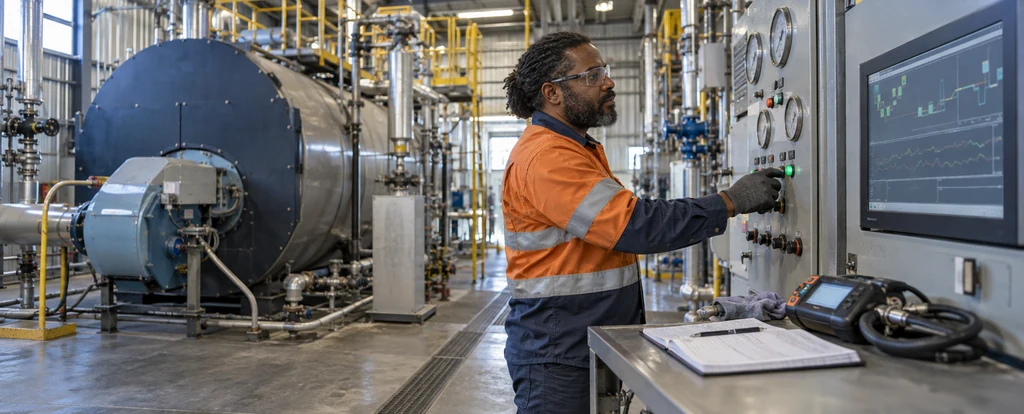
Boiler operators run the boilers and auxiliary plant that produce steam and hot water for industrial processes, heating and power.
- Median salary*
- $92,600
3.6%vs last year, before tax
- People employed
- 540
8.0%vs last year
- Projected growth
- +6.9%
to 2035
- AI exposure*
- Moderate
- automation risk
- Average hours
- 48/wk
+8h vs all jobs
- Shortage status
- Not in shortage
national
Boiler operators work in manufacturing plants, food processing sites, hospitals and utilities, wherever steam drives a process or heats a building. The job is plant operation rather than maintenance: operators run and adjust the boilers, feedwater systems, pumps and valves, while fitters and boilermakers carry out repairs. Much of the day happens at a control panel or on rounds, reading trends and making small corrections.
How much do boiler operators earn?
The median full-time salary for a boiler operator is $92,600 per annum, before tax, up $19,800 since 2018.
The roster moves pay as much as the job does: rotating shifts, overtime and public holidays attract penalty rates that lift total earnings well above the base rate. Resources sites and heavy manufacturing usually pay more than hospitals and food processing. The class of boiler you are certified to operate matters too, since higher-pressure and larger plant carries more responsibility, and enterprise agreements set most rates.
What does a boiler operator do day to day?
The list below is what fills most weeks; the exact mix shifts with seniority and whatever stage the current work is at.
- Monitoring boiler pressure, temperature and water levels on control panels and local gauges
- Adjusting fuel, air and water flows to hold combustion steady as steam demand changes
- Testing and dosing feedwater and condensate to prevent scale and corrosion in the tubes
- Starting up, shutting down and isolating boilers, pumps and valves for maintenance
- Logging readings through the shift and handing over the plant, because the next operator needs to know what changed
What skills do boiler operators need?
Employers look for operations management, plant and equipment operation, installation and maintenance, backed by Distributed control systems (DCS) fluency and strong safety and compliance awareness.
Specialist skills
- Operations management
- Plant and equipment operation
- Installation and maintenance
- Worksite safety management
- Process improvement
Software and tools
- Distributed control systems (DCS)
- SCADA
- Boiler management systems
- Computerised maintenance management systems (CMMS)
- Flue gas analysers
General skills
- Safety and compliance awareness
- Problem solving
- Attention to detail
Is the job growing?
About 540 people work as boiler operators in Australia, and employment is projected to grow 6.9% over the decade to 2035. That's modest growth: demand is steady rather than booming.
How do you become a boiler operator?
Here's the path most boiler operators take, step by step.
- 1Finish Year 12 or an equivalent
Formal entry requirements vary, and plenty of operators come in with Year 12 or below and learn the plant on the job. Maths and a physical science subject help with the chemistry, instrumentation and calculations you meet later.
- 2Start in a boiler house or process plant
Most operators begin as plant, process or utility operators and learn under supervision, building up logbook hours and competencies as they go. Traineeships in process manufacturing are one recognised route in.
- 3Complete a Certificate III in Process Plant Operations
This covers process control, isolation and permitting, and plant safety, and it is the qualification most operators hold. It can be done as a traineeship or as a course alongside work.
- 4Get the boiler certificate of competency for your state
Operating a boiler above a set pressure requires a certificate of competency from the state work health and safety regulator, and the certificate class matches the boiler's size and pressure. Requirements differ between states, so check the current rule with your regulator before you enrol in training.
- 5Build experience and keep your competencies current
Moving between fuel types, larger boilers and control room roles is how operators take on more responsibility, and that range of experience opens senior operator and shift supervisor positions. Refresher training and reassessment are part of holding the certificate, so book them around the roster rather than leaving them to lapse.
Ready to apply as a boiler operator?
Whether you're working toward becoming a boiler operator or already are one and want a hand with the next step (sharpening your resume for ATS screening, tightening your cover letter, or knowing what you'll actually be asked at interview), here are examples grounded in this specific role, not generic templates.
What jobs can a boiler operator move to?
Moving into Gas Plant Operator typically comes with the biggest pay rise, worth $91,100 a year more on average.
| Move to | Typical pay change | Overlap | Retraining |
|---|---|---|---|
| Gas Plant Operator Boiler operators can apply their process operations background to gas plant operation after a short course. | +$91,100 | 46% | short course |
| Chemical Plant Operator Boiler operators understand industrial process heating and can apply that to chemical plant operation with minimal retraining. | +$14,000 | 63% | minimal |
| Railway Track Machine Operator Boiler operators bring heavy plant and monitoring skills to railway track machine operation, requiring a short course. | +$14,000 | 79% | short course |
| Power Station Operator Boiler operators bring steam plant and process control experience to power station operation with minimal retraining. | +$11,400 | 67% | minimal |
| Water Treatment Operator Boiler operators bring plant monitoring and process control skills to water treatment, needing a short course. | +$3,600 | 48% | short course |
Moves are chosen from Jobs and Skills Australia's Data on Occupation Mobility, which follows income tax records between 2011-12 and 2020-21, together with entry requirements and skill overlap. A known move is one people were seen making in that data. Pay change compares median full-time pay for the two roles.
Who works as a boiler operator?
The typical boiler operator is 50 years old; 98% are men, 94% work full-time, and full-timers average 48 hours a week.
- 50
- Median age
- 2%
- Female share
- 94%
- Full-time
- +8h
- vs all-jobs avg
What's it like being a boiler operator?
Boiler operation is a shift job with a steady rhythm and the occasional spike: rounds, readings and small adjustments for most of the shift, then a rush when a burner trips or steam demand jumps. The skill is noticing drift early, so the work suits someone methodical who is comfortable with instruments and happy to spend long stretches without much company. Rosters usually run around the clock, including nights and weekends.
What people like
- The plant tells you how you are going. Pressure, level and steam flow respond as soon as you change something, so a good decision shows up on the trend within minutes.
- Defined procedures and clear rules. Startups, shutdowns and isolations follow written sequences, which suits people who like knowing exactly what the next step is.
- Quiet autonomy on shift. Beyond a small crew you are the person responsible for the plant, and a lot of the shift is yours to organise.
- Skills that carry across industries. Food processing, hospitals, mining and power generation all run boilers, so the certificate and experience move with you.
What people find hard
- Shift work takes it out of you. Rosters usually cover nights, weekends and public holidays, and the body clock never quite settles.
- Long quiet stretches. Between demand changes and faults, a large part of the shift is watching trends that are not moving much.
- Mistakes carry real consequences. Steam and hot water under pressure can injure or kill, so the level of care does not switch off when the plant is running smoothly.
- Logs, permits and water treatment records. Compliance paperwork has grown, and most of it is completed by the operator on shift rather than by a separate team.
Based on our synthesis of professional-body surveys and public accounts of the role, not first-person verified reviews.
Which industries employ boiler operators?
Manufacturing employs the largest share of boiler operators, followed by Mining.
Top employing industries
- 1Manufacturing
- 2Mining
- 3Agriculture, Forestry and Fishing
Ranked by employment share; the source doesn't publish an exact percentage per industry.
| Certificate III/IV | 45.6% | |
|---|---|---|
| Year 12 or below | 37% | |
| Diploma / Advanced Diploma | 5% | |
| Bachelor degree | 2.8% | |
| Postgraduate | 0% |
Will AI replace boiler operators?
Boiler operation sits in the middle range for automation. Distributed control systems and SCADA already hold most combustion, drum level and feedwater loops automatically, and large sites lean on them heavily. What remains with the operator is the judgement around them: picking up a trend that does not look right, managing water chemistry, and physically taking plant in and out of service.
Share of typical working time by exposure level
- Watching and adjusting the plant from the control roomThe DCS holds combustion and drum level at setpoint, so much of this is reading trends and stepping in when a loop drifts.30%high
- Starting up, shutting down and isolating plant for maintenanceBringing a boiler on line or taking it out of service means physical valve work, permit coordination and safety checks that automation cannot complete.30%low
- Testing and dosing feedwater and condensateAnalysers and automatic dosing handle routine control, but interpreting results and deciding on blowdown still sits with the operator.20%moderate
- Rounds, readings and shift handoverSome readings log themselves, but an operator still walks the plant to check for leaks, unusual noise and hot spots.20%moderate
Moves least exposed to AI
These career moves from boiler operator work are rated low for AI exposure:
- Railway Track Machine Operator
High skill overlap (79%), short course to get there, and a low automation-risk profile.
Common questions about becoming a boiler operator
Straight answers to the questions people ask most.
How much do boiler operators earn?
$92,600 per year before tax for full-time boiler operators. Shift penalties, overtime and the industry you work in change that figure more than experience does, so treat it as a midpoint rather than a rate for any one site.
How do you become a boiler operator?
Most operators start in a process plant or utility role, learn the boilers under supervision and complete a Certificate III in Process Plant Operations (PMA30120) along the way. If you will be operating plant above a set pressure, you also need a certificate of competency from your state's work health and safety regulator.
Are boiler operators in demand?
Boiler operators are currently not in shortage, and employment is projected to grow 6.9% over the decade to 2035. The workforce is small, about 540 people, so openings tend to come from operators retiring or moving into other plant roles.
Will AI or automation replace boiler operators?
Not the whole job. Control systems already hold combustion and drum level automatically in most plants, which shifts the operator's work towards investigating faults, managing water chemistry and taking plant in and out of service.
What jobs can a boiler operator move into?
Power station operation uses the same steam plant and control room skills with minimal retraining, and pays $11,400 more. Chemical plant operation draws on the same industrial process heating background at $14,000 more, while water treatment takes the monitoring side of the work and needs a short course, paying $3,600 more.
Do you need a licence to operate a boiler?
In most states you do once the boiler runs above a set pressure, and the work health and safety regulator issues certificates of competency by boiler class. The thresholds and classes differ between states, so confirm the requirement with your own regulator.
Related roles
- Power Station Operator
- Chemical Plant Operator
- Water Treatment Operator
- Gas Plant Operator
- Railway Track Machine Operator
- Machine Operator
Not sure this is you? Take the career quiz and get a ranked shortlist of roles that fit how you like to work.