Railway Track Machine Operator
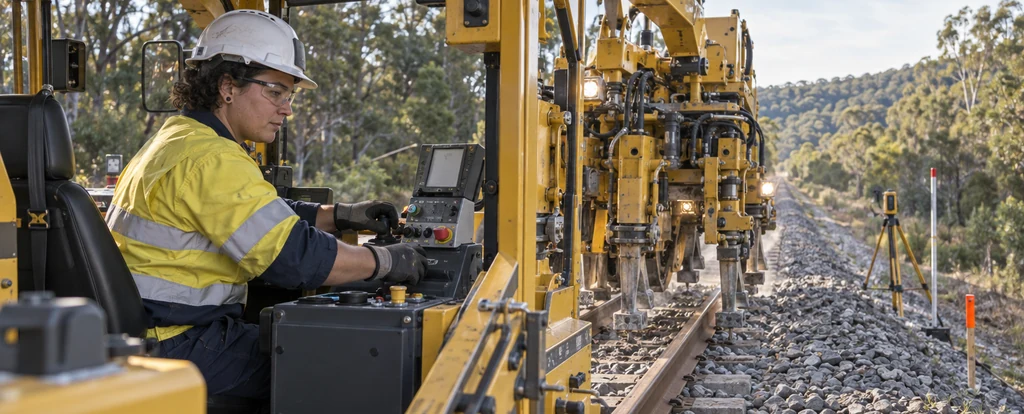
Railway track machine operators drive the heavy on-track plant that tamps, levels and renews rail track, keeping freight and passenger lines safe and running to schedule.
- Median salary*
- $106,600
3.6%vs last year, before tax
- People employed
- 390
2.5%vs last year
- Projected growth
- +3.7%
to 2035
- AI exposure*
- Low
- automation risk
- Average hours
- 44/wk
+4h vs all jobs
- Shortage status
- Not in shortage
national
Railway track machine operators work on live rail corridors, usually during night or weekend possessions when the line is closed to traffic, for rail infrastructure managers and specialist track contractors. Their job sits apart from the track workers alongside them: the crew handles components and tools, while the operator runs the machine and answers for the finished geometry. A tamper, for example, lifts the track, packs ballast under the sleepers and leaves the alignment within a few millimetres of the survey.
How much do railway track machine operators earn?
The median full-time salary for a railway track machine operator is $106,600 per annum, before tax, up $22,700 since 2018.
Pay is set mainly by the enterprise agreement covering the network or contractor you work for, so it moves when you change employers or cross into another state's rail system. Night and weekend possession work usually attracts shift penalties and overtime, and operators who hold more machine classes or take remote projects with camp accommodation tend to earn more.
What does a railway track machine operator do day to day?
The list below is what fills most weeks; the exact mix shifts with seniority and whatever stage the current work is at.
- Operating ballast tampers, regulators and stabilisers to align, level and compact track
- Setting machine parameters from track geometry data, work plans and survey marks
- Carrying out pre-start checks, refuelling and routine servicing of on-track plant
- Working within rail corridor protection, lookout and safe working rules
- Recording completed work, machine faults and track defects for maintenance supervisors
What skills do railway track machine operators need?
Employers look for plant and equipment operation, worksite safety management, installation and maintenance, backed by Ballast tamper onboard control systems fluency and strong safety and compliance awareness.
Specialist skills
- Plant and equipment operation
- Worksite safety management
- Installation and maintenance
- Operations management
Software and tools
- Ballast tamper onboard control systems
- Trimble GEDO track survey software
- SAP Plant Maintenance (PM)
- Hi-rail excavator control systems
- Track geometry recording systems
General skills
- Safety and compliance awareness
- Attention to detail
- Problem solving
- Time and deadline management
Is the job growing?
About 390 people work as railway track machine operators in Australia, and employment is projected to grow 3.7% over the decade to 2035. That's modest growth: demand is steady rather than booming.
How do you become a railway track machine operator?
Here's the path most railway track machine operators take, step by step.
- 1Start on a track crew
Most operators come up through a track renewal or maintenance crew, where they learn safe working rules, how a possession runs and how track is built before they touch a machine. Employers usually want six to twelve months of corridor experience first, and that time is paid.
- 2Complete a Certificate II or III in Rail Infrastructure
TAFE and registered training organisations deliver these, often part time while you work, and they cover track components, geometry and the hand tools used on site. A Certificate II is the common entry point, while a Certificate III suits people heading into machine or leading hand roles.
- 3Get your rail safety worker competency
You need a Rail Industry Worker (RIW) card and the safe working competency for the corridor you work on, renewed at set intervals. Rules differ between networks and states, so a competency held for one operator does not automatically cover another.
- 4Train on each machine class with your employer
Competency is assessed machine by machine, from tampers and regulators through to ballast cleaners, and signed off by a qualified assessor once you can run the plant unsupervised. Each extra class widens the work you can be rostered on.
- 5Or move across from heavy plant
Experienced earthmoving plant operators already have the machine control and site safety habits, and can pick up rail standards and corridor rules on the job. Some employers run bridging training for people making that move.
Ready to apply as a railway track machine operator?
Whether you're working toward becoming a railway track machine operator or already are one and want a hand with the next step (sharpening your resume for ATS screening, tightening your cover letter, or knowing what you'll actually be asked at interview), here are examples grounded in this specific role, not generic templates.
What jobs can a railway track machine operator move to?
Moving into Train Driver typically comes with the biggest pay rise, worth $49,500 a year more on average.
| Move to | Typical pay change | Overlap | Retraining |
|---|---|---|---|
| Train Driver Rail experience and track knowledge carry into train driving, though formal driver training and certification are required.Known move | +$49,500 | 26% | reskill |
| Crusher Operator Heavy machinery experience applies to crushing plant, with a short course for crusher operation, screening and materials handling. | +$13,000 | 82% | short course |
| Earthmoving Plant Operator Heavy plant skills transfer to earthmoving machinery, with retraining for earthmoving tickets, site conditions and different equipment.Known move | −$3,600 | 45% | reskill |
| Concrete Pump Operator Operating heavy plant translates to concrete pumping, with a short course covering pump setup, boom control and concrete placement. | −$15,600 | 94% | short course |
| Machine Operator Machine control and safety experience transfer to production machinery, though retraining is needed for manufacturing processes and equipment.Known move | −$25,800 | 41% | reskill |
Moves are chosen from Jobs and Skills Australia's Data on Occupation Mobility, which follows income tax records between 2011-12 and 2020-21, together with entry requirements and skill overlap. A known move is one people were seen making in that data. Pay change compares median full-time pay for the two roles.
Who works as a railway track machine operator?
The typical railway track machine operator is 41 years old; 97% are men, 90% work full-time, and full-timers average 44 hours a week.
- 41
- Median age
- 3%
- Female share
- 90%
- Full-time
- +4h
- vs all-jobs avg
What's it like being a railway track machine operator?
The rhythm of the job follows the possession: a short window, a firm deadline and a line that has to be handed back to traffic on time. Operators spend long shifts in a cab in all weathers, often at night and away from home, which suits people who like machinery, a clear task and a crew that knows its job. The pressure comes from small margins, because a missed measurement or a machine that breaks down can hold up the whole possession.
What people like
- You can see the result by the end of the shift. The track goes back into service at the geometry you set, and the next train over it confirms the work straight away.
- The machine does the heavy work. Tamping, lifting and lining are done from the cab, so the job is about control and measurement rather than swinging a shovel.
- Small crews with a clear task. A possession crew is compact and everyone has a defined role, which means you know your workmates and what is expected of you each shift.
- Possession rosters break up the week. Night and weekend work is the norm, but it often comes with rostered days off or blocks of leave between major projects.
What people find hard
- Night shifts and time away from home. Most track possessions are scheduled overnight or on weekends, and remote renewal projects can mean weeks in camp away from family.
- Heat, rain and ballast dust. Pre-starts, fault finding and repairs happen outside the cab in whatever the weather is doing, and ballast work is dusty and hard on the lungs and eyes.
- Waiting when the possession slips. Sign-on delays, other trades running late or a shortened window can leave the machine sitting idle while the clock runs down.
- Recertification and reporting. Machine competencies need renewing, and pre-start records, fault logs and defect reports all have to be completed before the shift ends.
Based on our synthesis of professional-body surveys and public accounts of the role, not first-person verified reviews.
Which industries employ railway track machine operators?
Construction employs the largest share of railway track machine operators, followed by Transport, Postal and Warehousing.
Top employing industries
- 1Construction
- 2Transport, Postal and Warehousing
- 3Manufacturing
Ranked by employment share; the source doesn't publish an exact percentage per industry.
| Year 12 or below | 49.1% | |
|---|---|---|
| Certificate III/IV | 37.8% | |
| Diploma / Advanced Diploma | 5.7% | |
| Bachelor degree | 3.1% | |
| Postgraduate | 1.8% |
Will AI replace railway track machine operators?
Track machine operation has low exposure to AI overall. On-track plant already uses automated tamping and lining control and track geometry recording systems to measure the finished work, but the machine still has to be set up for the ground conditions, driven through the possession and handed back safely. That setup and the read on what the track and ballast are actually doing stays with the operator.
Share of typical working time by exposure level
- Running the machine through the possessionTaking manual control where the ground is uneven, watching for obstructions and keeping the machine inside the possession limits.35%low
- Pre-start checks and servicingChecking hydraulics, fluids and bolts, refuelling and greasing, and clearing faults before the machine goes back on the track.25%low
- Setting up the machine for the jobReading the work plan and survey marks, entering the design geometry and choosing the tamping mode before the first pass.20%moderate
- Recording work and reporting defectsLogging completed metres, machine faults and track defects in systems such as SAP so the maintenance planner can schedule follow-up work.20%moderate
Common questions about becoming a railway track machine operator
Straight answers to the questions people ask most.
How much does a railway track machine operator earn?
Full-time railway track machine operators earn a median of $106,600 per year before tax. What you take home depends on the enterprise agreement covering your employer, the machine classes you hold and how much penalty-rate night and weekend work you pick up.
How do you become a railway track machine operator?
Most people start as a railway track worker or labourer on a renewal crew, then complete a Certificate II or III in Rail Infrastructure and build machine competencies with their employer. You also need an RIW card and the safe working competency for the corridor you work on.
Are railway track machine operators in demand?
Railway track machine operators are currently not in shortage, and employment is projected to grow 3.7% over the decade to 2035. The work follows track renewal and maintenance programs, so vacancies tend to appear when a network or contractor starts a major project rather than steadily through the year.
Will AI take over track machine operation?
Not much of it. Automated tamping control and track geometry recording systems already handle the measuring and much of the lining, but someone still has to set the machine up for the ground conditions, drive it through the possession and hand the track back safely.
What else can a railway track machine operator do?
One route out is train driving, which uses the same corridor knowledge and rail safety habits, though you need formal driver training and certification, and train drivers earn $49,500 more. Concrete pumping is close work with a similar machine, with 94% overlap in skills, and some operators move into earthmoving plant, where pay is $3,600 less.
What hours do railway track machine operators work?
Full-time operators average about 44 hours a week, and about 90% of them work full time. Shifts are built around track possessions, so nights, weekends and public holidays are common, with time off rostered between projects.
Related roles
- Train Driver
- Earthmoving Plant Operator
- Machine Operator
- Concrete Pump Operator
- Crusher Operator
- Railway Track Worker
Not sure this is you? Take the career quiz and get a ranked shortlist of roles that fit how you like to work.