Home Manufacturing & Production
Slaughterer
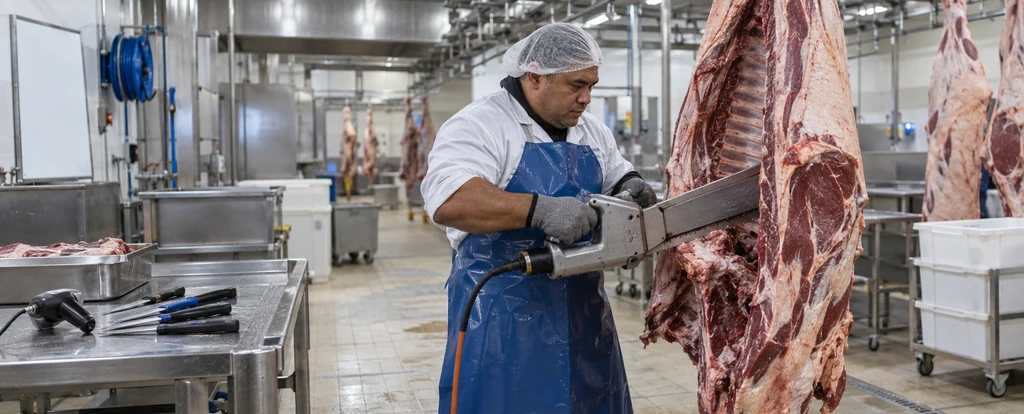
Slaughterers kill and process livestock in abattoirs and meat processing plants, preparing carcasses for the meat trade.
- Median salary*
- $62,400
4.3%vs last year, before tax
- People employed
- 1,800
0.0%vs last year
- Projected growth
- −3.4%
to 2035
- AI exposure*
- Moderate
- automation risk
- Average hours
- 40/wk
matches all-jobs average
- Shortage status
- Not in shortage
national
Nearly all of the work happens on the kill floor of an abattoir or processing plant, where animals are stunned, bled, skinned and eviscerated in a set sequence and at a pace set by the chain. It is a different job from butchery, which breaks down and prepares meat for sale, and from meat inspection, which checks the result. Most slaughterers work for large meat processing companies in teams of a dozen or more along a line.
How much do slaughterers earn?
The median full-time salary for a slaughterer is $62,400 per annum, before tax, up $13,200 since 2018.
Pay on a kill floor is usually set by an enterprise agreement covering the plant, so your classification and the site you work at matter more than the job title. Shift loadings, overtime and public holiday work add to base earnings. Skills that take longer to learn, such as stunning or precision knife work, usually sit at a higher classification than general labouring on the line.
What does a slaughterer do day to day?
The list below is what fills most weeks; the exact mix shifts with seniority and whatever stage the current work is at.
- Stunning animals using the plant's approved method and restraint equipment
- Bleeding and skinning carcasses as they move along the chain
- Eviscerating carcasses and separating offal for inspection
- Sharpening and cleaning knives through the shift and keeping the kill floor to hygiene standards
- Scanning carcass tags and recording the day's kill numbers
What skills do slaughterers need?
Employers look for food safety and hygiene, hand and power tool work, plant and equipment operation, backed by Stunning gun fluency and strong attention to detail.
Specialist skills
- Food safety and hygiene
- Hand and power tool work
- Plant and equipment operation
- Cleaning and grounds maintenance
Software and tools
- Stunning gun
- Carcass splitting saw
- Meat hooks
- Knives and steels
- Barcode scanner
General skills
- Attention to detail
- Physical stamina and dexterity
- Safety and compliance awareness
Is the job growing?
About 1,800 people work as slaughterers in Australia, and employment is projected to decline 3.4% over the decade to 2035. That's a real decline, worth weighing carefully before training into the role.
How do you become a slaughterer?
Here's the path most slaughterers take, step by step.
- 1Apply for an entry-level job at a processing plant
No formal qualification is usually required: 59% of slaughterers hold a Year 12 qualification or below. Plants take on labouring and kill floor assistant roles and train new starters on site.
- 2Complete the plant's induction and food safety training
You learn hygienic work practices, animal welfare requirements, personal safety and knife handling before you work on the chain, and some plants ask for a food safety certificate as well.
- 3Learn the kill floor sequence under supervision
Most people start at one station, such as hock removal or offal handling, then move towards stunning, bleeding and evisceration as their knife skills and speed build over the first year or two.
- 4Add a Certificate III in Meat Processing if you plan to stay
A Certificate III with a slaughtering stream is offered by some registered training organisations, and some employers support staff through it. It helps if you want to move into a leading hand role or towards meat inspection, which needs further study.
Ready to apply as a slaughterer?
Whether you're working toward becoming a slaughterer or already are one and want a hand with the next step (sharpening your resume for ATS screening, tightening your cover letter, or knowing what you'll actually be asked at interview), here are examples grounded in this specific role, not generic templates.
What jobs can a slaughterer move to?
Moving into Butcher typically comes with the biggest pay rise, worth $18,200 a year more on average.
| Move to | Typical pay change | Overlap | Retraining |
|---|---|---|---|
| Butcher Slaughterers can become butchers, using their meat knowledge in a trade that requires a butcher apprenticeship.Known move | +$18,200 | 47% | requalify |
| Meat Inspector Slaughterers can move into meat inspection, where their processing experience supports quality and safety checks after further study.Known move | +$14,600 | 8% | reskill |
| Meat Process Worker Slaughterers move into broader meat processing work, applying their kill floor and hygiene skills with little retraining.Known move | +$2,300 | 100% | minimal |
| Meat Boner and Slicer Slaughterers bring carcass knowledge and knife skills to meat boner and slicer roles on the same processing floor.Known move | −$2,600 | 80% | minimal |
Moves are chosen from Jobs and Skills Australia's Data on Occupation Mobility, which follows income tax records between 2011-12 and 2020-21, together with entry requirements and skill overlap. A known move is one people were seen making in that data. Pay change compares median full-time pay for the two roles.
Who works as a slaughterer?
The typical slaughterer is 35 years old; 95% are men, 80% work full-time, and full-timers average 40 hours a week.
- 35
- Median age
- 5%
- Female share
- 80%
- Full-time
- +0h
- vs all-jobs avg
What's it like being a slaughterer?
The job runs to the rhythm of the chain: animals come through at a steady rate, each person works their station, and the shift ends when the day's kill is done. It suits people who like physical work with a clear finish and don't mind cold rooms, repetition or early starts. The pressure comes from keeping pace and holding hygiene and welfare standards while your hands are doing skilled work.
What people like
- Knife skills that improve quickly. New starters are visibly better at breaking down a carcass after a few months, and the more skilled stations carry more responsibility and better classification.
- Clear teamwork on the chain. Everyone on the line depends on the person before them, so the work is social in a practical way and you always know what is expected of you.
- Work that ends when the shift ends. Knives, hooks and gear stay at the plant, and there is no paperwork or client contact to take home.
- A trade you can enter without a degree. Plants train people from scratch, so the pathway in is short compared with occupations that need years of study.
What people find hard
- Cold rooms and long stretches on your feet. Shifts are spent standing on hard floors in chilled areas, and the physical load accumulates over a week.
- The repetition of the chain. You make the same cuts in the same order hundreds of times a shift, which is hard on wrists, shoulders and concentration.
- Early starts and shift rosters. Processing plants often begin before dawn and run shifts, so your hours are set by the roster rather than by you.
- The work is misunderstood outside the industry. Kill floor work carries strict animal welfare and hygiene rules and regular inspection, but people outside meat processing often have a different picture of what the job involves.
Based on our synthesis of professional-body surveys and public accounts of the role, not first-person verified reviews.
Which industries employ slaughterers?
Manufacturing employs the largest share of slaughterers.
Top employing industries
- 1Manufacturing
Ranked by employment share; the source doesn't publish an exact percentage per industry.
| Year 12 or below | 59.1% | |
|---|---|---|
| Certificate III/IV | 21.8% | |
| Bachelor degree | 5.5% | |
| Diploma / Advanced Diploma | 2.1% | |
| Postgraduate | 0.8% |
Will AI replace slaughterers?
Automation has made inroads into parts of this job but not into the middle of it, which is why exposure sits at moderate. Mechanical stunning and restraint systems, barcode scanning and kill floor data systems are standard in larger plants, and they reduce some manual handling and paperwork. The knife work, carcass handling and animal welfare judgement on the chain are still done by hand.
Share of typical working time by exposure level
- Bleeding, skinning and eviscerating carcassesHand knives and hooks remain central because carcass size, fat cover and bruising vary from animal to animal.40%low
- Stunning and restraining animalsPowered restraint equipment and captive bolt or electrical stunning units reduce the physical effort, but someone still has to position the animal and confirm the stun worked before the chain moves on.20%low
- Hygiene, welfare and quality checks on the lineCameras and sensors increasingly flag contamination or welfare problems, though a person still inspects the carcass and decides what happens to it.20%moderate
- Recording kill numbers and carcass detailsBarcode scanners and plant management software now capture most of the figures that used to be written up on the floor.20%high
Common questions about becoming a slaughterer
Straight answers to the questions people ask most.
How much does a slaughterer earn?
A slaughterer's median pay is $62,400 per year before tax. Enterprise agreements, shift loadings and overtime move that figure, and plants with more skilled kill floor classifications generally pay above the base rate.
How do you become a slaughterer?
Most people start with an entry-level job at a meat processing plant and learn on the job, since no formal qualification is required to begin. The plant trains you in hygiene, animal welfare and knife work, and a Certificate III in Meat Processing (AMP30622) is an option once you decide to stay in the trade.
Are slaughterers in demand?
Slaughterers are currently not in shortage, and employment is projected to decline 3.4% over the decade to 2035. Most openings come from experienced workers leaving the trade rather than from new positions, so it helps to look at the plants hiring in your area and to ask about training on offer.
Will AI or automation replace slaughterers?
Automation has reached parts of the job but not the middle of it. Mechanical stunning, restraint systems and carcass tracking software are standard in larger plants and cut some manual handling and paperwork. The knife work and animal handling stay with people, because carcasses vary too much from animal to animal for machines to take over.
What can a slaughterer move on to?
Most moves stay on the processing floor: meat boner and slicer work uses the same knife skills and hand-eye work ($2,600 less), and broader meat process worker roles need little retraining ($2,300 more). Butchery is a larger step that requires a trade apprenticeship and pays $18,200 more, while meat inspection suits people who would rather check carcasses than cut them and needs further study.
What are the hours like?
Full-time slaughterers average 40 hours a week, usually on shift rosters with early starts and overtime when the plant is busy. Processing runs to a daily schedule, so the pace and finish time depend on how many animals are on the kill that day.
Related roles
- Meat Boner and Slicer
- Meat Process Worker
- Butcher
- Meat Inspector
- Meat Process Worker
- Meat Boner and Slicer
Not sure this is you? Take the career quiz and get a ranked shortlist of roles that fit how you like to work.