Home Manufacturing & Production
Stone Machine Operator
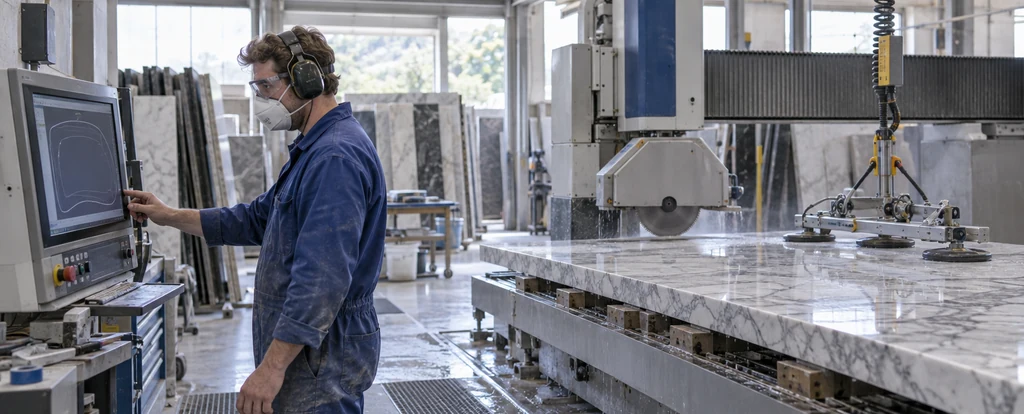
Stone machine operators cut, shape and polish stone on computer-controlled saws and polishers, turning slabs into benchtops, tiles and architectural features.
- Median salary*
- $67,600
3.5%vs last year, before tax
- People employed
- 310
3.3%vs last year
- Projected growth*
- −6%
to 2035
- AI exposure*
- Moderate
- automation risk
- Average hours*
- 38/wk
−2h vs all jobs
- Shortage status*
- Not in shortage
national
Most stone machine operators work in fabrication workshops, though some spend part of the week on site fitting what they have already cut. They are machine setters rather than stonemasons, because the job starts with reading the plan, programming the saw or router, then finishing the edges and checking the fit. Benchtop and architectural stone businesses are the main employers, along with workshops supplying building, landscape and municipal projects.
How much do stone machine operators earn?
The median full-time salary for a stone machine operator is $67,600 per annum, before tax, up $14,400 since 2018.
Pay is usually set by the manufacturing award, a stonemasonry award or an enterprise agreement, so overtime, shift arrangements and the size of the workshop make a real difference to what you take home. Operators who can program CNC equipment, run installation crews or lead a small team tend to sit at the higher end, and site work sometimes carries allowances on top of the workshop rate. Smaller fabricators can pay above or below the middle of the range depending on how full the order book is.
What does a stone machine operator do day to day?
The list below is what fills most weeks; the exact mix shifts with seniority and whatever stage the current work is at.
- Programming bridge saws and CNC routers from cutting plans and digital templates
- Loading and positioning slabs on the cutting bed with vacuum lifters or overhead cranes
- Running the cutting cycle and watching for chipping, drifting tolerances or blade wear
- Polishing, edge profiling and hand finishing cut pieces before they leave the workshop
- Checking finished dimensions against the job sheet and preparing pieces for transport or installation
What skills do stone machine operators need?
Employers look for reading plans and specifications, plant and equipment operation, hand and power tool work, backed by Slabsmith fluency and strong attention to detail.
Specialist skills
- Reading plans and specifications
- Plant and equipment operation
- Hand and power tool work
- Installation and maintenance
- Worksite safety management
Software and tools
- Slabsmith
- AutoCAD
- AlphaCAM
- Bridge saw
- CNC stone router
General skills
- Attention to detail
- Problem solving
Is the job growing?
About 310 people work as stone machine operators in Australia, and employment is projected to decline 6% over the decade to 2035. That's a real decline, worth weighing carefully before training into the role.
How do you become a stone machine operator?
Here's the path most stone machine operators take, step by step.
- 1Start with a Certificate III, or a traineeship
A Certificate III in stonemasonry or a manufacturing traineeship covers machine setup, cutting, finishing and safety, and can be done as an Australian Apprenticeship while you work. The most common qualification among people already in the role is Certificate III/IV, held by about 34% of the workforce, but plenty of operators learn the machines entirely on the job.
- 2Get workshop experience
Many people come in as a labourer, offsider or general hand, moving slabs, cleaning up and learning the machines before they set a saw themselves. It is paid work, and for someone with no trade background it is often the quickest way into machine operating.
- 3Learn the software as well as the machine
Slabsmith, AutoCAD and AlphaCAM are used to nest pieces on a slab and generate the cutting files, and digital templating has replaced manual site measurement in larger businesses. Being able to set a job up from a plan, rather than only run a machine someone else has set, is what separates an operator from a machine hand.
- 4Add the licences site work needs
A White Card is required to work on construction sites, and workshops commonly ask for a forklift licence or overhead crane competency for moving slabs. You also need to be comfortable working to silica dust controls, which in most workshops means water suppression, respirators and housekeeping.
- 5Take on programming, quality or crew leading
Experienced operators move into setting out jobs, checking finished work, or running a small production team, and some shift towards templating, estimating or installation supervision. These roles rely on the same measuring and machine knowledge but take you off the saw for part of the week.
Ready to apply as a stone machine operator?
Whether you're working toward becoming a stone machine operator or already are one and want a hand with the next step (sharpening your resume for ATS screening, tightening your cover letter, or knowing what you'll actually be asked at interview), here are examples grounded in this specific role, not generic templates.
What jobs can a stone machine operator move to?
Moving into Tunneller typically comes with the biggest pay rise, worth $44,200 a year more on average.
| Move to | Typical pay change | Overlap | Retraining |
|---|---|---|---|
| Tunneller Stone machine operator's rock cutting and machine control experience supports tunnel excavation and ground support tasks. | +$44,200 | 89% | short course |
| Plastics Technician Stone machine operator's machine monitoring and quality checking skills suit controlling plastic production equipment and output. | +$7,300 | 67% | minimal |
| Industrial Spray Painter Stone machine operator's surface preparation, masking and finishing experience carries into applying protective coatings to industrial products. | +$4,200 | 89% | minimal |
| Concrete Products Machine Operator Stone machine operator's machine setting, cutting and finishing skills transfer directly to forming and finishing concrete products. | +$0 | 78% | minimal |
| Sign Installer Stone machine operator's measuring, cutting and fixing skills adapt to installing signage, with a short course for site and height work. | −$1,000 | 100% | short course |
Moves are chosen from Jobs and Skills Australia's Data on Occupation Mobility, which follows income tax records between 2011-12 and 2020-21, together with entry requirements and skill overlap. A known move is one people were seen making in that data. Pay change compares median full-time pay for the two roles.
Who works as a stone machine operator?
The typical stone machine operator is 42 years old; 94% are men, 88% work full-time, and full-timers average 38 hours a week.
- 42
- Median age
- 6%
- Female share
- 88%
- Full-time
- −2h
- vs all-jobs avg
What's it like being a stone machine operator?
The day runs around the machines: slabs are measured and nested on screen, cut, then finished by hand, and the pace depends on how many jobs are on the board. Workshops are loud, wet underfoot and busy in bursts, so a quiet week can flip into long days when a builder needs a benchtop before a handover. The work suits people who like seeing a plan become a finished piece and who are careful with measurements, and it is quieter and more repetitive than a site-based trade.
What people like
- The finished piece is something you can point to. A benchtop, a stair tread or a wall panel leaves the workshop cut to the tolerance you set, and you often see it installed on a job that stays visible for years.
- Getting a job to fit exactly. A tight template, a clean edge and a mitre that lines up are the measures of good work here, and the machine and the software give you clear feedback on whether you got it right.
- The material changes the job. Granite, marble, limestone and engineered stone cut and polish differently, so the settings, blades and finishing change with each slab that comes in.
- Skills that carry across industries. Measuring, machine setup, cutting and finishing are wanted in concrete products, plastics, signage and tunnelling work, which gives you options if the stone market slows.
What people find hard
- Silica dust and water everywhere. Cutting and polishing stone produces fine dust, so the job depends on water suppression, respirators and constant housekeeping, and the floor around the saw is wet most of the day.
- Heavy slabs and expensive mistakes. A slab can weigh hundreds of kilograms, and a misread measurement, a chipped edge or a bad first cut can ruin material that is costly to replace.
- Demand follows construction. Order books move with housing, renovation and commercial building activity, so quieter periods mean fewer shifts and less overtime rather than different work.
- Long spells on your feet at the machine. Shifts are spent standing at the saw or the polisher, in noise and usually in ear protection, and the work between jobs is repetitive.
Based on our synthesis of professional-body surveys and public accounts of the role, not first-person verified reviews.
Which industries employ stone machine operators?
Other Non-Metallic Mineral Product Manufacturing employs the largest share of stone machine operators, followed by Building Construction.
Top employing industries
- 1Other Non-Metallic Mineral Product Manufacturing
- 2Building Construction
- 3Cement, Lime, Plaster and Concrete Product Manufacturing
- 4Architectural Services
- 5Landscape Construction
Ranked by employment share; the source doesn't publish an exact percentage per industry.
| Certificate III/IV | 34% | |
|---|---|---|
| Diploma / Advanced Diploma | 26% | |
| Bachelor degree | 20% | |
| Year 12 or below | 20% |
Will AI replace stone machine operators?
Stone machine operating sits in the middle: layout and templating software such as Slabsmith, AutoCAD and AlphaCAM already handles much of the planning and nesting, and CNC routers and bridge saws carry out the cuts themselves. What keeps the exposure from being higher is the physical and finishing side, loading slabs, judging each piece and hand working edges, which stays with the operator. In smaller workshops a lot of that judgment is still done by eye rather than by software.
Share of typical working time by exposure level
- Setting and running the bridge saw or CNC routerThe cut itself is largely automated once the job is set up, but choosing the blade, setting offsets and adjusting when the stone chips or drifts is still the operator's call.30%moderate
- Polishing, edging and hand finishingHand finishing decides how an edge looks and feels, and matching a mitre, easing a chipped corner or working carefully around a sink cut-out is done by eye and feel.30%low
- Nesting pieces on a slab and generating cutting filesSoftware such as Slabsmith and AlphaCAM works out the most efficient arrangement and writes the machine file, so the operator mainly sets the constraints, checks grain direction and works around defects.20%high
- Loading and positioning slabsVacuum lifters and overhead cranes do the lifting, but judging a slab's weight, its hidden faults and a safe path across the workshop floor is hands-on work.20%low
Moves least exposed to AI
These career moves from stone machine operator work are rated low for AI exposure:
- Sign Installer
High skill overlap (100%), short course to get there, and a low automation-risk profile.
- Tunneller
High skill overlap (89%), short course to get there, and a low automation-risk profile.
Common questions about becoming a stone machine operator
Straight answers to the questions people ask most.
How much does a stone machine operator earn?
Stone machine operators earn a median of $67,600 per annum, before tax. What you take home moves with the size of the workshop, how much overtime is available and how much of the machine programming and setting you handle.
How do you become a stone machine operator?
Most people start in a workshop as a labourer or offsider and learn the saws, routers and polishers on the job, sometimes while completing a Certificate III in stonemasonry (CPC32320) or a manufacturing traineeship. Learning the nesting and templating software helps you move from machine hand to operator.
Are stone machine operators in demand?
Stone machine operators are currently not in shortage. Employment is projected to decline 6% over the decade to 2035, so work is likely to come more from replacing operators who leave the trade than from new positions being created.
Will AI replace stone machine operators?
Parts of the job are already automated, and the rest is harder to hand over. Software such as Slabsmith, AutoCAD and AlphaCAM works out how pieces nest on a slab and produces the cutting files, but slabs still have to be loaded, watched and hand finished, and that side of the work stays with the operator.
What can a stone machine operator move into?
The machine setting and finishing skills transfer to industrial spray painting, which pays $4,200 more, and to plastics technician work, which pays $7,300 more. Operators with rock cutting and machine control experience can move into tunnelling, which pays $44,200 more, usually after a short course covering site and ground support work.
Do you need a licence to work as a stone machine operator?
No licence covers the occupation itself, but a White Card is required for construction sites and employers often ask for a forklift licence or overhead crane competency in the workshop. You will also be expected to work to the silica dust controls your workplace uses.
Related roles
- Concrete Products Machine Operator
- Industrial Spray Painter
- Plastics Technician
- Sign Installer
- Tunneller
- Concrete Products Machine Operator
Not sure this is you? Take the career quiz and get a ranked shortlist of roles that fit how you like to work.