Turf Grower
Turf growers produce the rolls of instant lawn that landscapers, sports grounds and home owners lay as a finished surface.
- Median salary*
- $67,600
4.0%vs last year, before tax
- People employed
- 390
2.5%vs last year
- Projected growth
- +4.6%
to 2035
- AI exposure*
- Moderate
- automation risk
- Average hours
- 46/wk
+6h vs all jobs
- Shortage status*
- Not in shortage
national
Turf growing happens on farms on the edge of cities and in rural districts, where blocks of grass are sown, watered and cut into rolls for sale. The work sits upstream of greenkeeping: a greenkeeper maintains an existing surface, while a turf grower produces the material in the first place. Most sales go to landscapers, turf retailers, councils and the builders of sports venues.
How much do turf growers earn?
The median full-time salary for a turf grower is $67,600 per annum, before tax, up $14,100 since 2018.
Most turf growers are paid under the horticulture award, so the rate depends on your classification, your experience and whether you take on leading hand or supervisor duties. Overtime and penalty rates lift earnings through the spring and summer harvest, and some farms add a production bonus for loads cut and shipped. The size of the operation matters as well, since a farm supplying major projects can pay more than a small family property.
What does a turf grower do day to day?
The list below is what fills most weeks; the exact mix shifts with seniority and whatever stage the current work is at.
- Preparing seedbeds and laying turf sod on ground worked up for a new crop
- Running irrigation and fertiliser programs through the growing season
- Walking the blocks to check for pests, disease and weeds
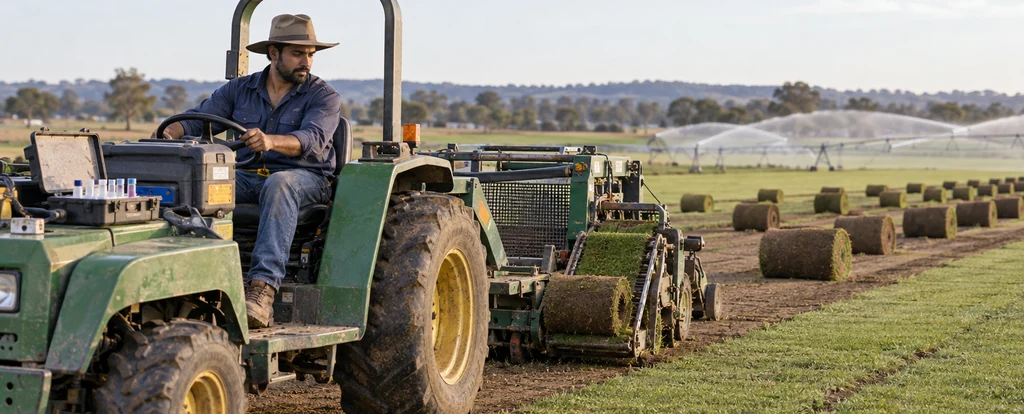
- Operating tractors and turf harvesters to cut, lift and roll turf for dispatch
- Servicing machinery and irrigation lines between harvests, often before the first cut of the day
What skills do turf growers need?
Employers look for operations management, plant and equipment operation, inventory management, backed by Tractors fluency and strong attention to detail.
Specialist skills
- Operations management
- Plant and equipment operation
- Inventory management
- Worksite safety management
Software and tools
- Tractors
- Turf harvesters
- Irrigation systems
- Soil testing kits
- Spreadsheet software
General skills
- Attention to detail
- Problem solving
- Physical stamina and dexterity
Is the job growing?
About 390 people work as turf growers in Australia, and employment is projected to grow 4.6% over the decade to 2035. That's modest growth: demand is steady rather than booming.
How do you become a turf grower?
Here's the path most turf growers take, step by step.
- 1Start with a paid job on a turf farm
No formal qualification is needed to get in, and most growers learn on the job. A season on a production farm teaches soil preparation, irrigation and machinery from the ground up, and you are paid while you learn.
- 2Study horticulture or turf management
A Certificate III in Horticulture (AHC30722) (Turf) or a Certificate III in Sports Turf Management (AHC31324) at TAFE covers the plant science and turf-specific knowledge that speeds up progression. Both can be done as a traineeship or part time while you keep working.
- 3Add the licences and qualifications the job uses
A forklift licence, a heavy vehicle licence, chemical user accreditation for spraying and a White Card for delivery work on construction sites are common on turf farms. Which ones you need varies with the farm and the state.
- 4Take on leading hand and management duties
Running a harvest crew, ordering inputs and scheduling deliveries is how growers move into farm manager roles. It is usually the step that comes before managing a property in your own right.
Ready to apply as a turf grower?
Whether you're working toward becoming a turf grower or already are one and want a hand with the next step (sharpening your resume for ATS screening, tightening your cover letter, or knowing what you'll actually be asked at interview), here are examples grounded in this specific role, not generic templates.
What jobs can a turf grower move to?
Moving into Sports Turf Manager typically comes with the biggest pay rise, worth $18,200 a year more on average.
| Move to | Typical pay change | Overlap | Retraining |
|---|---|---|---|
| Sports Turf Manager Turf production experience leads into managing sports turf, with further study in turf management needed. | +$18,200 | 58% | reskill |
| Greenkeeper Turf growing skills carry across to greenkeeping, but an apprenticeship in sports turf management is required.Known move | +$8,700 | 38% | requalify |
| Orchardist Orchard work uses the same crop cultivation and harvest skills, with little extra training required. | +$5,200 | 83% | minimal |
| Flower Grower Flower growing draws on the same plant production skills, with minimal retraining for a different crop. | −$2,600 | 100% | minimal |
Moves are chosen from Jobs and Skills Australia's Data on Occupation Mobility, which follows income tax records between 2011-12 and 2020-21, together with entry requirements and skill overlap. A known move is one people were seen making in that data. Pay change compares median full-time pay for the two roles.
Who works as a turf grower?
The typical turf grower is 48 years old; 86% are men, 84% work full-time, and full-timers average 46 hours a week.
- 48
- Median age
- 14%
- Female share
- 84%
- Full-time
- +6h
- vs all-jobs avg
What's it like being a turf grower?
The job follows the growing season: spring and summer are the busy months, when turf is cut and shipped daily, and winter is quieter, given to repairs, maintenance and planning. It is physical outdoor work with a lot of machinery, and it suits people who like seeing a paddock turn into a product on a truck. Weather, water and breakdowns set the pace more than a roster does.
What people like
- A finished product you can point to. A block of turf leaves the farm as neat rolls on a pallet, and you can drive past the oval or the front yard it ends up in.
- Working outdoors with machinery. Most of the day is spent on a tractor, a mower or a harvester rather than at a desk.
- Variety across the year. Sowing, irrigating, spraying, harvesting and repairs are distinct jobs, and the mix changes with the season.
- Small teams and real responsibility. Turf farms run with few staff, so newcomers pick up machinery, irrigation and pest work quickly rather than waiting years for a turn.
What people find hard
- Weather sets the schedule. Turf cannot be harvested wet, so a run of rain can squeeze a whole week of orders into a narrow window.
- Long days in the peak season. Full-time turf growers average 46 hours a week, and harvest weeks run longer than that.
- Water, land and input costs. Fuel, fertiliser, water and machinery repairs eat into margins, which shows up in what farms can pay.
- Repetitive work during harvest. Cutting, rolling and loading the same blocks day after day through the peak can wear thin.
Based on our synthesis of professional-body surveys and public accounts of the role, not first-person verified reviews.
Which industries employ turf growers?
Agriculture, Forestry and Fishing employs the largest share of turf growers.
Top employing industries
- 1Agriculture, Forestry and Fishing
Ranked by employment share; the source doesn't publish an exact percentage per industry.
| Year 12 or below | 53.3% | |
|---|---|---|
| Certificate III/IV | 28.7% | |
| Diploma / Advanced Diploma | 7.9% | |
| Bachelor degree | 4.6% | |
| Postgraduate | 1% |
Will AI replace turf growers?
Automation reaches the planning and record-keeping side of turf growing more than the paddock itself. Irrigation controllers, soil sensors and farm software already run watering schedules and chemical records, but the physical work of cutting, lifting and rolling turf, and the judgement that goes with it, still needs a person on the machine. Overall, the job sits at a moderate level of exposure.
Share of typical working time by exposure level
- Mowing, lifting and rolling turfTractor guidance helps keep passes straight, but the harvester operator judges roll thickness, moisture and cutting depth by feel.30%low
- Scouting for pests, weeds and diseasePhone apps identify common turf diseases from a photo, yet deciding whether to spray, and with what, depends on walking the block.25%moderate
- Orders, dispatch and record keepingOnline ordering, stock systems and farm software handle bookings and spray diaries, cutting paperwork that used to fill an evening.25%high
- Irrigation and moisture schedulingSoil moisture probes and weather-linked controllers now run watering cycles on their own, though someone still walks the blocks after a hot spell or a burst line.20%moderate
Moves least exposed to AI
These career moves from turf grower work are rated low for AI exposure:
- Greenkeeper
Some skill overlap (38%), requalify to get there, and a low automation-risk profile.
- Sports Turf Manager
Solid skill overlap (58%), reskill to get there, and a low automation-risk profile.
- Orchardist
High skill overlap (83%), little retraining to get there, and a low automation-risk profile.
- Flower Grower
High skill overlap (100%), little retraining to get there, and a low automation-risk profile.
Common questions about becoming a turf grower
Straight answers to the questions people ask most.
How much do turf growers earn?
Turf growers earn a median of $67,600 per year before tax, and pay moves with your classification, your overtime and whether you take on supervisory duties. Larger farms and those supplying major projects tend to pay more than small family properties, and peak-season hours add penalty rates.
How do you become a turf grower?
Most people start by taking a job on a turf farm, because no formal qualification is required and the work is learned on the job. A Certificate III in Horticulture (AHC30722) (Turf) or in Sports Turf Management, taken as a traineeship or part time, helps you move into better-paid and more senior roles.
Are turf growers in demand?
Turf growers are currently not in shortage, and employment is projected to grow 4.6% over the decade to 2035. With about 390 people working in the occupation nationally, most openings come from growers leaving the industry, and hiring tends to happen ahead of the spring and summer harvest.
Will AI change turf growing?
Much of the work happens outdoors with plants, soil and heavy machinery, which keeps automation at arm's length, and the exposure sits mainly in planning, records and diagnosis. Moisture sensors, weather-linked irrigation controllers and farm software already handle scheduling and chemical recording, while spraying and harvest calls still rest with the grower.
What can a turf grower move into?
Turf production experience leads into greenkeeping and sports turf management, though greenkeeping usually requires an apprenticeship in sports turf management and a sports turf manager role pays $18,200 more. Orchardists and flower growers move across with little extra training, because the crop cultivation and harvest skills are the same. A further step is running your own turf farm or contracting business, which is often where earnings grow.
What is the difference between a turf grower and a greenkeeper?
A turf grower produces turf as a crop on a farm, while a greenkeeper maintains an established playing surface at a golf course, racecourse or oval. The two share knowledge of grass varieties and soil, and greenkeepers often begin in turf production before taking up an apprenticeship in sports turf management.
Related roles
Not sure this is you? Take the career quiz and get a ranked shortlist of roles that fit how you like to work.