Visitor Information Officer
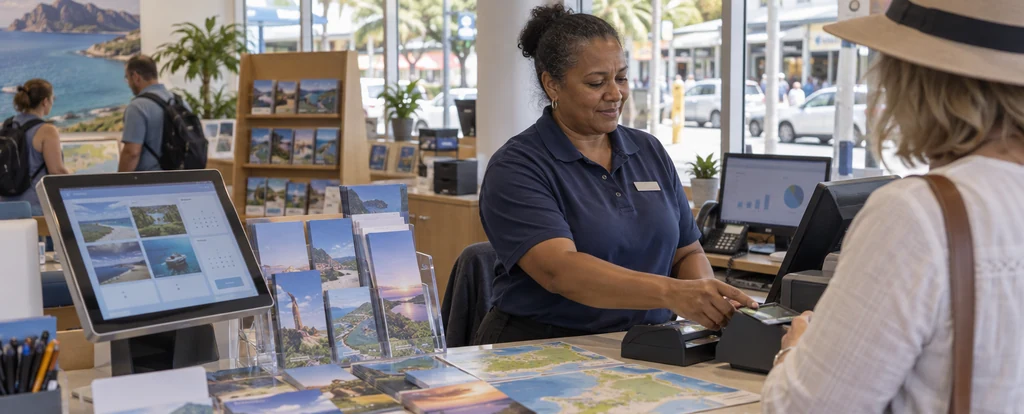
Visitor information officers answer visitors' questions about a destination and book the tours and experiences that follow.
- Median salary*
- $58,200
4.5%vs last year, before tax
- People employed
- 1,300
0.0%vs last year
- Projected growth
- +9.3%
to 2035
- AI exposure*
- Moderate
- automation risk
- Average hours
- 39/wk
−1h vs all jobs
- Shortage status
- In shortage
national
The work happens at visitor centres, council information desks, attraction counters and, in some roles, over the phone, email and live chat. What separates it from travel agency work is scope: a travel agent sells flights and packages, while a visitor information officer sells the place they live in, drawing on local knowledge that shifts with every road closure, festival and new opening. Most work for local councils or regional tourism bodies in small teams that share weekend and public holiday rosters.
How much do visitor information officers earn?
The median full-time salary for a visitor information officer is $58,200 per annum, before tax, up $12,400 since 2018.
Pay depends less on the job title than on who employs you: local government roles follow a council enterprise agreement with annual increments, while privately run attractions and small seasonal centres often pay closer to the award rate. Casual and part-time contracts are common, and those hours usually attract casual loading, with weekend and public holiday penalty rates lifting the hourly rate further. Team leader roles, and positions that combine the desk with event coordination, sit above the ordinary range.
What does a visitor information officer do day to day?
The list below is what fills most weeks; the exact mix shifts with seniority and whatever stage the current work is at.
- Staffing the counter, phone and email desk, answering questions about transport, attractions and events
- Making bookings for tours, accommodation and activities, and handling changes and cancellations
- Keeping brochures, maps and digital listings stocked and current, including opening hours that shift with the season
- Selling souvenirs, gift vouchers and admission passes, and balancing the till at the end of a shift
- Recording enquiries and visitor numbers so the council or tourism body can see what people ask for
What skills do visitor information officers need?
Employers look for event coordination, operations management, backed by Rezdy fluency and strong customer service.
Specialist skills
- Event coordination
- Operations management
Software and tools
- Rezdy
- FareHarbor
- Microsoft Office
- Salesforce
- Google Analytics
General skills
- Customer service
- Written communication
- Digital literacy
- Stakeholder management
Is the job growing?
About 1,300 people work as visitor information officers in Australia, and employment is projected to grow 9.3% over the decade to 2035. That's modest growth: demand is steady rather than booming.
How do you become a visitor information officer?
Here's the path most visitor information officers take, step by step.
- 1Finish Year 12 and get customer-facing experience
Retail, hospitality or reception work teaches the pace of answering questions all day, and many visitor information officers start from exactly those jobs. About 27% of people in the role hold Year 12 or below as their highest qualification, so a degree is not the entry point.
- 2Add a tourism qualification if you want to specialise
A Certificate III or IV in Tourism at TAFE covers destination knowledge, booking systems and customer service, and takes roughly six months to a year. It helps most when you are competing for council or tourism board roles, where other applicants often hold one.
- 3Build the extras employers ask for
A current driver's licence matters in regional centres where the desk also covers surrounding towns, a first aid certificate appears regularly in job ads, and a second language is an advantage where international visitors are common. Volunteering at a local visitor centre or festival puts local knowledge and contacts on your resume.
- 4Apply through councils, tourism bodies and attractions
Local government advertises on its own careers pages and runs panel interviews against set selection criteria, so answer each criterion directly. Private attractions and tour operators hire more casually, often ahead of a peak season, and weekend availability is usually part of the deal.
Ready to apply as a visitor information officer?
Whether you're working toward becoming a visitor information officer or already are one and want a hand with the next step (sharpening your resume for ATS screening, tightening your cover letter, or knowing what you'll actually be asked at interview), here are examples grounded in this specific role, not generic templates.
What jobs can a visitor information officer move to?
Moving into Event Coordinator typically comes with the biggest pay rise, worth $26,800 a year more on average.
| Move to | Typical pay change | Overlap | Retraining |
|---|---|---|---|
| Event Coordinator Visitor information officers' event and visitor service experience helps them coordinate local events, from planning to delivery.Known move | +$26,800 | 26% | reskill |
| Tour Guide Visitor information officers' knowledge of local attractions and visitor needs suits tour guide work, leading groups and sharing stories.Known move | +$16,300 | 19% | reskill |
| Travel Agent Visitor information officers bring local destination knowledge and customer service skills to travel agent roles, selling tourism experiences.Known move | +$11,000 | 17% | reskill |
Moves are chosen from Jobs and Skills Australia's Data on Occupation Mobility, which follows income tax records between 2011-12 and 2020-21, together with entry requirements and skill overlap. A known move is one people were seen making in that data. Pay change compares median full-time pay for the two roles.
Who works as a visitor information officer?
The typical visitor information officer is 46 years old; 80% are women, 44% work full-time, and full-timers average 39 hours a week.
- 46
- Median age
- 80%
- Female share
- 44%
- Full-time
- −1h
- vs all-jobs avg
What's it like being a visitor information officer?
The rhythm of the job follows the visitor season, so summer weekends and school holidays are the busiest and a mid-week winter shift can be quiet enough to catch up on listings. Work moves between the counter, the phone, the booking system and the brochure rack, with a steady stream of small problems to solve: a bus running late, a road closed, a family with three hours and no plan. It suits people who like talking to strangers, know their region well and do not mind repeating themselves.
What people like
- You see the result straight away. A visitor walks in with a vague idea and leaves with a booked tour, a map and a plan for the day, and you were the one who put it together.
- The work changes with the visitors. School groups, international travellers and locals showing off their town to relatives all bring different questions, so the pace and the conversation shift through a shift.
- You get to know your own patch properly. The role pushes you to learn the walks, cafes, history and quiet stops that even long-term locals miss, and to keep that knowledge current as things open and close.
- It opens doors into the wider industry. Working alongside tour operators, event organisers and accommodation providers builds a network that helps when you want to move into guiding, events or travel sales.
What people find hard
- Weekends and public holidays are the job. Visitor centres are busiest exactly when everyone else is off, so rosters run across Saturday, Sunday and the Christmas break.
- Some questions come round every day. Where are the toilets, what is open, how do I get to the lookout: a good share of the work is repeating the same answers patiently to the tenth person that morning.
- You cannot fix the thing they are upset about. A cancelled ferry, a closed track or a rained-out event lands on your desk, and often the most you can do is find an alternative.
- Quiet seasons mean thinner hours. Small centres staff up for summer and cut back after Easter, so contracts are often casual or seasonal and the hours follow the crowds.
Based on our synthesis of professional-body surveys and public accounts of the role, not first-person verified reviews.
Which industries employ visitor information officers?
Public Administration and Safety employs the largest share of visitor information officers, followed by Administrative and Support Services.
Top employing industries
- 1Public Administration and Safety
- 2Administrative and Support Services
- 3Arts and Recreation Services
Ranked by employment share; the source doesn't publish an exact percentage per industry.
| Year 12 or below | 26.9% | |
|---|---|---|
| Bachelor degree | 22.8% | |
| Certificate III/IV | 19.6% | |
| Diploma / Advanced Diploma | 17.5% | |
| Postgraduate | 7.9% |
Will AI replace visitor information officers?
The job is moderately exposed to automation. Booking platforms, live chat and translation tools now cover a good share of the routine questions and reservations, which changes what the desk is for rather than removing it. Local knowledge, relationships with operators and the judgement to sort out a disrupted visit remain human work.
Share of typical working time by exposure level
- Answering questions at the counter and by phoneChatbots and destination websites handle the standard questions, but many visitors arrive with a half-formed plan that needs a conversation to untangle.35%moderate
- Making and changing bookingsPlatforms such as Rezdy and FareHarbor already manage availability, payment and confirmation, so the officer mainly deals with changes, group bookings and problems the system cannot resolve.25%high
- Keeping listings, hours and event details currentAI can draft directory entries and social posts, but someone still has to ring the cafe to check whether it opens on Mondays in winter.25%moderate
- Working with local operators and running promotionsKnowing which operator suits a group, and calling in a favour when a tour falls through, depends on relationships built over several seasons.15%low
Common questions about becoming a visitor information officer
Straight answers to the questions people ask most.
How much does a visitor information officer earn?
Median full-time pay is $58,200 per year before tax, and casual or part-time roles are usually paid an hourly rate plus casual loading. Local government enterprise agreements and weekend penalty rates push take-home pay above that figure, while small privately run centres and seasonal work tend to sit below it, so treat the median as a starting point rather than a fixed rate.
How do you become a visitor information officer?
Most people come in through customer service work and learn the destination on the job. A Certificate III or IV in Tourism helps for council and tourism board roles, while a driver's licence, first aid certificate and a second language are common advantages. About 27% of people in the role hold Year 12 or below, so a degree is not required.
Are visitor information officers in demand?
Visitor information officers are currently in shortage nationally, and employment is projected to grow 9.3% over the decade to 2035. The occupation is small, so openings cluster in tourism regions and larger centres and often attach to the visitor season, which means flexibility about location and timing helps.
Will AI replace visitor information officers?
AI already handles part of the job, mostly the routine end of it. Chatbots and booking platforms answer simple questions and manage availability, and translation tools help with information for international visitors. What the desk still does is ring the whale-watching operator directly when a family arrives on the one morning the boats are full, and find them something else worth doing before their ferry leaves.
What can a visitor information officer move into?
Tour guiding is one route, and it typically pays $16,300 more because both roles rely on the same local knowledge and people skills. Travel agency work pays $11,000 more and uses the booking systems and destination advice you already handle, while event coordination pays $26,800 more and builds on the operator contacts you have made. Each move usually needs some retraining, but the customer-facing core carries over.
Do visitor information officers work weekends?
Yes, and that is when the job is busiest, because visitor centres fill up on weekends, public holidays and school breaks. Rosters are shared across a small team, so most officers work some weekend shifts in exchange for days off mid-week. Availability across the holiday period is usually part of the job.
Related roles
Not sure this is you? Take the career quiz and get a ranked shortlist of roles that fit how you like to work.