Weighbridge Operator
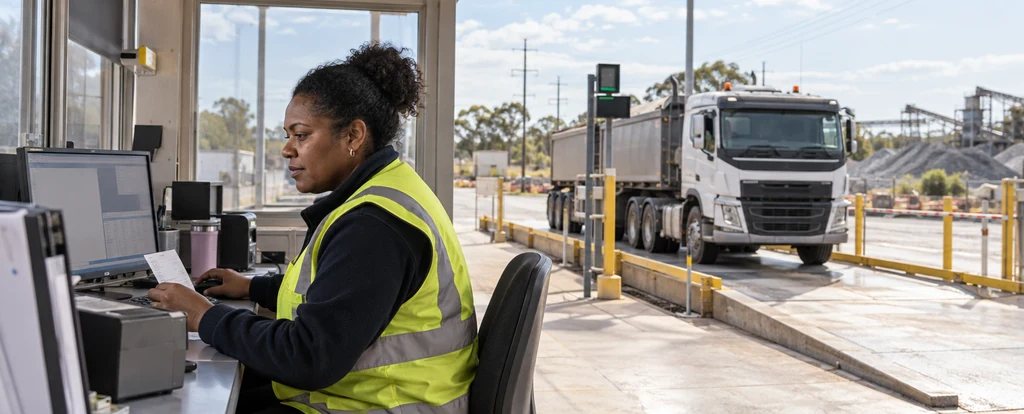
Weighbridge operators weigh trucks, record what they're carrying and keep loads within legal limits.
- Median salary*
- $67,600
3.7%vs last year, before tax
- People employed
- 1,100
0.0%vs last year
- Projected growth
- +6.9%
to 2035
- AI exposure*
- High
- automation risk
- Average hours
- 44/wk
+4h vs all jobs
- Shortage status
- Not in shortage
national
Weighbridge operators sit at the gate of sites that move bulk material: quarries, mines, waste transfer stations, grain receivals, timber yards and concrete plants. They weigh each truck in and out, record the load, and hand the driver a docket that becomes the site's invoice and stock record. It is clerical work in an industrial setting, and the nearest equivalent in an office, an administration officer, has none of the traffic, weather or load-limit judgement.
How much do weighbridge operators earn?
The median full-time salary for a weighbridge operator is $67,600 per annum, before tax, up $14,000 since 2018.
Pay depends heavily on the site and the roster, so mine and quarry operators on enterprise agreements usually earn more than a small council transfer station or landfill. Night, weekend and public holiday shifts attract penalty rates, and remote or fly-in, fly-out sites pay more again, while permanent day shift at a quiet yard sits at the lower end.
What does a weighbridge operator do day to day?
The list below is what fills most weeks; the exact mix shifts with seniority and whatever stage the current work is at.
- Weighing trucks in and out and recording the gross, tare and net weights
- Entering vehicle, load and customer details into the weighbridge software
- Printing and issuing dockets to drivers and reconciling them at the end of the shift
- Checking loads against weight limits, permits and paperwork before a vehicle leaves
- Directing drivers on and off the bridge and answering questions about where to go next
What skills do weighbridge operators need?
Employers look for operations management, regulatory compliance, data analysis, backed by AccuWeigh fluency and strong attention to detail.
Specialist skills
- Operations management
- Regulatory compliance
- Data analysis
Software and tools
- AccuWeigh
- Weightronix
- Microsoft Excel
- SAP
- TruckMate
General skills
- Attention to detail
- Customer service
- Safety and compliance awareness
- Written communication
Is the job growing?
About 1,100 people work as weighbridge operators in Australia, and employment is projected to grow 6.9% over the decade to 2035. That's modest growth: demand is steady rather than booming.
How do you become a weighbridge operator?
Here's the path most weighbridge operators take, step by step.
- 1Get on site in another role first
Most weighbridge operators start as a yard hand, labourer, plant operator or site administrator and move across when a bridge job opens. Employers usually train on the job, so a steady record on the site counts for more than a qualification.
- 2Complete the site safety requirements
A White Card is needed on construction sites, and mines, quarries and waste facilities add their own inductions, medicals and PPE rules. You will also be expected to know the site's traffic management and load-limit procedures.
- 3Learn the weighbridge software and docket system
Systems such as AccuWeigh and Weightronix, or a site's own setup linked to SAP, take a few weeks to feel comfortable with. Understanding how the weights you record flow into invoicing and stock reporting is what opens up more of the site's work.
- 4Add a certificate if you want to move up
A Certificate III in supply chain operations (TLI30325) or transport and logistics is the usual qualification behind supervisor, dispatch and compliance roles, and it can be done part time while you keep working.
Ready to apply as a weighbridge operator?
Whether you're working toward becoming a weighbridge operator or already are one and want a hand with the next step (sharpening your resume for ATS screening, tightening your cover letter, or knowing what you'll actually be asked at interview), here are examples grounded in this specific role, not generic templates.
What jobs can a weighbridge operator move to?
Moving into Office Manager typically comes with the biggest pay rise, worth $22,400 a year more on average.
| Move to | Typical pay change | Overlap | Retraining |
|---|---|---|---|
| Office Manager Weighbridge operators bring compliance and record-keeping discipline to office management, with further study in administration and supervision.Known move | +$22,400 | 42% | reskill |
| Transport Operations Inspector Weighbridge operators already check compliance and load limits, so transport inspection work builds on the same regulatory knowledge. | +$20,800 | 50% | short course |
| Stock Controller Weighbridge operators understand weights and load records, which supports stock control work monitoring inventory levels and movements. | +$13,200 | 65% | minimal |
| Import Export Clerk Weighing and documenting freight translates directly to import and export clerking, where the same load records and compliance knowledge are used. | +$7,800 | 86% | minimal |
| Administration Officer Weighbridge operators bring accurate record keeping and load documentation into administration roles, with further study to broaden their office skills.Known move | −$9,400 | 38% | reskill |
Moves are chosen from Jobs and Skills Australia's Data on Occupation Mobility, which follows income tax records between 2011-12 and 2020-21, together with entry requirements and skill overlap. A known move is one people were seen making in that data. Pay change compares median full-time pay for the two roles.
Who works as a weighbridge operator?
The typical weighbridge operator is 46 years old; 63% are women, 76% work full-time, and full-timers average 44 hours a week.
- 46
- Median age
- 63%
- Female share
- 76%
- Full-time
- +4h
- vs all-jobs avg
What's it like being a weighbridge operator?
The job runs to the flow of trucks rather than a task list, so long quiet stretches are broken by a queue when a delivery or a load-out arrives and a run of drivers all want to get moving. Accuracy matters more than speed, because the weights you record become invoices, compliance records and stock figures that someone will check later. It suits people who are comfortable working largely alone, following a set procedure and holding their ground with a driver who does not like the number.
What people like
- Each load is finished when the truck leaves. Weigh, record, issue, next truck. Very little carries over from one shift to the next, which suits anyone who likes a clean end to the day.
- You are the site's record keeper. Every load in and out passes through your hands, and that record is what the business bills from and what regulators inspect.
- Quiet stretches between vehicles. At smaller sites or on night shift you may go an hour or more without a truck, and the pace picks up only when a delivery arrives.
- Outdoor work without the heavy lifting. You are on an industrial site, often in your own booth, and the physical demands are light compared with most jobs in the yard.
What people find hard
- The weather sets the tone. Booths get hot in summer and cold in winter, and you will still walk out to check a plate, a permit or a driver's paperwork in it.
- Shift work and weekends. Mines, quarries and waste facilities often run two or three shifts, and grain receivals and peak periods mean weekend coverage as well.
- Weight disputes with drivers. A driver who is over a limit, short-loaded or missing a permit will argue the number, and you are the one who has to hold the line.
- Repetition on a busy day. A steady queue means running the same weigh, record and docket cycle hundreds of times in a shift, with the same explanations each time.
Based on our synthesis of professional-body surveys and public accounts of the role, not first-person verified reviews.
Which industries employ weighbridge operators?
Electricity, Gas, Water and Waste Services employs the largest share of weighbridge operators, followed by Manufacturing.
Top employing industries
- 1Electricity, Gas, Water and Waste Services
- 2Manufacturing
- 3Mining
Ranked by employment share; the source doesn't publish an exact percentage per industry.
| Year 12 or below | 58.4% | |
|---|---|---|
| Certificate III/IV | 24.2% | |
| Diploma / Advanced Diploma | 8% | |
| Bachelor degree | 4.4% | |
| Postgraduate | 1.2% |
Will AI replace weighbridge operators?
Weighbridge operation is one of the more exposed jobs in transport, because the core task is capturing a number and writing it down. An automated bridge with number plate recognition, RFID tags and sensors can weigh a truck, log the result and issue the docket without an operator, and many larger sites already run unattended outside peak hours. What automation has not taken over is the person at the gate dealing with drivers, questioning a load that does not look right and deciding when a vehicle should not leave.
Share of typical working time by exposure level
- Weighing trucks and capturing load weightsSensors and number plate recognition can weigh a vehicle and log the result unattended, which is why unmanned bridges are spreading at high-volume sites.35%high
- Issuing dockets and entering load detailsSoftware already generates dockets and pushes load records into systems such as SAP, so the operator's part is mostly checking rather than typing.25%high
- Checking load limits, permits and paperworkThe system flags an overload or an expired permit, but deciding what to do about a non-conforming load still relies on someone who knows the site's rules.20%moderate
- Directing drivers on and off the bridgeRadio calls, hand signals and a bit of diplomacy with a driver running late, which is the part of the job that keeps it on site.20%low
Common questions about becoming a weighbridge operator
Straight answers to the questions people ask most.
How much does a weighbridge operator earn?
Weighbridge operators earn $67,600 per year before tax. Pay moves with the site and the roster, since mine and quarry agreements pay more than a small transfer station and night, weekend and public holiday shifts attract penalty rates.
How do you become a weighbridge operator?
There is no required qualification, and most operators learn the work on the job after starting in another role on the same site. Employers look for accurate record keeping, a site induction or White Card, and the temperament to deal with a driver calmly when a load does not match its paperwork.
Are weighbridge operators in demand?
Weighbridge operators are currently not in shortage, and employment is projected to grow 6.9% over the decade to 2035. With about 1,100 people in the role nationally, openings depend on what is operating near you rather than appearing evenly across the country, so it pays to ask at the quarries, waste facilities and receival sites in your area.
Will AI replace weighbridge operators?
Much of the weighing and docketing is already being automated. Unattended weighbridges using number plate recognition, RFID tags on trucks and weight sensors handle the routine traffic at many larger sites, and the software writes the docket and updates the stock record without anyone touching it. What is left is the exceptions: drivers with the wrong paperwork, disputed weights, loads that should not leave, and coordinating who goes where on site.
What can a weighbridge operator move into?
Import export clerks use the same freight documentation and compliance knowledge, and the move usually comes with $7,800 more and very little retraining. Stock controllers apply the same understanding of weights and inventory movements, earning $13,200 more. Transport operations inspectors build on the load-limit and compliance side of the job and earn $20,800 more, although that move normally takes a short course.
Do weighbridge operators work shifts?
Often, yes. Sites that run around the clock, including mines, quarries and larger waste facilities, roster operators across two or three shifts with weekend and public holiday coverage. Day-shift work is common at smaller yards and council facilities, so the hours vary with the employer.
Related roles
- Administration Officer
- Import Export Clerk
- Office Manager
- Stock Controller
- Transport Operations Inspector
- Administration Officer
Not sure this is you? Take the career quiz and get a ranked shortlist of roles that fit how you like to work.