Airline Customer Service Agent
Airline customer service agents look after passengers at check-in, the gate and the service desk, keeping departures on schedule and helping when plans change.
- Median salary*
- $67,600
4.3%vs last year, before tax
- People employed
- 2,700
0.0%vs last year
- Projected growth*
- +1%
to 2035
- AI exposure*
- Moderate
- automation risk
- Average hours*
- 38/wk
−2h vs all jobs
- Shortage status*
- Not in shortage
national
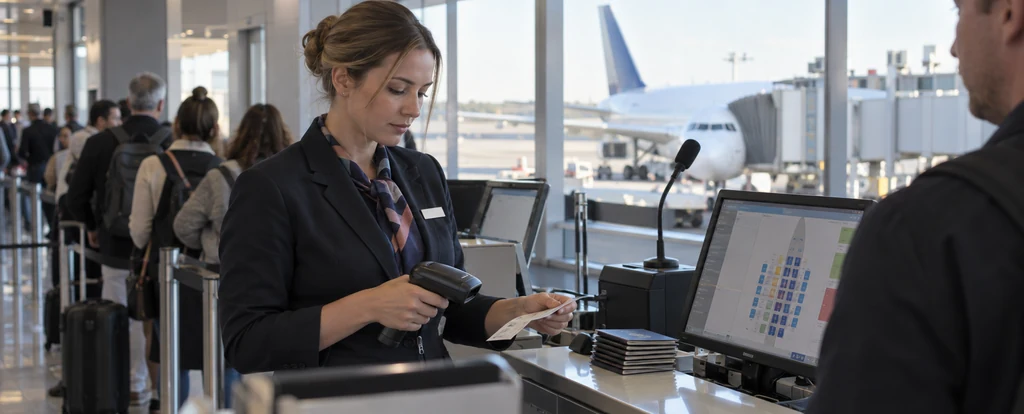
Airline customer service agents work at check-in counters, boarding gates and airport service desks for domestic and international carriers, and they are usually the first and last airline employee a passenger deals with in the terminal. That terminal focus separates them from airport ground crew, who handle aircraft turnaround, baggage handling and airside tasks. Most are employed directly by an airline or by a ground handling company, and they work a rotating roster covering early starts, nights, weekends and public holidays.
How much do airline customer service agents earn?
The median full-time salary for an airline customer service agent is $67,600 per annum, before tax, up $14,300 since 2018.
Pay depends heavily on who employs you: airlines with enterprise agreements generally pay more than outsourced ground handlers doing similar terminal work. Shift penalties for early mornings, nights, weekends and public holidays can add a lot to the base rate, so the roster you hold matters as much as the classification. Team leader and airport duty roles sit above the median.
What does an airline customer service agent do day to day?
The list below is what fills most weeks; the exact mix shifts with seniority and whatever stage the current work is at.
- Checking in passengers, verifying passports and visas, and issuing boarding passes
- Accepting and tagging baggage, and charging for excess or oversized items
- Rebooking passengers when flights are delayed, cancelled or oversold
- Coordinating boarding at the gate, including announcements and last minute seat changes
- Tracing delayed baggage and handling complaints at the service desk
What skills do airline customer service agents need?
Employers look for regulatory compliance, operations management, backed by Amadeus Altea fluency and strong customer service.
Specialist skills
- Regulatory compliance
- Operations management
Software and tools
- Amadeus Altea
- Sabre
- SITA Horizon
- Microsoft Office
General skills
- Customer service
- Written communication
- Problem solving
- Attention to detail
- Time and deadline management
Is the job growing?
About 2,700 people work as airline customer service agents in Australia, and employment is projected to grow 1% over the decade to 2035. That's modest growth: demand is steady rather than booming.
How do you become an airline customer service agent?
Here's the path most airline customer service agents take, step by step.
- 1Finish school with customer facing work behind you
Retail, hospitality or call centre work gives you practice at the conversations this job involves: long queues, booking problems and people who are already frustrated before they reach you.
- 2Consider a qualification in aviation or tourism
A certificate III or IV in aviation ground operations, or a travel and tourism qualification, can help an application stand out. It is not the main way in, though, because airlines train new starters on their own systems, and the workforce holds a mix of certificates, diplomas and degrees.
- 3Apply to airlines and ground handling companies
Recruitment usually involves a group assessment and an interview based on customer service scenarios, plus typing and numeracy checks for some carriers. Ground handlers often run recruitment rounds more often than airlines, which can make them an easier first step into the terminal.
- 4Clear the security and medical checks
You need an Aviation Security Identification Card, which involves a police check and a background verification, and some roles also require a medical assessment. After that, the airline trains you on its departure control and reservations systems, such as Amadeus Altea or Sabre.
- 5Learn the fare and disruption rules, not just the check-in screen
Agents who understand rerouting, fare conditions and baggage liability become the ones supervisors rely on, and that knowledge is what opens up team leader, airport duty and head office roles.
Ready to apply as an airline customer service agent?
Whether you're working toward becoming an airline customer service agent or already are one and want a hand with the next step (sharpening your resume for ATS screening, tightening your cover letter, or knowing what you'll actually be asked at interview), here are examples grounded in this specific role, not generic templates.
What jobs can an airline customer service agent move to?
Moving into Aerodrome Reporting Officer typically comes with the biggest pay rise, worth $23,400 a year more on average.
| Move to | Typical pay change | Overlap | Retraining |
|---|---|---|---|
| Aerodrome Reporting Officer Airline customer service agents bring airport familiarity, safety awareness and reporting habits to aerodrome checks; a short course covers aerodrome inspection and reporting requirements. | +$23,400 | 60% | short course |
| Transport Revenue Officer Airline customer service agents bring passenger handling, ticketing knowledge and conflict resolution to transport revenue duties; a short course covers fare compliance and authority. | +$11,400 | 91% | short course |
| Import Export Clerk Airline customer service agents bring documentation, deadline and customer coordination skills to import export clerking; minimal retraining covers customs and freight paperwork. | +$7,800 | 71% | minimal |
| Communications Operator Airline customer service agents bring calm customer communication, multitasking and computer skills to communications operator work; a short course covers emergency call handling. | +$7,800 | 100% | short course |
Moves are chosen from Jobs and Skills Australia's Data on Occupation Mobility, which follows income tax records between 2011-12 and 2020-21, together with entry requirements and skill overlap. A known move is one people were seen making in that data. Pay change compares median full-time pay for the two roles.
Who works as an airline customer service agent?
The typical airline customer service agent is 41 years old; 70% are women, 33% work full-time, and full-timers average 38 hours a week.
- 41
- Median age
- 70%
- Female share
- 33%
- Full-time
- −2h
- vs all-jobs avg
What's it like being an airline customer service agent?
The work has a clear rhythm: a rush before each departure, a lull in between, and a roster that shifts week to week. The pressure arrives in bursts, when weather, engineering faults or a late aircraft leave a terminal full of people who all need an answer at once. It suits people who stay level headed in front of an unhappy queue and enjoy the puzzle of finding a workable option quickly.
What people like
- You see the result of your shift. A gate that clears on time, or a stranded passenger on the next available flight, is a visible finish to the day rather than a task handed on to someone else.
- The terminal is a social workplace. You deal with hundreds of travellers a day, and the crew, ground staff and colleagues around you change with each roster.
- Travel benefits and weekday days off. Many airlines offer discounted or standby travel to staff, and rotating rosters mean some days off fall on quiet weekdays when everyone else is at work.
- Clear rules to work within. Fare, visa and baggage rules give you a framework, and the satisfaction comes from finding the option that fits someone's situation inside it.
What people find hard
- Angry passengers land on you. Delays and cancellations are usually outside the agent's control, but the person at the counter absorbs the frustration and has to keep working through it.
- The roster shapes your life. Early starts, late finishes, weekends and public holidays are normal, and family plans have to fit around a roster published weeks in advance.
- Plenty of repetition. Check-in is largely the same sequence hundreds of times a shift, from document checks to bag tags, and that sameness wears on some people.
- Little room to bend the rules. Fare and baggage conditions are set elsewhere, so agents often have to refuse a request they can see is reasonable.
Based on our synthesis of professional-body surveys and public accounts of the role, not first-person verified reviews.
Which industries employ airline customer service agents?
Transport, Postal and Warehousing employs the largest share of airline customer service agents, followed by Information Media and Telecommunications.
Top employing industries
- 1Transport, Postal and Warehousing
- 2Information Media and Telecommunications
- 3Administrative and Support Services
- 4Arts and Recreation Services
- 5Public Administration and Safety
Ranked by employment share; the source doesn't publish an exact percentage per industry.
| Bachelor degree | 38% | |
|---|---|---|
| Diploma / Advanced Diploma | 24% | |
| Certificate III/IV | 20% | |
| Postgraduate | 10% | |
| Other | 8% |
Will AI replace airline customer service agents?
This is a moderately exposed job, because the transactional half of it is steadily moving to self-service. Kiosks, airline apps and automatic rebooking rules now handle most straightforward check-ins and simple itinerary changes. What stays with a person is the unpredictable part: a terminal full of delayed passengers, unaccompanied minors, document and visa problems, and complaints that need a decision on the spot.
Share of typical working time by exposure level
- Check-in and boarding processingKiosks, mobile check-in and automated document checks handle most routine passengers, leaving agents the exceptions such as visa queries and oversize baggage.30%high
- Rebooking passengers after delays and cancellationsAutomated rules handle simple connections, but an agent still works out what a family with a tight onward booking can realistically fly on tonight.30%moderate
- Baggage claims and tracingTracing systems match most delayed bags automatically, while compensation decisions and the harder conversations remain at the service desk.20%moderate
- Special assistance and gate coordinationGetting a wheelchair passenger, an unaccompanied minor or a tight transfer onto an aircraft happens in real time with ground staff and crew, and no system replaces that.20%low
Common questions about becoming an airline customer service agent
Straight answers to the questions people ask most.
How much do airline customer service agents earn?
Full-time airline customer service agents earn a median of $67,600 per annum, before tax. Treat that as a guide, because enterprise agreements, shift penalties and whether you work for an airline or an outsourced ground handler all move the figure.
How do I become an airline customer service agent?
Most people get in through an airline's or ground handler's own recruitment and training rather than a specific degree. Customer facing experience in retail, hospitality or a call centre helps, and a certificate III or IV in aviation or tourism can strengthen an application. You also need to pass the checks for an Aviation Security Identification Card.
Are airline customer service agents in demand?
Airline customer service agents are currently not in shortage, and employment is projected to grow 1% over the decade to 2035. Openings mostly appear when a carrier or a ground handler runs a recruitment round, so it pays to watch their careers pages and apply as soon as one opens.
Will AI replace airline customer service agents?
Not entirely, though parts of the job are already automated. Self-service kiosks, airline apps and automatic rebooking rules have taken over most routine check-in and simple changes. The exceptions stay with people: a queue after a cancellation, an unaccompanied minor, a visa problem discovered at the gate.
What can airline customer service agents move into?
Transport revenue officer roles use the same fare and passenger knowledge and pay about $11,400 more. Import export clerk work draws on the documentation and deadline habits and needs little retraining, and communications operator roles suit agents who stay calm handling calls under pressure. Most of these moves need a short course on top of what you already know.
What are the hours like?
Full-time agents average 38 hours a week, and 33% of the workforce works full time. The roster rotates, so expect early starts before the first departures, late finishes after the last arrivals, and weekends and public holidays in the mix.
Related roles
- Transport Revenue Officer
- Aerodrome Reporting Officer
- Import Export Clerk
- Communications Operator
- Ticket Seller
- Transport Conductor
Not sure this is you? Take the career quiz and get a ranked shortlist of roles that fit how you like to work.