Broadcast Transmitter Operator
Broadcast transmitter operators keep radio and television signals reaching audiences by running and repairing the equipment at transmission sites.
- Median salary*
- $85,800
4.5%vs last year, before tax
- People employed
- 430
7.5%vs last year
- Projected growth
- +8.3%
to 2035
- AI exposure*
- Moderate
- automation risk
- Average hours
- 40/wk
matches all-jobs average
- Shortage status
- Not in shortage
national
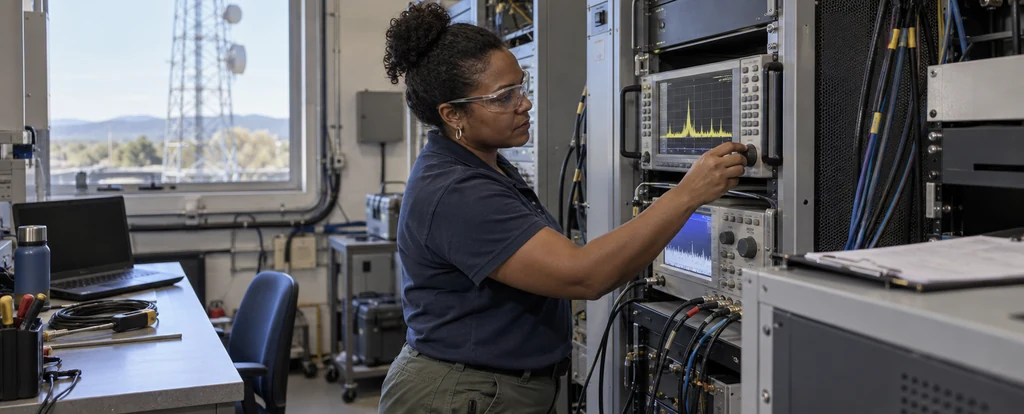
Most of the work happens at transmitter sites, from hilltop towers to regional stations, and many of those sites run unattended with the equipment watched from a control centre. The job covers the transmission chain from the incoming studio feed through to the antenna, which is what separates it from studio-based broadcast technicians who work with cameras, mixing desks and playout systems. Shifts and on-call cover run around the clock, because a service that drops off air has to be brought back quickly.
How much do broadcast transmitter operators earn?
The median full-time salary for a broadcast transmitter operator is $85,800 per annum, before tax, up $18,200 since 2018.
Pay in this job is shaped more by the roster than by the job title. Shift work, night shifts, public holidays and on-call availability all attract penalty rates or allowances under the enterprise agreements most transmission sites operate under, so two operators on similar base rates can take home quite different amounts. Technical level matters as well, and operators who can work safely on high-power transmitters and take charge of maintenance generally sit further up the scale.
What does a broadcast transmitter operator do day to day?
The list below is what fills most weeks; the exact mix shifts with seniority and whatever stage the current work is at.
- Monitoring output power, frequency and modulation across several services
- Carrying out scheduled maintenance on transmitters, antennas and feeder systems
- Diagnosing faults and restoring service, sometimes by driving to a remote site
- Aligning and testing equipment with spectrum analysers and test receivers after repairs or upgrades
- Keeping site records and compliance documentation for the broadcaster and ACMA
What skills do broadcast transmitter operators need?
Employers look for installation and maintenance, plant and equipment operation, networks and systems administration, backed by Burk Technology ARC Plus fluency and strong safety and compliance awareness.
Specialist skills
- Installation and maintenance
- Plant and equipment operation
- Networks and systems administration
- Operations management
Software and tools
- Burk Technology ARC Plus
- Rohde & Schwarz test receivers
- Orban Optimod audio processors
- SNMP monitoring platforms
- Spectrum analysers
General skills
- Safety and compliance awareness
- Problem solving
- Attention to detail
Is the job growing?
About 430 people work as broadcast transmitter operators in Australia, and employment is projected to grow 8.3% over the decade to 2035. That's modest growth: demand is steady rather than booming.
How do you become a broadcast transmitter operator?
Here's the path most broadcast transmitter operators take, step by step.
- 1Finish Year 12 with maths and physics, or start with a Certificate II in electronics
The subjects that matter are the ones behind basic electrical theory and measurement. A Certificate II in electronics is a common starting point for school leavers who want to begin paid work while they study, and it gives you something to show an employer while you look for a traineeship.
- 2Complete a Certificate III or IV in electronics and communications, or a diploma in telecommunications engineering
These qualifications cover the electronics, radio frequency and fault-finding groundwork the job relies on. Many people do the certificate as a traineeship with a transmission or telecommunications employer, which means earning while they learn, and a diploma suits someone who already has a trade or technical background.
- 3Build hands-on experience with transmission or field equipment
Entrants commonly come across from electronics technician work, telecommunications field or rigging roles, or audio-visual and broadcast equipment repair. Paid experience on live systems counts for a lot, because employers are judging whether you can work safely around high voltages and tall structures.
- 4Move into a transmitter site role and learn the specific systems
About 27% of the current workforce finished school and no further, so a degree is not the standard entry point; plenty of operators learn the transmitter and monitoring systems on the job, alongside the site procedures and safety rules that come with each location.
Ready to apply as a broadcast transmitter operator?
Whether you're working toward becoming a broadcast transmitter operator or already are one and want a hand with the next step (sharpening your resume for ATS screening, tightening your cover letter, or knowing what you'll actually be asked at interview), here are examples grounded in this specific role, not generic templates.
What jobs can a broadcast transmitter operator move to?
Moving into Telecommunications Field Engineer typically comes with the biggest pay rise, worth $15,600 a year more on average.
| Move to | Typical pay change | Overlap | Retraining |
|---|---|---|---|
| Telecommunications Field Engineer Broadcast transmitter operators can move into telecommunications field engineering by adding diploma-level network design to their radio and transmission maintenance experience. | +$15,600 | 58% | reskill |
| Data Centre Technician Broadcast transmitter operators bring electronic monitoring and equipment repair skills to computing infrastructure, with a short course covering servers and networking. | +$5,200 | 67% | short course |
| Television Equipment Operator Broadcast transmitter operators bring transmission monitoring and fault repair skills to television equipment operation, with further study covering studio and outside broadcast systems.Known move | +$2,600 | 44% | reskill |
Moves are chosen from Jobs and Skills Australia's Data on Occupation Mobility, which follows income tax records between 2011-12 and 2020-21, together with entry requirements and skill overlap. A known move is one people were seen making in that data. Pay change compares median full-time pay for the two roles.
Who works as a broadcast transmitter operator?
The typical broadcast transmitter operator is 37 years old; 77% are men, 80% work full-time, and full-timers average 40 hours a week.
- 37
- Median age
- 23%
- Female share
- 80%
- Full-time
- +0h
- vs all-jobs avg
What's it like being a broadcast transmitter operator?
The rhythm is mostly routine, with long stretches of planned maintenance and monitoring broken by faults that need an immediate response, whatever the hour. The work suits people who like technical systems, are comfortable with their own company on site, and prefer solving a problem to talking about it. It also asks for discipline, because the checks, isolations and records exist to keep you safe around high power and heights.
What people like
- A fault you can trace and fix. When a service drops off air, there is a clear problem, a set of measurements and a result you can see once the signal returns. That feedback arrives quickly and often within the same shift.
- Time with the equipment rather than in meetings. Much of the day is spent at a rack, a test set or a tower base, working through maintenance schedules and fault logs. It suits people who would rather be hands-on than coordinating other people's work.
- Sites most people never see. Transmitter stations sit on hilltops, in regional towns and on the edges of cities, and the job takes you to all of them. The trade-off is that a lot of that travel is solo and in whatever weather the site is having.
- Skills that carry into other technical fields. Monitoring systems, electronics repair and network troubleshooting are needed in computing infrastructure and telecommunications as well. That gives you options if you later want a change of direction.
What people find hard
- On-call and night work. Broadcasters run around the clock, so rosters include nights, weekends and public holidays, and a call-out can come at any hour. The loadings compensate for it, but the disruption to sleep and plans is real.
- Remote sites and bad weather. Getting to a fault can mean a long drive and an access track that is muddy, icy or overgrown. You are often the only person on site, which makes preparation and communication with the control room important.
- Being the one accountable for staying on air. Off-air time is measured and reported, and the operator on duty is the one explaining it. That pressure sits in the background even on quiet shifts.
- A narrow field, so sideways moves take retraining. The systems are specialised, and moving into television equipment operation, telecommunications engineering or data centre work means studying the parts of those jobs you have not done. It is a manageable step, but rarely an instant one.
Based on our synthesis of professional-body surveys and public accounts of the role, not first-person verified reviews.
Which industries employ broadcast transmitter operators?
Information Media and Telecommunications employs the largest share of broadcast transmitter operators, followed by Arts and Recreation Services.
Top employing industries
- 1Information Media and Telecommunications
- 2Arts and Recreation Services
Ranked by employment share; the source doesn't publish an exact percentage per industry.
| Bachelor degree | 32.9% | |
|---|---|---|
| Year 12 or below | 27.1% | |
| Diploma / Advanced Diploma | 19.5% | |
| Certificate III/IV | 12.1% | |
| Postgraduate | 3% |
Will AI replace broadcast transmitter operators?
Automation is well established in this job and has taken over much of the watching. SNMP monitoring platforms, remote telemetry and Burk-style control systems track transmitter performance, raise alarms and can switch a service to a backup unit or lower power before anyone arrives, so the operator spends less time staring at meters than they once did. What has not changed is that physical repairs, antenna work and the judgement about a site's condition need a person on location, which is why the exposure sits in the middle rather than at either end.
Share of typical working time by exposure level
- Watching transmitter performance and responding to alarmsMonitoring software raises the alarm and logs the trend, so the operator's job is deciding whether a reading means a failing component, a feed problem or a fault that has already cleared itself.30%moderate
- Scheduled maintenance and repairs on transmitters and antennasReplacing an amplifier module, reseating a feeder connector or checking an antenna at height is hands-on work that no monitoring system can do from a control room.30%low
- Diagnosing faults and restoring serviceRemote diagnostics narrow the possibilities and automated switching often keeps a service on air, but an intermittent fault at a regional site still usually ends with a technician testing hardware on site.25%moderate
- Site records and compliance documentationPerformance logs, maintenance histories and ACMA reporting are increasingly generated from the monitoring system, leaving the operator to check and sign off what it produces.15%high
Moves least exposed to AI
These career moves from broadcast transmitter operator work are rated low for AI exposure:
- Telecommunications Field Engineer
Solid skill overlap (58%), reskill to get there, and a low automation-risk profile.
Common questions about becoming a broadcast transmitter operator
Straight answers to the questions people ask most.
How much do broadcast transmitter operators earn?
Broadcast transmitter operators earn a median of $85,800 per year before tax. The roster moves that figure more than anything else, because shift loadings, on-call allowances and public holiday work add to the base rate, and operators who handle high-power sites and lead maintenance tend to be paid above it.
How do you become a broadcast transmitter operator?
Most people enter through a Certificate III or IV in electronics and communications, often as a traineeship, then move into a site role from electronics technician or telecommunications field work. The certificate gives you the electrical and radio frequency theory, while the site work teaches the transmitters, monitoring systems and safety procedures you will actually use.
Are broadcast transmitter operators in demand?
Broadcast transmitter operators are currently not in shortage, and employment is projected to grow 8.3% over the decade to 2035. The occupation is small, so openings in any given year depend as much on staff turnover at the transmission network operators and broadcasters as on the growth figure itself.
Will AI and automation replace broadcast transmitter operators?
Not entirely, but automation already handles a large share of the monitoring. Remote telemetry and network monitoring platforms flag alarms, log performance and can switch a service to a backup transmitter without anyone attending, which shifts the operator's work toward interpreting faults and deciding what to do. Climbing a tower, replacing a failed amplifier or assessing a site's condition still needs someone on the ground.
What other jobs can broadcast transmitter operators move into?
Television equipment operation is closely related broadcast work and often pays $2,600 more, though you would retrain in studio and outside broadcast systems. Moving into telecommunications field engineering usually means $15,600 more and suits operators who add diploma-level network design to their transmission maintenance experience. Data centre technician work, at $5,200 more, is a shorter step because the electronic monitoring and equipment repair skills carry across with a short course in servers and networking.
Is broadcast transmitter operation mostly solo work?
Yes, a lot of it is. Unattended sites mean you are often alone with the equipment and in radio contact with a control centre, which suits people who like working independently and can follow procedures without supervision. It helps to be comfortable raising problems early rather than sitting on them until the end of a shift.
Related roles
- Television Equipment Operator
- Telecommunications Field Engineer
- Data Centre Technician
- Television Equipment Operator
- Marketing Assistant
- Broadcast Program Director
Not sure this is you? Take the career quiz and get a ranked shortlist of roles that fit how you like to work.