Data Centre Technician
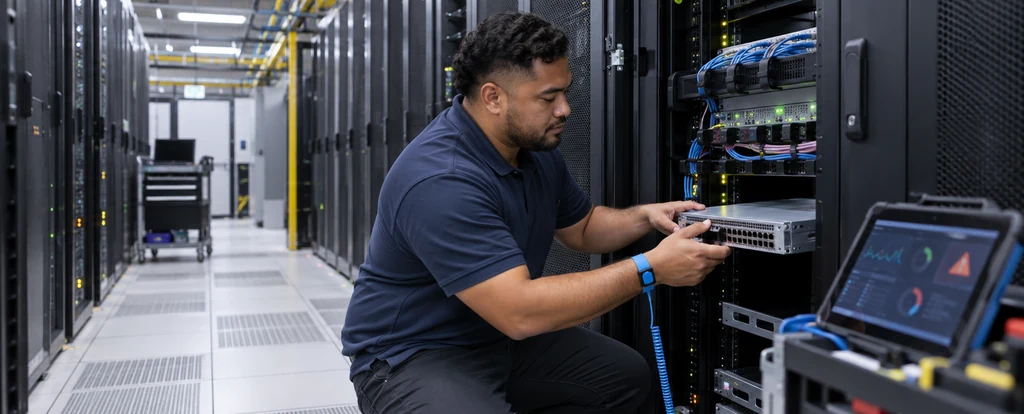
Data centre technicians install, monitor and repair the servers, storage and network hardware inside data halls, keeping the systems that banks, hospitals and government services rely on running.
- Median salary*
- $91,000
4.5%vs last year, before tax
- People employed*
- 4,200
2.4%vs last year
- Projected growth*
- +8%
to 2035
- AI exposure*
- Moderate
- automation risk
- Average hours*
- 40/wk
matches all-jobs average
- Shortage status*
- In shortage (metro)
national
They work in secure, tightly controlled rooms run by banks, cloud providers, telecommunications companies and government agencies, where the job is the physical layer: racking equipment, running cable and keeping power and cooling within range. The role sits close to systems administration, but a systems administrator works mainly in operating systems and user accounts, while a data centre technician is on the floor with the hardware. Most large facilities run shift rosters with on-call cover, under strict security and safety procedures.
How much do data centre technicians earn?
The median full-time salary for a data centre technician is $91,000 per annum, before tax, up $19,300 since 2018.
Pay here moves with your roster more than with your job title, because shift loadings, weekend and public holiday penalties and on-call allowances can add a good deal to a base rate. Government and financial sector facilities often sit under enterprise agreements with defined loadings, while cloud providers and colocation sites vary more. Vendor certifications and a security clearance also affect what individual employers are willing to offer.
What does a data centre technician do day to day?
The list below is what fills most weeks; the exact mix shifts with seniority and whatever stage the current work is at.
- Racking, stacking and cabling servers, switches and storage arrays during builds and expansions
- Monitoring power, cooling, humidity and alarm systems, and responding when readings drift
- Running diagnostics and swapping out failed disks, power supplies and network modules
- Keeping asset records, access logs and spare parts inventory up to date
- Escalating network, hardware and environmental faults to engineering teams with the detail they need to act
What skills do data centre technicians need?
Employers look for installation and maintenance, networks and systems administration, technical support and troubleshooting, backed by Schneider Electric EcoStruxure IT fluency and strong attention to detail.
Specialist skills
- Installation and maintenance
- Networks and systems administration
- Technical support and troubleshooting
- Operations management
Software and tools
- Schneider Electric EcoStruxure IT
- ServiceNow
- PRTG Network Monitor
- iLO / iDRAC
- Linux command line
General skills
- Attention to detail
- Problem solving
- Safety and compliance awareness
Is the job growing?
About 4,200 people work as data centre technicians in Australia, and employment is projected to grow 8% over the decade to 2035. That's modest growth: demand is steady rather than booming.
How do you become a data centre technician?
Here's the path most data centre technicians take, step by step.
- 1Start with a certificate or diploma in information technology
A Certificate III or IV in Information Technology (Networking) at TAFE takes roughly six to twelve months, and a diploma around two years. Either gives you the networking, hardware and operating system basics that entry-level data hall roles ask for.
- 2Add vendor certifications for the equipment you will handle
Employers look for qualifications from the makers of the hardware in the hall, such as Dell and HPE for servers, Cisco for switching, and Schneider Electric for power and cooling systems. These are short courses you can usually take while working.
- 3Get in through a nearby hardware or support role
Helpdesk, computer hardware technician and office equipment technician roles all lead here, and the hardware ones need only a short course to adapt. Many technicians move across after a year or two of servicing equipment elsewhere.
- 4Meet the site requirements for the facilities you want
Government and defence data centres require a security clearance, and every site runs induction, safety and access training before you work unsupervised. Applying early matters, because clearances can take months to come through.
Ready to apply as a data centre technician?
Whether you're working toward becoming a data centre technician or already are one and want a hand with the next step (sharpening your resume for ATS screening, tightening your cover letter, or knowing what you'll actually be asked at interview), here are examples grounded in this specific role, not generic templates.
What jobs can a data centre technician move to?
Moving into Systems Administrator typically comes with the biggest pay rise, worth $37,000 a year more on average.
| Move to | Typical pay change | Overlap | Retraining |
|---|---|---|---|
| Systems Administrator Server hall technicians bring hands-on hardware and monitoring experience to systems administration, needing further study in operating systems and user support. | +$37,000 | 30% | reskill |
| Site Reliability Engineer Server hall technicians bring monitoring and incident response habits to site reliability engineering, but need reskilling in automation, coding and distributed systems. | +$31,200 | 23% | reskill |
| Network Engineer Server hall technicians handle network hardware and cabling, a foundation for network engineering, but deeper routing, switching and configuration study is required. | +$29,100 | 13% | reskill |
| Cloud Engineer Server hall technicians understand physical infrastructure and uptime, which carries into cloud engineering, though platform and automation skills need substantial retraining. | +$20,800 | 26% | reskill |
Moves are chosen from Jobs and Skills Australia's Data on Occupation Mobility, which follows income tax records between 2011-12 and 2020-21, together with entry requirements and skill overlap. A known move is one people were seen making in that data. Pay change compares median full-time pay for the two roles.
Who works as a data centre technician?
The typical data centre technician is 36 years old; 84% are men, 88% work full-time, and full-timers average 40 hours a week.
- 36
- Median age
- 16%
- Female share
- 88%
- Full-time
- +0h
- vs all-jobs avg
What's it like being a data centre technician?
The job has a clear rhythm: planned installations and maintenance during the day, then monitoring and incident response around the clock. Much of the work is procedural and documented, which suits people who like knowing the correct step and following it carefully, and the faults that do appear are usually concrete and diagnosable. Shift work is the main trade-off, and the physical side of the hall matters more than newcomers expect.
What people like
- Uptime you can point to. By the end of a shift you know whether the work held: systems stayed up, alarms cleared, the rack you built is running.
- Faults with concrete answers. A failed disk, a dying power supply, a bad cable and a hot aisle all have a diagnosis and a fix, so the work tends to finish rather than trail on.
- Documented, ordered work. Change procedures and maintenance schedules mean you rarely have to guess at what comes next or work out priorities from scratch.
- Rosters that free up weekdays. Shift patterns, penalty rates and quieter weekday periods suit people who would rather have time off outside peak commuting hours.
What people find hard
- Nights, weekends and on-call. Data centres do not close, so rosters include night shifts and public holidays, and a failure at 2am can mean being called in.
- Escorted access and security process. Sign-ins, escorts and restrictions on devices and photographs are necessary in a client facility, but they slow down work that feels urgent.
- Heavy, warm and noisy floor work. Lifting equipment into racks, working in warm aisles and wearing hearing protection for long stretches are part of the job.
- Quiet stretches broken by urgency. Some shifts are routine checks and paperwork, then a cooling fault or a battery alarm arrives with a short window to fix it.
Based on our synthesis of professional-body surveys and public accounts of the role, not first-person verified reviews.
Which industries employ data centre technicians?
Information Media and Telecommunications employs the largest share of data centre technicians, followed by Professional, Scientific and Technical Services.
Top employing industries
- 1Information Media and Telecommunications
- 2Professional, Scientific and Technical Services
- 3Financial and Insurance Services
- 4Public Administration and Safety
Ranked by employment share; the source doesn't publish an exact percentage per industry.
| Bachelor degree | 38% | |
|---|---|---|
| Diploma / Advanced Diploma | 24% | |
| Certificate III/IV | 20% | |
| Postgraduate | 10% | |
| Other | 8% |
Will AI replace data centre technicians?
This job sits in the middle: monitoring and alerting are increasingly automated, while installation and repair stay firmly physical. Software such as Schneider Electric EcoStruxure IT and PRTG Network Monitor continuously watches temperature, power draw and device health and raises alerts earlier than a technician on a walk-through would, which turns a lot of the work from watching dashboards into verifying and acting on what the system reports. Cabling, racking and component swaps still need someone in the hall with tools.
Share of typical working time by exposure level
- Racking, cabling and installing hardwareMounting a switch, running and labelling cable and dressing a rack is hands-on work in a secured space, and no tool lifts equipment into a cabinet for you.35%low
- Diagnosing and replacing failed componentsMonitoring software can flag a failing disk or power supply, but confirming which module is at fault and swapping it under a change procedure is still manual.25%moderate
- Monitoring power, cooling and environmental alarmsTools like EcoStruxure IT and PRTG poll temperature, humidity and device health constantly and raise alerts automatically, so the technician's time goes into triage and escalation rather than reading gauges.25%high
- Keeping asset records, work orders and access logs currentWorkflow systems such as ServiceNow generate and route work orders on their own, leaving the technician to make sure entries stay accurate as hardware is added and retired.15%high
Common questions about becoming a data centre technician
Straight answers to the questions people ask most.
How much does a data centre technician earn?
Data centre technicians earn a median of $91,000 per year before tax. Treat that as a guide, because shift loadings, on-call allowances and security clearance requirements change what individual sites pay.
How do you become a data centre technician?
Most people start with a Certificate III or IV in Information Technology (Networking) or a diploma, then add vendor certifications for the servers, switches and power systems they will handle. A nearby role in hardware repair or IT support is another common entry point, often needing only a short course to adapt.
Are data centre technicians in demand?
Data centre technicians are currently in shortage in metropolitan areas, and employment is projected to grow 8% over the decade to 2035 over the decade to 2035. The openings cluster around large facilities as new capacity is built in stages, so hiring tends to move with construction and fit-out schedules.
Will AI and automation replace data centre technicians?
Monitoring and alert triage are already heavily automated, with tools such as Schneider Electric EcoStruxure IT and PRTG Network Monitor watching temperature, power draw and device health and raising alerts before a person would notice. That shifts the technician's work towards verifying and responding to what the software reports. Installing, cabling and physically replacing hardware still needs someone on the floor, so the role is changing rather than disappearing.
What can a data centre technician move into?
Systems administration, cloud engineering and site reliability engineering are common destinations, each building on the hardware and monitoring habits of the data hall, though all three need further study in operating systems, automation and coding. Network engineering suits people who enjoy the cabling and switching side, with deeper study in routing and configuration. Pay typically rises with these moves, for example systems administrators earn $37,000 more and cloud engineers $20,800 more.
Do data centre technicians work shifts?
Most large facilities run around the clock, so rosters include nights, weekends and public holidays, usually with shift loadings attached. Smaller sites and in-house IT teams keep closer to business hours and cover the rest with on-call.
Related roles
- Systems Administrator
- Cloud Engineer
- Site Reliability Engineer
- Network Engineer
- Computer Hardware Technician
- Office Equipment Technician
Not sure this is you? Take the career quiz and get a ranked shortlist of roles that fit how you like to work.