Calibration Technician
Calibration technicians check, adjust and certify measuring instruments so the readings that laboratories, factories and utilities rely on stay accurate.
- Median salary*
- $75,400
3.7%vs last year, before tax
- People employed*
- 4,500
0.0%vs last year
- Projected growth*
- +3%
to 2035
- AI exposure*
- Moderate
- automation risk
- Average hours*
- 38/wk
−2h vs all jobs
- Shortage status*
- Not in shortage
national
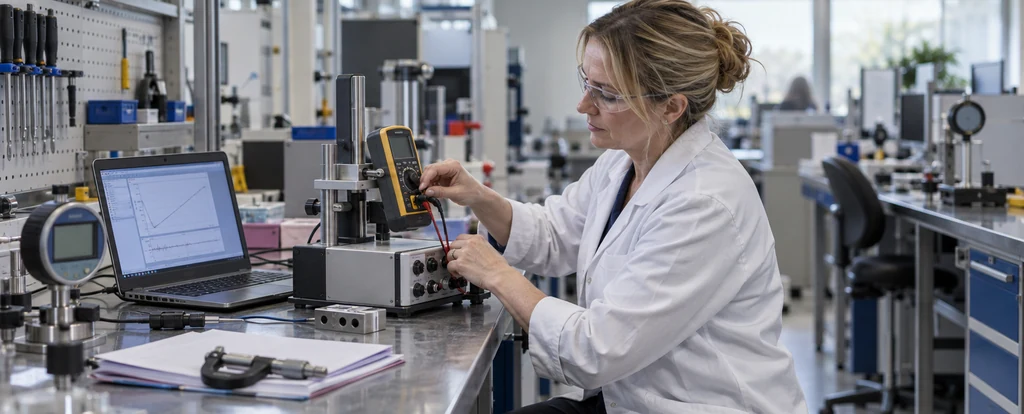
The work happens on a bench in a calibration laboratory, on a production floor or at a customer's site, and the constant is comparison: an instrument's reading is measured against a reference standard that traces back to a national authority. What separates the job from general instrument repair is the record keeping, because every adjustment and uncertainty figure has to be documented well enough to survive an audit. Calibration technicians work in accredited testing laboratories, manufacturer service centres, and the instrument teams of utilities, mines and water authorities.
How much do calibration technicians earn?
The median full-time salary for a calibration technician is $75,400 per annum, before tax, up $15,500 since 2018.
Where you work shapes pay as much as experience does, with calibration roles in mining, gas and utilities generally sitting above those in manufacturing laboratories, and site or shutdown work adding overtime and allowances. Accreditation matters too, since a technician signed off to issue certificates in an accredited laboratory carries more responsibility than one doing incoming checks on a production line. Shift rosters and regular travel to remote sites are the other main levers.
What does a calibration technician do day to day?
The list below is what fills most weeks; the exact mix shifts with seniority and whatever stage the current work is at.
- Checking instruments against reference standards, from handheld multimeters and pressure gauges to temperature probes and flow meters
- Recording results and calculating measurement uncertainty so each certificate reflects what the instrument can actually hold
- Adjusting or repairing instruments that sit outside tolerance, then re-testing to confirm the fix
- Setting up calibration rigs and looking after the reference equipment they depend on
- Keeping traceability records, certificates and calibration schedules current for customers and auditors
What skills do calibration technicians need?
Employers look for plant and equipment operation, installation and maintenance, regulatory compliance, backed by Fluke MET/CAL fluency and strong attention to detail.
Specialist skills
- Plant and equipment operation
- Installation and maintenance
- Regulatory compliance
- Field inspection and testing
Software and tools
- Fluke MET/CAL
- Keysight BenchVue
- National Instruments LabVIEW
- Mitutoyo MeasurLink
- Microsoft Excel
General skills
- Attention to detail
- Problem solving
- Written communication
Is the job growing?
About 4,500 people work as calibration technicians in Australia, and employment is projected to grow 3% over the decade to 2035. That's modest growth: demand is steady rather than booming.
How do you become a calibration technician?
Here's the path most calibration technicians take, step by step.
- 1Finish Year 12 with maths, and physics if you can
Calibration courses and employers assume Year 12 maths, and physics helps with the electrical, pressure and flow work. You do not need a high ATAR for a traineeship, so a solid pass in those subjects is enough.
- 2Take a Certificate III or IV in engineering or laboratory techniques
Calibration and measurement units sit inside the engineering technical and laboratory techniques qualifications, where you learn to use reference standards, write certificates and work to a quality system. It usually takes one to two years, and many people complete it as a traineeship while already employed.
- 3Start on the bench as a technician or assistant
Entry roles often begin with incoming checks and simple instruments under supervision, with more complex work added as you earn sign-off. Employers generally provide the instrument-specific training, including calibration software such as Fluke MET/CAL or Keysight BenchVue.
- 4Build depth in one measurement area
Technicians tend to settle into electrical, temperature, pressure, dimensional or flow measurement. Depth in a single discipline is what makes you useful to an accredited laboratory, and it is usually what senior signatory roles ask for.
- 5Add a diploma if you want the laboratory or supervisory path
A diploma or degree in engineering or instrumentation opens up laboratory supervision, method development and specialist calibration work. Plenty of technicians stay on the tools without one and are valued for hands-on skill instead.
Ready to apply as a calibration technician?
Whether you're working toward becoming a calibration technician or already are one and want a hand with the next step (sharpening your resume for ATS screening, tightening your cover letter, or knowing what you'll actually be asked at interview), here are examples grounded in this specific role, not generic templates.
What jobs can a calibration technician move to?
Moving into Electronic Engineering Technician typically comes with the biggest pay rise, worth $36,000 a year more on average.
| Move to | Typical pay change | Overlap | Retraining |
|---|---|---|---|
| Electronic Engineering Technician Electronic calibration experience supports testing and maintaining electronic systems, with further study in electronics required for the technician role. | +$36,000 | 43% | reskill |
| Non-destructive Testing Technician Calibration skills transfer directly to non-destructive testing, where precision measurement and equipment checks are central, needing minimal extra training. | +$26,000 | 63% | minimal |
| Gas Network Technician Gas network instrumentation and measurement draw on calibration skills, with a short course in gas operations and safety. | +$26,000 | 54% | short course |
| Underground Services Locator Locating buried services uses similar detection and measurement equipment, with a short course covering underground locating and safety. | +$18,200 | 57% | short course |
| Biomedical Technician Calibrating medical equipment builds on instrument skills, but a diploma in biomedical technology is needed to enter the field. | +$15,600 | 63% | reskill |
Moves are chosen from Jobs and Skills Australia's Data on Occupation Mobility, which follows income tax records between 2011-12 and 2020-21, together with entry requirements and skill overlap. A known move is one people were seen making in that data. Pay change compares median full-time pay for the two roles.
Who works as a calibration technician?
The typical calibration technician is 40 years old; 88% are men, 88% work full-time, and full-timers average 38 hours a week.
- 40
- Median age
- 12%
- Female share
- 88%
- Full-time
- −2h
- vs all-jobs avg
What's it like being a calibration technician?
Calibration work runs on schedules, so the week is a mix of booked jobs, certificate writing and the occasional instrument that refuses to settle. The rhythm suits someone who likes a defined task with a correct answer, and who does not mind that the same instrument type comes back next month. Interruptions are usually technical rather than personal, which makes it a quieter working life than many technical trades.
What people like
- The work has a right answer. An instrument is either within tolerance or it is not, and the uncertainty budget either supports the certificate or it does not. That clarity appeals to people who like knowing when a job is finished.
- Instruments from every industry cross the bench. One week it might be a hospital's infusion pump, the next a winery's flow meter or a mine's gas detector. The variety comes from the customers rather than the task.
- You can see a fix work. Adjusting an instrument that has drifted and watching the readings come back into line gives immediate feedback, which is rarer in technical work than it sounds.
- Structured, planned days. Calibration intervals mean work is booked ahead, so most days follow an order you can see in the morning. Site visits and shutdowns break the pattern in a way that suits people who like occasional travel.
What people find hard
- Repetition is built into the schedule. A laboratory calibrating the same model of pressure gauge all week is doing necessary work, not varied work. The challenge usually comes from the instrument, not the setting.
- The paperwork is half the job. Certificates, traceability records and uncertainty budgets have to be right, and an error found in an audit falls back on the technician who signed it. Good bench skills alone are not enough.
- Due dates cluster. Calibration cycles and plant shutdowns bunch work into the same few weeks, and customers with a lapsed certificate are rarely relaxed about it.
- Not every bench is clean. Site work can mean a mine, a sewage treatment plant or a factory floor, in heat or noise, with the instrument carefully packed for the trip home.
Based on our synthesis of professional-body surveys and public accounts of the role, not first-person verified reviews.
Which industries employ calibration technicians?
Manufacturing employs the largest share of calibration technicians, followed by Professional, Scientific and Technical Services.
Top employing industries
- 1Manufacturing
- 2Professional, Scientific and Technical Services
- 3Electricity, Gas, Water and Waste Services
- 4Mining
- 5Public Administration and Safety
Ranked by employment share; the source doesn't publish an exact percentage per industry.
| Certificate III/IV | 34% | |
|---|---|---|
| Diploma / Advanced Diploma | 26% | |
| Bachelor degree | 20% | |
| Year 12 or below | 20% |
Will AI replace calibration technicians?
Calibration sits in the middle of the range: the software side of the job is steadily automating, while the physical comparison and the judgement about whether an instrument is fit to use still need a person. Calibration management systems and programs such as Fluke MET/CAL already handle scheduling, data capture and uncertainty calculations, which removes the arithmetic but not the decisions. Instruments that log their own drift and digital certificates cut paperwork further, yet someone still has to set up the rig, notice an odd reading and decide the instrument needs repair.
Share of typical working time by exposure level
- Running calibrations against reference standardsAutomated benches and calibration software capture each test point, but a technician still connects the instrument, sets the conditions and watches for a reading that behaves unexpectedly.40%moderate
- Recording results and calculating uncertaintyCalibration software produces certificates and uncertainty budgets directly from the raw data, which has removed most of the manual calculation and transcription from the job.25%high
- Adjusting instruments back into toleranceTrimmers, seals, linkages and sensor alignment still need hands, and knowing how far to turn something comes from having adjusted that instrument type before.20%low
- Setting up rigs and maintaining reference equipmentWorking out what a job needs and keeping reference standards inside their own calibration intervals is planned and checked by people, not by the systems that record the results.15%low
Moves least exposed to AI
These career moves from calibration technician work are rated low for AI exposure:
- Biomedical Technician
High skill overlap (63%), reskill to get there, and a low automation-risk profile.
Common questions about becoming a calibration technician
Straight answers to the questions people ask most.
How much does a calibration technician earn?
Calibration technicians earn $75,400 per year before tax at the median for full-time work. That figure is a midpoint across industries, so it sits above what a small manufacturing laboratory pays and below what a mine site or utility typically pays, and it rises with accreditation and specialist skill.
How do you become a calibration technician?
Most people enter through a Certificate III or IV in engineering or laboratory techniques, often as a traineeship that combines study with paid bench work. From there you build experience on more complex instruments, and your employer usually trains you on its calibration software and quality system.
Are calibration technicians in demand?
Calibration technicians are currently not in shortage in Australia, and employment is projected to grow 3% over the decade to 2035 over the decade to 2035. The work follows industry regulation and quality certification rather than the wider hiring cycle, so opportunities cluster in manufacturing, utilities, mining and testing laboratories, and employers often value experience over a specific qualification.
Will AI and automation replace calibration technicians?
Automation has already taken over part of the job, particularly data capture, uncertainty calculations and certificate generation, and that trend will continue. What stays with the technician is the physical setup, the adjustment of an instrument back into tolerance and the judgement call about whether a reading is believable or an instrument needs repair.
What can a calibration technician move into?
Non-destructive testing is a close move: the precision measurement and equipment checks overlap, and most technicians need only minimal extra training, with pay around $26,000 more. Biomedical technician work builds on instrument calibration but usually requires a diploma in biomedical technology, and pays about $15,600 more, while a gas network technician role draws on the same measurement skills with a short course in gas operations, at around $26,000 more.
Do you need a university degree to be a calibration technician?
No. The industry runs on certificates and diplomas, and most technicians learn the instrument-specific work on the job. A degree in engineering or instrumentation is useful if you want to move into method development, laboratory management or specialist metrology, but it is not an entry requirement.
Related roles
- Non-destructive Testing Technician
- Biomedical Technician
- Electronic Engineering Technician
- Underground Services Locator
- Gas Network Technician
- Test and Tag Technician
Not sure this is you? Take the career quiz and get a ranked shortlist of roles that fit how you like to work.