Non-destructive Testing Technician
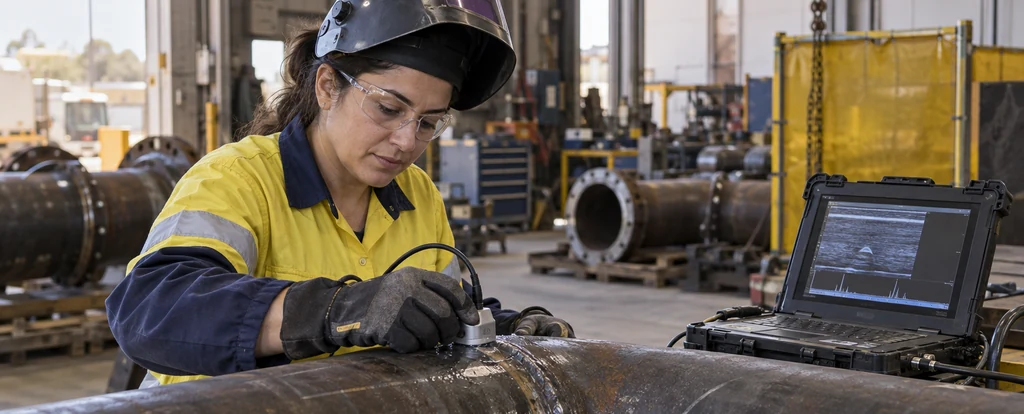
Non-destructive testing technicians inspect welds, pipes and structures without cutting them open, checking that pressure vessels, pipelines and mine equipment are safe to stay in service.
- Median salary*
- $101,400
3.6%vs last year, before tax
- People employed
- 1,400
0.0%vs last year
- Projected growth*
- +5%
to 2035
- AI exposure*
- Moderate
- automation risk
- Average hours*
- 42/wk
+2h vs all jobs
- Shortage status*
- In shortage
national
Non-destructive testing technicians check the internal condition of welds, castings, pipelines and structural components using methods such as ultrasonic, radiographic, magnetic particle and dye penetrant testing, which find cracks, voids and corrosion without damaging the part. Unlike a welding inspector, who judges a weld against a welding code, they establish what is actually inside the metal and certify whether a component is fit for service. The work concentrates in mining support services, oil and gas, fabrication, construction and defence, and often involves site work, shutdowns and shift rosters.
How much do non-destructive testing technicians earn?
The median full-time salary for a non-destructive testing technician is $101,400 per annum, before tax, up $21,600 since 2018.
Pay moves with how many test methods you are certified in and at what level, because a technician who can interpret results and sign off a component carries more responsibility than one working under supervision. Sector shapes it too: mining support, oil and gas and defence work often come with roster, shutdown and site allowances that a workshop job does not. Radiation licences and extra method endorsements open up the work that pays above the ordinary award.
What does a non-destructive testing technician do day to day?
The list below is what fills most weeks; the exact mix shifts with seniority and whatever stage the current work is at.
- Testing welds, castings and pipework with ultrasonic, radiographic, magnetic particle and dye penetrant methods
- Reading radiographs and scan traces to identify cracks, voids, inclusions and corrosion
- Calibrating probes, film and reference blocks and checking readings against known standards
- Writing inspection reports that record the method, the findings and whether a component is fit for service
- Setting up radiation barriers, confined space controls and other safety measures before testing begins
What skills do non-destructive testing technicians need?
Employers look for plant and equipment operation, field inspection and testing, laboratory analysis, backed by Olympus OmniScan (ultrasonic and phased array) fluency and strong attention to detail.
Specialist skills
- Plant and equipment operation
- Field inspection and testing
- Laboratory analysis
- Regulatory compliance
Software and tools
- Olympus OmniScan (ultrasonic and phased array)
- Zetec UltraVision
- Waygate Technologies Rhythm
- DURR NDT D-Tect (digital radiography)
- Carestream INDUSTREX digital radiography
General skills
- Attention to detail
- Safety and compliance awareness
- Problem solving
- Written communication
Is the job growing?
About 1,400 people work as non-destructive testing technicians in Australia, and employment is projected to grow 5% over the decade to 2035. That's modest growth: demand is steady rather than booming.
How do you become a non-destructive testing technician?
Here's the path most non-destructive testing technicians take, step by step.
- 1Come in through a trade or an engineering qualification
Welding, fabrication, mechanical fitting and electrical trades are common entry points, and a Certificate III or IV in engineering is the qualification most people in the role hold, at about 34% of the workforce. Year 12 maths and physics help with the theory behind the methods.
- 2Get certified in the test methods
Certification comes from the Australian Institute for Non-Destructive Testing, which assesses technicians to ISO 9712 in methods such as ultrasonic, radiographic, magnetic particle and dye penetrant testing. You start at Level 1 under supervision and build the training, documented experience and exams needed for Level 2.
- 3Add the licences site work needs
Radiographic testing requires a radiation licence from your state or territory regulator, and construction sites ask for a White Card, plus confined space and working at heights training for vessels, towers and tanks. The rules differ by state, so check with the regulator where you intend to work.
- 4Build hours across methods and industries
Level 2 certification is what lets you test and report without direct supervision, and it depends on documented experience across different methods and jobs. Shutdowns, pipeline work and mine sites are where most technicians accumulate those hours.
- 5Move to Level 3 or into inspection work
Level 3 technicians write the procedures, supervise others and carry the technical accountability for a job, which usually takes several years of Level 2 experience. From there, welding inspection, marine survey or rail examination are realistic directions.
Ready to apply as a non-destructive testing technician?
Whether you're working toward becoming a non-destructive testing technician or already are one and want a hand with the next step (sharpening your resume for ATS screening, tightening your cover letter, or knowing what you'll actually be asked at interview), here are examples grounded in this specific role, not generic templates.
What jobs can a non-destructive testing technician move to?
Moving into Marine Surveyor typically comes with the biggest pay rise, worth $13,000 a year more on average.
| Move to | Typical pay change | Overlap | Retraining |
|---|---|---|---|
| Marine Surveyor Structural inspection and testing knowledge supports marine survey work, though maritime qualifications and surveyor training are needed. | +$13,000 | 53% | reskill |
| Welding Inspector Non-destructive testing skills in weld inspection carry into welding inspection, with extra certification in welding codes and quality standards. | +$2,600 | 53% | short course |
| Train Examiner Inspection and testing discipline transfers to rail vehicle examination, with rail-specific training and safety accreditation required. | −$2,600 | 60% | short course |
| Underground Services Locator Locating buried services relies on detection equipment and site inspection, building on non-destructive testing experience with short training. | −$7,800 | 55% | short course |
| Calibration Technician Calibration work shares the same measurement, instrumentation and quality discipline, so the move needs little extra study. | −$26,000 | 63% | minimal |
Moves are chosen from Jobs and Skills Australia's Data on Occupation Mobility, which follows income tax records between 2011-12 and 2020-21, together with entry requirements and skill overlap. A known move is one people were seen making in that data. Pay change compares median full-time pay for the two roles.
Who works as a non-destructive testing technician?
The typical non-destructive testing technician is 38 years old; 92% are men, 89% work full-time, and full-timers average 42 hours a week.
- 38
- Median age
- 8%
- Female share
- 89%
- Full-time
- +2h
- vs all-jobs avg
What's it like being a non-destructive testing technician?
The job runs on a mix of workshop and site work, where the testing itself is a short, careful burst of activity and the preparation and paperwork around it take longer than newcomers expect. Shutdowns and construction projects set the pace, so hours can be long and travel regular, but the work is methodical and rule-bound. It suits people who like knowing exactly what standard they are working to and who do not mind the conditions that come with testing plant in service.
What people like
- Results you can point to. A radiograph or scan trace shows the defect, so you can tell a client whether a weld is sound or needs repair, which is a clear answer to a real question.
- Different sites and different equipment. The same methods turn up on refinery piping, mine plant, pressure vessels, bridges and defence equipment, so the setting changes even when the technique does not.
- Written rules about what good looks like. Standards and procedures define what counts as a defect and what to do about it, so there is rarely an argument about whether a job was done properly.
- Certification that is recognised overseas. ISO 9712 certification is used in many countries, which gives experienced technicians options outside Australia.
What people find hard
- Radiation and confined space controls slow everything down. Radiographic work means exclusion barriers, dosimeters and clearances before a shot is taken, and entering a vessel adds another layer of checks, so a job that takes minutes to shoot can take hours to set up.
- Rosters, travel and night work. Shutdowns and remote sites set the calendar, and FIFO or camp rosters mean weeks away from home at a time.
- The record-keeping. Every test needs calibration records, method details and a written report, and clients and auditors expect that paperwork to stand up years later.
- Long runs of the same test. On a fabrication or pipeline job you may test hundreds of similar welds in heat, at height or in dust, and the repetition is harder than the technique.
Based on our synthesis of professional-body surveys and public accounts of the role, not first-person verified reviews.
Which industries employ non-destructive testing technicians?
Mining support services employs the largest share of non-destructive testing technicians, followed by Oil and gas extraction.
Top employing industries
- 1Mining support services
- 2Oil and gas extraction
- 3Manufacturing
- 4Construction
- 5Public administration and safety (defence)
Ranked by employment share; the source doesn't publish an exact percentage per industry.
| Certificate III/IV | 34% | |
|---|---|---|
| Diploma / Advanced Diploma | 26% | |
| Bachelor degree | 20% | |
| Year 12 or below | 20% |
Will AI replace non-destructive testing technicians?
Automation reaches the analysis and the paperwork more than the testing itself, so the overall exposure sits at a moderate level. Scanning and reporting software can flag likely defects on a radiograph or ultrasonic trace and draft the inspection record, but someone still has to place the probe, work inside a radiation barrier and sign off that a weld is fit for service.
Share of typical working time by exposure level
- Reading and interpreting the indicationsSoftware increasingly highlights probable defects on a scan and ranks them, but distinguishing a real crack from a geometry echo is still the technician's call.30%moderate
- Recording results and issuing reportsReport templates, calibration logs and method records are being generated automatically from the test data, leaving the technician to review and sign.30%high
- Setting up and calibrating equipmentCalibrating probes against reference blocks and getting a transducer seated on an awkward weld still needs hands on the job.20%low
- Running the test on site or in the workshopClimbing into a vessel, working at height or scanning a pipeline in the heat is physical work that machines do not reach yet.20%low
Common questions about becoming a non-destructive testing technician
Straight answers to the questions people ask most.
How much do non-destructive testing technicians earn?
$101,400 per year before tax for full-time work. What you earn above that depends on how many methods you are certified in, your certification level, and whether the work is site-based with rosters and allowances or in a workshop. Adding a radiation licence or another method endorsement is the most direct way to lift it.
How do you become a non-destructive testing technician?
Most people arrive from a trade or an engineering qualification and then get certified through the Australian Institute for Non-Destructive Testing, which assesses technicians to ISO 9712 in each test method. You begin at Level 1 working under supervision and build training hours, logged experience and exams before moving to Level 2. Site work also needs a radiation licence for radiography and a White Card or confined space training for construction jobs.
Are non-destructive testing technicians in demand?
Non-destructive testing technicians are currently in shortage nationally. Employment is projected to grow 5% over the decade to 2035, and because the occupation is small, with about 1,400 people working in it, openings often come from technicians retiring or moving into inspection and supervision. Certification is the main thing employers screen for, so it is worth checking which methods and industries the jobs near you are asking for.
Will AI and automation replace non-destructive testing technicians?
The tools that analyse results are the exposed part: digital radiography and ultrasonic software increasingly flag likely defects and draft the record for a technician to check. The physical work is much harder to automate, because someone still has to reach the weld, set up the probe or film, stay inside the radiation barrier and sign off the result. Overall the role sits at a moderate level of exposure rather than being replaced outright.
What can non-destructive testing technicians move into?
Welding Inspector is a close move, since you are already testing welds and only need extra certification in welding codes and quality standards, and the pay difference is $2,600 more. Train Examiner is another, at $2,600 less, building on the same testing discipline with rail-specific training and safety accreditation. Experienced technicians also take on contract work or start their own inspection business, which is often where earnings grow.
Do you need a degree to work as a non-destructive testing technician?
No, a degree is not required, and most people in the role hold a Certificate III or IV or a diploma. About 20% of the current workforce has a bachelor degree, often in engineering or science, which can help with procedure writing and Level 3 certification later. Certification to ISO 9712 is what employers actually look for first.
Related roles
- Welding Inspector
- Calibration Technician
- Marine Surveyor
- Train Examiner
- Underground Services Locator
- Test and Tag Technician
Not sure this is you? Take the career quiz and get a ranked shortlist of roles that fit how you like to work.