Dairy Farm Worker
Dairy farm workers milk the herd, feed and check the cows, and keep the shed and equipment running so milk leaves the farm in saleable condition.
- Median salary*
- $59,800
3.8%vs last year, before tax
- People employed
- 4,200
0.0%vs last year
- Projected growth
- +1.8%
to 2035
- AI exposure*
- Low
- automation risk
- Average hours
- 47/wk
+7h vs all jobs
- Shortage status*
- In shortage (regional)
national
Dairy farm workers spend their days in the milking shed and out on the pasture, mostly on family-owned or corporate farms in the dairying regions. The role sits between general farm work and herd management: you handle animals every day, but the routine is built around the twice-daily milking and the hygiene standards that keep milk safe for processing. Most dairy farm workers are full time, and the working week starts early.
How much do dairy farm workers earn?
The median full-time salary for a dairy farm worker is $59,800 per annum, before tax, up $12,400 since 2018.
Most dairy farm workers are paid under the Pastoral Award, so the rate depends on your classification level and whether you're permanent, part time or casual. Larger corporate farms, and jobs where you also handle herd health or machinery, tend to pay above the award, and on-farm housing is sometimes part of the package, which changes what lands in your account. Herd size and the region matter too, since farms in the main dairying districts compete for the same small pool of workers.
What does a dairy farm worker do day to day?
The list below is what fills most weeks; the exact mix shifts with seniority and whatever stage the current work is at.
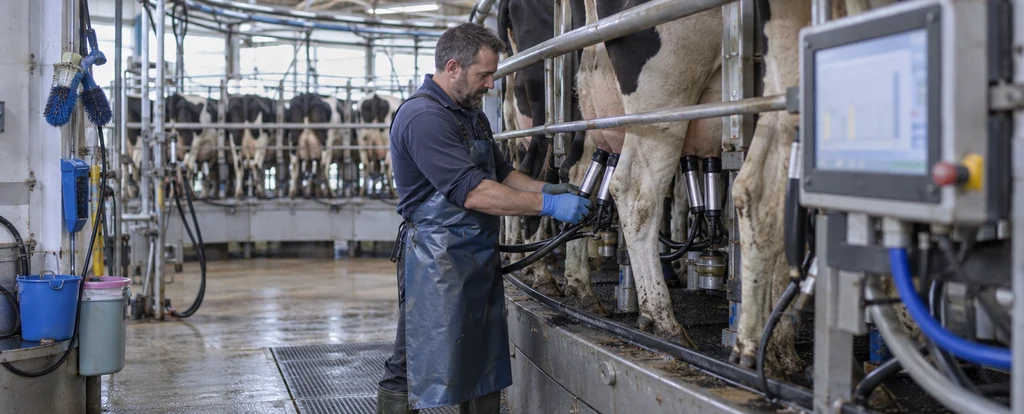
- Milking the herd in the shed twice a day, attaching cups and watching the milk for signs of mastitis
- Checking cow health and condition, drafting animals that need treatment and reporting problems to the herd manager
- Feeding out hay, silage or grain and shifting stock between paddocks on a rotation
- Cleaning the milking plant, vat and yards to food safety and hygiene standards
- Assisting with calving and calf rearing, and entering production and treatment records into herd software
What skills do dairy farm workers need?
Employers look for animal care and handling, plant and equipment operation, cleaning and grounds maintenance, backed by DairyComp 305 fluency and strong physical stamina and dexterity.
Specialist skills
- Animal care and handling
- Plant and equipment operation
- Cleaning and grounds maintenance
- Food safety and hygiene
Software and tools
- DairyComp 305
- Lely T4C
- Tractor
- ATV
- Milking machine
General skills
- Physical stamina and dexterity
- Safety and compliance awareness
Is the job growing?
About 4,200 people work as dairy farm workers in Australia, and employment is projected to grow 1.8% over the decade to 2035. That's modest growth: demand is steady rather than booming.
How do you become a dairy farm worker?
Here's the path most dairy farm workers take, step by step.
- 1Start with an entry-level job on a farm
No formal qualification is needed for milking and general farm work, and farms hire on reliability and a willingness to learn. About 58% of people in the role have Year 12 or below, and training in milking, animal handling and shed hygiene happens on the job.
- 2Get a car licence and the basic farm certificates
Dairying regions sit well outside town, so a driver's licence is usually the first thing an employer asks about. A tractor or forklift licence, quad bike training and a chemical handling certificate widen what you can be trusted to do beyond the milking roster.
- 3Add a Certificate III in Agriculture (Dairy Production)
TAFE and agricultural colleges offer the qualification, often as a traineeship, and it usually takes around 12 to 24 months while you work and get paid. About 22% of people in the role hold a certificate III or IV, and it helps if you want to move into herd management rather than stay on the milking roster.
- 4Build the skills farms pay more for
Artificial insemination, calf rearing, mastitis management and machinery operation are learned through short courses or on the job, and they are what separate a general hand from someone a farm wants to keep.
- 5Move into a second-in-charge or herd manager role
These positions carry responsibility for the milking routine, herd health and other staff, and they are the usual step before share farming or farm management.
Ready to apply as a dairy farm worker?
Whether you're working toward becoming a dairy farm worker or already are one and want a hand with the next step (sharpening your resume for ATS screening, tightening your cover letter, or knowing what you'll actually be asked at interview), here are examples grounded in this specific role, not generic templates.
What jobs can a dairy farm worker move to?
Moving into Truck Driver typically comes with the biggest pay rise, worth $42,100 a year more on average.
| Move to | Typical pay change | Overlap | Retraining |
|---|---|---|---|
| Truck Driver Farm vehicle experience and livestock transport knowledge can lead into truck driving, though a heavy vehicle licence is needed.Known move | +$42,100 | 4% | reskill |
| Process Worker Dairy farm workers move into process work using similar machinery, hygiene and physical stamina, often adding food safety training.Known move | +$19,200 | 18% | reskill |
| Agricultural Machinery Operator Milking and feeding routines build practical machinery skills, so dairy farm workers can specialise in agricultural machinery operation with formal training.Known move | +$15,600 | 13% | reskill |
| Dairy Farmer Dairy farm workers can step up to dairy farmer by taking on herd ownership, farm management and business responsibilities.Known move | +$14,000 | 38% | reskill |
| Meat Process Worker Animal handling, hygiene and physical work carry into meat processing, with short training in food safety and knife skills.Known move | +$4,900 | 61% | short course |
Moves are chosen from Jobs and Skills Australia's Data on Occupation Mobility, which follows income tax records between 2011-12 and 2020-21, together with entry requirements and skill overlap. A known move is one people were seen making in that data. Pay change compares median full-time pay for the two roles.
Who works as a dairy farm worker?
The typical dairy farm worker is 31 years old; 61% are men, 59% work full-time, and full-timers average 47 hours a week.
- 31
- Median age
- 39%
- Female share
- 59%
- Full-time
- +7h
- vs all-jobs avg
What's it like being a dairy farm worker?
The job is built around the milking roster, which runs twice a day, every day of the year, so early starts, weekend work and public holidays are part of the pattern rather than an occasional extra. The hours between milkings go on feeding, moving stock and maintenance, which means you're outdoors in all weather and on your feet for most of it. People who settle into it tend to like animals, prefer practical work to desk work, and are comfortable with a routine that repeats.
What people like
- You can see whether your work is going well. Milk production, cell counts and cow condition respond to how well feeding, milking and hygiene are done, so the daily numbers tell you something real about the job you did.
- Outdoors and on the move. Most of the day is spent with animals and machinery rather than in an office, and the work keeps you fit without a gym membership.
- You learn the whole farm. Milking, feeding, animal health and equipment all come into the role, which is why it works as a grounding for herd management or farm management later.
- Small teams with real responsibility. Many farms run with a handful of staff, so you're trusted with the herd early rather than watching someone else do the work.
What people find hard
- Early starts and a split day. Milking usually starts before dawn and runs again in the late afternoon, so the day is broken in two and social plans take more arranging.
- The roster runs every day. Cows are milked on weekends and public holidays, so days off fall on a roster rather than on the calendar.
- Weather and physical wear. Feeding out and shifting stock happen in heat, rain and mud, and the lifting, bending and machinery work adds up over years.
- Pay is set by the award on many farms. Getting ahead on pay usually means moving up the classification levels, taking on herd health or machinery work, or moving into management.
Based on our synthesis of professional-body surveys and public accounts of the role, not first-person verified reviews.
Which industries employ dairy farm workers?
Agriculture, Forestry and Fishing employs the largest share of dairy farm workers.
Top employing industries
- 1Agriculture, Forestry and Fishing
Ranked by employment share; the source doesn't publish an exact percentage per industry.
| Year 12 or below | 58% | |
|---|---|---|
| Certificate III/IV | 22.1% | |
| Bachelor degree | 8% | |
| Diploma / Advanced Diploma | 4.8% | |
| Postgraduate | 1.8% |
Will AI replace dairy farm workers?
Dairy farm work has low exposure overall, because the job is built around animals, weather and machinery that can't be handled remotely. Robotic milking, automated drafting and herd management software such as DairyComp 305 and Lely T4C are established on larger farms, and they take over much of the milking routine and the record keeping. What stays with the worker is the physical work around the herd: drafting cows, treating them, feeding out and keeping the shed and fences in order.
Share of typical working time by exposure level
- Milking the herdAutomated cup removal and robotic units handle part of the milking, but cows are still drafted, checked and treated by hand at each of the two daily milkings.35%low
- Herd health and animal handlingSensors flag a drop in milk yield or rumination, and someone still has to bring the cow in, work out what is wrong and treat it.30%low
- Feeding out and moving stockFeed allocation software and automated feeders can set rations, though most farms still need a person on the tractor or the bike shifting stock between paddocks.20%moderate
- Milk quality testing and herd recordsHerd software logs production, cell counts and treatment history automatically, so the worker mostly samples, checks the exceptions and corrects the records.15%high
Common questions about becoming a dairy farm worker
Straight answers to the questions people ask most.
How much does a dairy farm worker earn?
The median is $59,800 per year before tax for full-time work. Most farms pay under the Pastoral Award, so your classification level, casual loading and whether housing is included all change what you take home.
How do you become a dairy farm worker?
Most people start by applying for a milking or general farm job, because no formal qualification is required. Farms look for reliability and comfort around large animals, and they train new staff in milking, herd handling and hygiene. A car licence helps, since dairying regions are often well outside town.
Is there demand for dairy farm workers?
Dairy farm workers are currently in shortage in regional areas, and employment is projected to grow 1.8% over the decade to 2035. Openings come up across the dairying regions rather than in the cities, and farms often take on people without dairy experience and train them in the shed.
Will automation replace dairy farm workers?
Robotic milking, automated drafting and herd management software are already working on some farms, and they take over much of the milking routine and the record keeping. The animals still need drafting, checking and treating by hand, and sheds, fences and feed still need physical work. The technology changes how the job is done more than whether it exists.
What can a dairy farm worker move into?
Meat processing uses the same animal handling and hygiene work, with a short course in food safety and knife skills, and median pay there is $4,900 more than for dairy farm work. Agricultural machinery operation suits workers who already handle the tractor and feeding gear. Moving up to dairy farmer through herd ownership or share farming is often where earnings grow, because you take a share of the business rather than a wage.
What are the hours like?
Full-time dairy farm workers average about 47 hours a week, and 59% work full time. Milking runs twice a day, every day, so rosters include early starts, weekends and public holidays.
Related roles
- Dairy Farmer
- Agricultural Machinery Operator
- Process Worker
- Meat Process Worker
- Truck Driver
- Station Hand
Not sure this is you? Take the career quiz and get a ranked shortlist of roles that fit how you like to work.