Dairy Farmer
Dairy farmers milk a herd of cattle twice a day and manage the feed, health and breeding that keep it producing.
- Median salary*
- $73,800
4.4%vs last year, before tax
- People employed
- 8,800
0.0%vs last year
- Projected growth
- +1.2%
to 2035
- AI exposure*
- Low
- automation risk
- Average hours
- 64/wk
+24h vs all jobs
- Shortage status
- Not in shortage
national
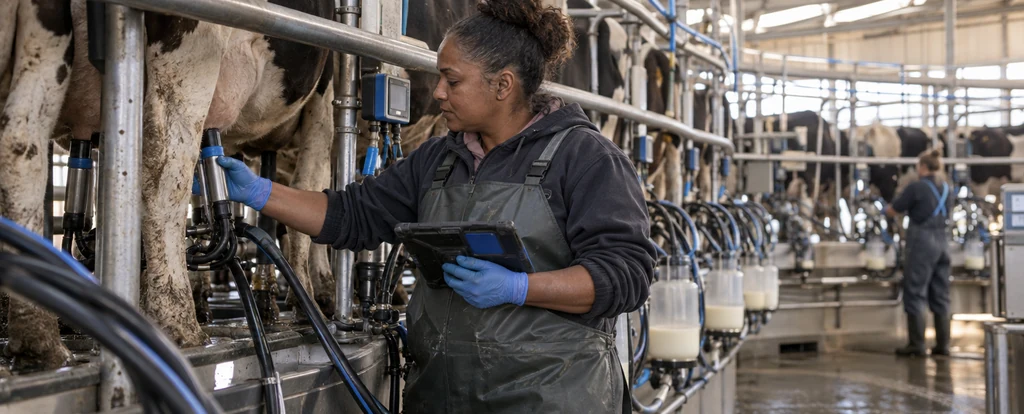
Dairy farmers run the herd along with the pastures, machinery and often the staff that keep milk flowing to a processor. Most are owner-operators or sharefarmers rather than employees, so the business decisions and the twice-daily milking sit in the same hands, unlike a dairy farm worker who follows a set roster. About 8,800 people work in the occupation, and the cows set the schedule: milking twice a day, every day, calving included.
How much do dairy farmers earn?
The median full-time salary for a dairy farmer is $73,800 per annum, before tax, up $15,600 since 2018.
Pay on a dairy farm depends on whether you own the herd, sharefarm or work for wages, so two people doing similar milking work can take home very different amounts. Owner-operators carry the milk price and the feed bill themselves, which means a good season and a poor one look nothing alike. Waged roles are usually covered by the Pastoral Award, which sets overtime and penalty rates for the early and late milkings and for public holidays.
What does a dairy farmer do day to day?
The list below is what fills most weeks; the exact mix shifts with seniority and whatever stage the current work is at.
- Milking the herd on a twice-daily roster and watching for mastitis and udder health
- Rotating pasture, growing fodder crops and managing supplementary feed through the season
- Running herd health, mating, calving and calf rearing programs
- Maintaining the milking plant, fences, water systems and farm machinery
- Keeping herd, milk production, chemical and compliance records for the dairy processor
What skills do dairy farmers need?
Employers look for animal care and handling, plant and equipment operation, operations management, backed by DairyCOMP 305 herd management software fluency and strong safety and compliance awareness.
Specialist skills
- Animal care and handling
- Plant and equipment operation
- Operations management
- Inventory management
Software and tools
- DairyCOMP 305 herd management software
- Tru-Test milk meters
- Lely robotic milking systems
- AgriWebb farm management software
- Spreadsheet and herd record software
General skills
- Safety and compliance awareness
- Physical stamina and dexterity
- People leadership
Is the job growing?
About 8,800 people work as dairy farmers in Australia, and employment is projected to grow 1.2% over the decade to 2035. That's modest growth: demand is steady rather than booming.
How do you become a dairy farmer?
Here's the path most dairy farmers take, step by step.
- 1Start on the milking roster
Most dairy farmers learn the job by taking a paid farmhand position, where you pick up stock handling, milking routine, udder health and machinery work from people already running the shed. No qualification is needed to start, and school leavers often begin this way while still deciding whether the industry suits them.
- 2Add a formal qualification
A Certificate III in Agriculture (AHC30122) (Dairy Production) covers milking, nutrition, herd health and farm records, and is usually done as a traineeship that combines paid farm work with TAFE study. It is not compulsory, but it helps when applying for second-in-charge and herd manager roles, and a Diploma of Agriculture (AHC50122) adds the business, feed budgeting and staff management units.
- 3Learn the management side
Running a farm means setting a feed budget, managing staff rosters, dealing with the processor and meeting milk quality standards, so a stint as herd manager or second-in-charge matters more than another certificate. Licences for heavy vehicles and agricultural chemicals are often picked up along the way because the work requires them.
- 4Move into ownership through sharefarming
Sharefarming, where you run a herd under an agreement with the landowner and build equity from the milk cheque, is the common route in for people without family land. Others buy a farm as a going concern, inherit one, or move across from beef cattle, where much of the cattle and pasture knowledge carries over.
Ready to apply as a dairy farmer?
Whether you're working toward becoming a dairy farmer or already are one and want a hand with the next step (sharpening your resume for ATS screening, tightening your cover letter, or knowing what you'll actually be asked at interview), here are examples grounded in this specific role, not generic templates.
What jobs can a dairy farmer move to?
Moving into Truck Driver typically comes with the biggest pay rise, worth $28,100 a year more on average.
| Move to | Typical pay change | Overlap | Retraining |
|---|---|---|---|
| Truck Driver Dairy farmers bring heavy vehicle operation and livestock transport experience, but need a truck licence and road transport training to move into driving.Known move | +$28,100 | 18% | reskill |
| Beef Cattle Farmer Dairy farmers bring cattle handling, grazing management and herd health skills, moving into beef production with minimal retraining.Known move | −$12,400 | 62% | minimal |
Moves are chosen from Jobs and Skills Australia's Data on Occupation Mobility, which follows income tax records between 2011-12 and 2020-21, together with entry requirements and skill overlap. A known move is one people were seen making in that data. Pay change compares median full-time pay for the two roles.
Who works as a dairy farmer?
The typical dairy farmer is 48 years old; 68% are men, 82% work full-time, and full-timers average 64 hours a week.
- 48
- Median age
- 32%
- Female share
- 82%
- Full-time
- +24h
- vs all-jobs avg
What's it like being a dairy farmer?
The job runs on the milking roster, so the day starts before dawn and finishes after the second milking in the late afternoon, with calving, silage and repairs filling the middle. Full-time dairy farmers average 64 hours a week, and weather, the milk price and animal health set the pressure, because a downed cow or a failed pump cannot wait until Monday. It suits people who like working with animals and machinery outdoors and who accept that the herd sets the calendar rather than a roster clerk.
What people like
- Working with animals every day. The core of the work is physical and immediate: bringing the herd in, checking udders, feeding out and seeing how the cows are milking.
- Hands-on work alongside the business side. Owner-operators decide the breed, the feed and how much to invest in the plant, so the same person who milks the herd also makes the calls that shape the farm.
- Results you can measure. Milk is tested and measured at every pickup, so a change to the ration or a herd health treatment shows up in the numbers within days rather than at the end of the year.
- A rural life with family involved. Many farms are family operations with a house on the property, and children often grow up helping in the shed, which is hard to find in most jobs.
What people find hard
- The twice-daily roster. Cows have to be milked morning and evening, every day, so weekends and public holidays look the same as any other day and a break needs someone else to cover the shed.
- Prices and seasons you don't control. Drought lifts the feed bill and cuts production, while the farm-gate milk price is set by the processor's contract, so a well-run farm can still have a tight year.
- Physical work in every kind of weather. Early starts in the cold and wet, lifting, and long days on machinery are part of the job, and injuries are a real risk when you are tired.
- Compliance and record keeping. Herd records, chemical use, animal welfare and milk quality standards all have to be documented, and the paperwork grows with the size of the herd.
Based on our synthesis of professional-body surveys and public accounts of the role, not first-person verified reviews.
Which industries employ dairy farmers?
Agriculture, Forestry and Fishing employs the largest share of dairy farmers.
Top employing industries
- 1Agriculture, Forestry and Fishing
Ranked by employment share; the source doesn't publish an exact percentage per industry.
| Year 12 or below | 48.6% | |
|---|---|---|
| Certificate III/IV | 24.9% | |
| Diploma / Advanced Diploma | 10.6% | |
| Bachelor degree | 9.2% | |
| Postgraduate | 1.8% |
Will AI replace dairy farmers?
Dairy farming is a low-exposure occupation, because the work is carried out in a paddock and a milking shed with animals, and animals do not follow a script. Robotic milking systems, milk meters and herd management software have taken over part of the milking routine and most of the record keeping, and they flag problems rather than solve them. Decisions about feed, pasture, breeding and machinery still depend on someone reading the conditions on that farm.
Share of typical working time by exposure level
- Feed, pasture and breeding decisionsRation software can model a feed budget on paper, yet what goes in the trough depends on reading the paddock, the weather and the condition of the cows.35%low
- Milking the herdRobotic units and swing-over sheds automate part of the routine and record each cow's yield, but someone still brings the herd in, checks udders and settles a cow that will not let down.30%low
- Machinery, fences and plant maintenanceMilking plant, tractors, fencing and water systems are repaired on the farm, usually by the farmer, with sensors and monitors flagging a fault rather than fixing it.20%low
- Herd records and milk quality paperworkHerd software tracks production, mating and treatments and processor reporting is largely digital, but interpreting the records and signing off on milk quality stays with the farmer.15%moderate
Common questions about becoming a dairy farmer
Straight answers to the questions people ask most.
How much does a dairy farmer earn?
Dairy farmers earn $73,800 per annum, before tax, for full-time work. Owner-operators and sharefarmers can earn more or less depending on the milk price and the season, so the figure is most reliable for waged positions.
How do you become a dairy farmer?
Most people start as a paid farmhand on a milking roster, where herd handling, udder health and machinery work are learned on the job. A Certificate III in Agriculture (AHC30122) (Dairy Production), often done as a traineeship, helps with management roles, and sharefarming is the usual route into running your own herd without buying land.
Are dairy farmers in demand?
Dairy farmers are currently not in shortage, and employment is projected to grow 1.2% over the decade to 2035. Because the work is tied to land and herds rather than to new positions, openings mostly come from farmers leaving the industry, and the practical way in is a farmhand job in an established dairying region.
Will robots or AI replace dairy farmers?
Dairy farming is one of the least exposed jobs to AI, because the work happens in a paddock and a milking shed with animals that do not follow a script. Robotic milking units, milk meters and herd management software such as DairyCOMP 305 already handle part of the milking routine and a lot of the record keeping, but they do not decide what to feed the herd, handle a sick cow or repair a failed pump.
What else can a dairy farmer do?
Moving into beef cattle farming keeps most of the cattle husbandry and pasture skills and needs minimal retraining, and pay is around $12,400 less. Driving pays around $28,100 more, but it needs a heavy vehicle licence and road transport training, and little of the farming skill set carries over. Going the other way, dairy farm workers can move up through herd management into sharefarming, which is often where earnings grow.
Related roles
Not sure this is you? Take the career quiz and get a ranked shortlist of roles that fit how you like to work.