Dental Prosthetist
Dental prosthetists design, make and fit removable dental prostheses such as dentures so that patients can eat, speak and smile comfortably again.
- Median salary*
- $85,800
4.5%vs last year, before tax
- People employed
- 880
2.2%vs last year
- Projected growth
- +20.6%
to 2035
- AI exposure*
- Moderate
- automation risk
- Average hours
- 43/wk
+3h vs all jobs
- Shortage status
- In shortage
national
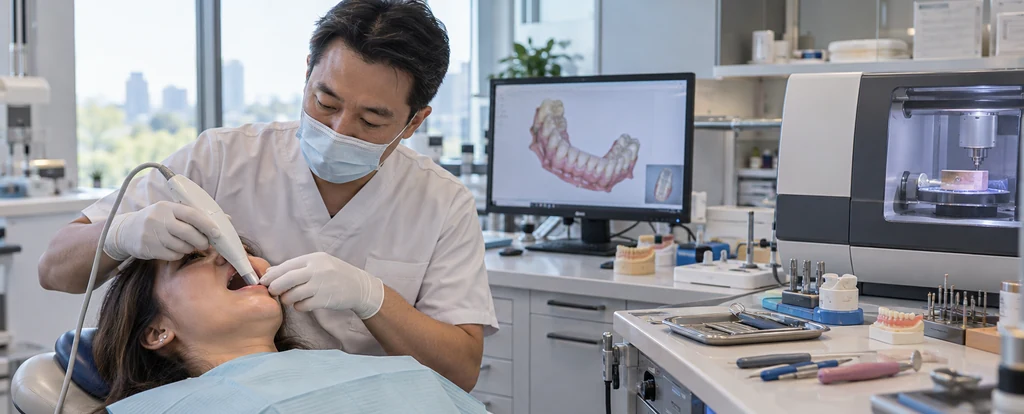
Most dental prosthetists work in their own clinic or a group practice, seeing patients directly and often running an on-site laboratory as well. They are registered practitioners, which means they can assess a patient, take the impression or scan, make the denture and fit it without a dentist in the room, referring on when someone needs treatment beyond a prosthesis. The role sits between clinical care and hands-on manufacturing, which is what separates it from a dental technician who builds to a dentist's prescription and rarely meets the patient.
How much do dental prosthetists earn?
The median full-time salary for a dental prosthetist is $85,800 per annum, before tax, up $18,200 since 2018.
How you work changes the figure more than experience does: an employee in someone else's clinic earns a salary, while a prosthetist running their own practice sets fees and carries the costs of the lab, materials and staff. Whether the manufacturing happens in-house or goes out to a dental laboratory affects the margin either way. Patient numbers, and how much of the week goes to clinical appointments rather than bench work, also move earnings.
What does a dental prosthetist do day to day?
The list below is what fills most weeks; the exact mix shifts with seniority and whatever stage the current work is at.
- Assessing a patient's mouth, gums and existing dentures, and taking impressions or digital scans
- Designing full and partial dentures and other removable appliances in CAD software or by hand
- Making the prosthesis in an on-site lab, using milling machines, 3D printers and finishing tools
- Fitting, adjusting and repairing dentures as the mouth changes over time
- Advising patients on care and cleaning, and referring them to a dentist or specialist when they need treatment beyond a prosthesis
What skills do dental prosthetists need?
Employers look for patient care and support, clinical assessment and treatment, craft and handmade production, backed by 3Shape Dental System fluency and strong attention to detail.
Specialist skills
- Patient care and support
- Clinical assessment and treatment
- Craft and handmade production
- Infection control and hygiene
Software and tools
- 3Shape Dental System
- exocad
- Intraoral scanners (e.g. TRIOS)
- CAD/CAM milling machines
- Dental practice management software
General skills
- Attention to detail
- Written communication
- Digital literacy
Is the job growing?
About 880 people work as dental prosthetists in Australia, and employment is projected to grow 20.6% over the decade to 2035. That's very strong growth. Few roles in Australia are expanding this fast, and it points to solid demand for years to come.
How do you become a dental prosthetist?
Here's the path most dental prosthetists take, step by step.
- 1Complete an approved dental prosthetics qualification
The usual route is a Diploma of Dental Prosthetics, which takes around two years and includes supervised clinical experience with patients. Some providers offer a bachelor's degree pathway, which takes longer and suits school leavers starting from scratch.
- 2Register with the Dental Board of Australia
Registration through AHPRA is what allows you to assess and treat patients without a dentist supervising your work. It requires your approved qualification, English language evidence, a criminal history check and professional indemnity insurance.
- 3Build patient experience in a practice
New graduates often start in an established clinic or a dental laboratory, where they see how a denture behaves in a real mouth rather than on a model. Fitting and adjustment skills build fastest there.
- 4Learn the digital workflow
Most practices now scan and design in programs such as exocad or 3Shape, then mill or print the prosthesis in-house. Employers look for that experience, and it is quicker to pick up early in your career than retrofitting later.
- 5Keep your registration current each year
Renewal depends on continuing professional development and ongoing insurance. Staying registered is what keeps you able to practise, and it is also the base you need if you later want to open your own clinic.
Ready to apply as a dental prosthetist?
Whether you're working toward becoming a dental prosthetist or already are one and want a hand with the next step (sharpening your resume for ATS screening, tightening your cover letter, or knowing what you'll actually be asked at interview), here are examples grounded in this specific role, not generic templates.
What jobs can a dental prosthetist move to?
None of the roles dental prosthetists typically move into pay more than the role itself. Dental Hygienist is the closest match. If a bigger salary is the goal, moving up into a senior or principal position within the role is usually the faster route than moving sideways.
| Move to | Typical pay change | Overlap | Retraining |
|---|---|---|---|
| Dental Hygienist Their understanding of oral anatomy and patient care transfers to dental hygiene, with a short course required for registration. | +$0 | 58% | short course |
| Dental Therapist Dental prosthetists can become dental therapists with a short course, using their patient assessment skills to treat children's oral health. | −$2,600 | 45% | short course |
Moves are chosen from Jobs and Skills Australia's Data on Occupation Mobility, which follows income tax records between 2011-12 and 2020-21, together with entry requirements and skill overlap. A known move is one people were seen making in that data. Pay change compares median full-time pay for the two roles.
Who works as a dental prosthetist?
The typical dental prosthetist is 53 years old; 82% are men, 69% work full-time, and full-timers average 43 hours a week.
- 53
- Median age
- 18%
- Female share
- 69%
- Full-time
- +3h
- vs all-jobs avg
What's it like being a dental prosthetist?
The week splits between the clinic and the bench, mixing face-to-face appointments with hours of careful hands-on making. Each prosthesis is built for one mouth, so small errors show up quickly and patients notice them before you do. It suits people who like working with their hands and with people, and who are comfortable that much of the craft happens away from the patient's view.
What people like
- Making something that fits one person. You build a denture for an individual mouth, and you know within minutes of the fitting whether it sits well enough to eat with.
- Following patients through a change. People often arrive embarrassed about missing teeth or a denture that has become painful, and you see them through to something they can wear all day.
- Independent practice. Registration lets you assess, make and fit without a dentist supervising, so you can run your own clinic and keep the clinical relationship yourself.
- Craft alongside technology. You can design on screen and mill the prosthesis, or work at the bench in wax and acrylic, and the digital tools have taken much of the repetitive casting out of the job.
What people find hard
- Precision leaves little room for shortcuts. A fraction of a millimetre changes how a denture feels, so rushed work comes back as a patient in discomfort and a remake at your own cost.
- Managing expectations about what a prosthesis can do. Patients often hope a new denture will feel like their own teeth, and explaining the limits takes patience and a clear conversation up front.
- Long solitary hours in the lab. A large share of the making happens alone at the bench, which drags if you would rather be in a busy clinical day.
- A small profession. There are relatively few dental prosthetists in Australia, so finding a locum to cover leave or a buyer for a practice takes planning and local contacts.
Based on our synthesis of professional-body surveys and public accounts of the role, not first-person verified reviews.
Which industries employ dental prosthetists?
Health Care and Social Assistance employs the largest share of dental prosthetists, followed by Manufacturing.
Top employing industries
- 1Health Care and Social Assistance
- 2Manufacturing
Ranked by employment share; the source doesn't publish an exact percentage per industry.
| Diploma / Advanced Diploma | 69.4% | |
|---|---|---|
| Bachelor degree | 9.2% | |
| Certificate III/IV | 8.3% | |
| Postgraduate | 3.9% | |
| Year 12 or below | 0.3% |
Will AI replace dental prosthetists?
This is a moderately exposed job, and most of the change has already happened in the lab rather than in the clinic. Intraoral scanners and CAD software have replaced impression trays and wax-ups, and milling machines and 3D printers cut the prosthesis from a block or build it in layers. What stays with the prosthetist is the assessment, the fit in a real mouth and the adjustments made once a patient is wearing it.
Share of typical working time by exposure level
- Designing dentures in CAD softwarePrograms such as 3Shape and exocad can propose a design straight from the scan, and your work becomes refining tooth position, occlusion and fit rather than building from scratch.30%high
- Fitting, adjusting and repairing denturesMuch of the week is appointments where a denture is checked in the mouth, trimmed for a pressure spot or repaired, and that hands-on contact with a patient is hard to automate.30%low
- Assessing patients and scanning the mouthAn intraoral scanner captures the shape of the mouth in minutes, but reading the gums, the bite and how much a patient can tolerate still comes from the prosthetist.20%moderate
- Milling, printing and finishing prosthesesA milling machine or printer produces the base and teeth, leaving the prosthetist to hand-finish, polish and check the result before it goes near a patient.20%high
Moves least exposed to AI
These career moves from dental prosthetist work are rated low for AI exposure:
- Dental Hygienist
Solid skill overlap (58%), short course to get there, and a low automation-risk profile.
- Dental Therapist
Solid skill overlap (45%), short course to get there, and a low automation-risk profile.
Common questions about becoming a dental prosthetist
Straight answers to the questions people ask most.
How much does a dental prosthetist earn?
Full-time dental prosthetists earn a median of $85,800 per year before tax. Treat that as a guide, because pay depends on whether you are an employee or a practice owner, how much lab work you keep in-house and where you are located.
How do you become a dental prosthetist?
Complete an approved dental prosthetics qualification, then register with the Dental Board of Australia through AHPRA before you can practise. The diploma takes around two years and includes clinical training, and some providers offer a degree pathway. Many people come into it after working as a dental technician or dental assistant.
Are dental prosthetists in demand?
Dental prosthetists are currently in shortage nationally, and employment is projected to grow 20.6% over the decade to 2035 over the decade to 2035. Because the profession is small, demand is unevenly spread: a regional practice may search for a prosthetist for a long time while a city clinic has several nearby.
How much will AI change dental prosthetist work?
Moderate. Scanning, CAD design and milling have already taken over much of the shaping and casting that was once done by hand, which speeds up production and makes remakes cheaper. The clinical side, assessing a mouth, adjusting a fit and judging what a patient can tolerate, still needs a person in the room.
What can a dental prosthetist move into?
Dental hygienists do comparable patient work, and moving across takes a short course with pay about the same. Dental therapy also needs a short course and pays around $2,600 less. The other common path is ownership: many experienced prosthetists open their own clinic, and that is often where earnings grow. Dental technicians and dental assistants come the other way into this role, though a full qualification is needed to practise independently.
Do you need to be registered to work as a dental prosthetist?
Yes. Dental prosthetists are registered health practitioners, and the Dental Board of Australia sets the requirements: an approved qualification, English language evidence, a criminal history check and professional indemnity insurance. Registration is renewed each year and depends on continuing professional development.
Related roles
- Dental Hygienist
- Dental Therapist
- Dental Technician
- Dental Assistant
- Radiographer
- Nuclear Medicine Technologist
Not sure this is you? Take the career quiz and get a ranked shortlist of roles that fit how you like to work.