Dental Technician
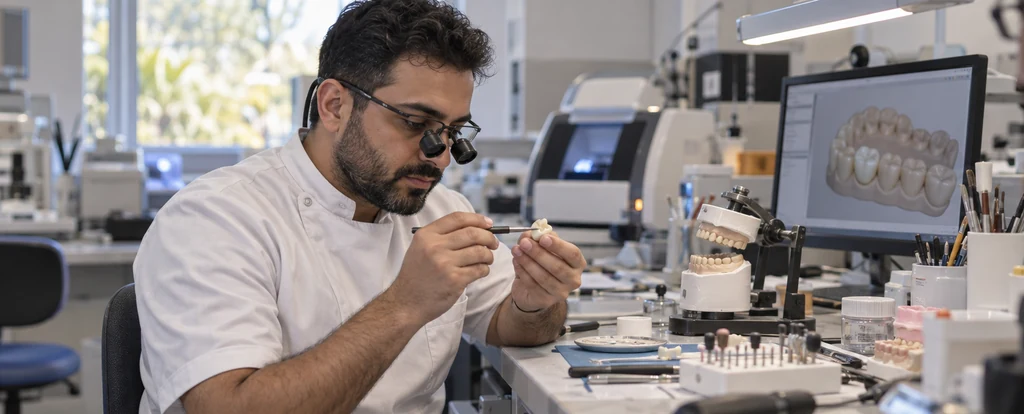
Dental technicians make the crowns, bridges, dentures and orthodontic appliances that dentists fit, working from impressions, scans and written prescriptions.
- Median salary*
- $67,600
3.8%vs last year, before tax
- People employed
- 2,800
0.0%vs last year
- Projected growth
- +20.6%
to 2035
- AI exposure*
- Moderate
- automation risk
- Average hours
- 42/wk
+2h vs all jobs
- Shortage status
- In shortage
national
Most work in commercial laboratories that supply a number of dental practices, though some larger practices keep a technician on site. The job is bench based and behind the scenes: unlike a dental prosthetist, a dental technician rarely meets the patient whose mouth they are making for. Each item is built to tight tolerances and checked for fit, shade and infection control before it goes back to the clinician.
How much do dental technicians earn?
The median full-time salary for a dental technician is $67,600 per annum, before tax, up $14,100 since 2018.
Pay moves with the laboratory you work for, your specialisation and how much of the work you can handle digitally, with ceramics and implant work usually at the higher end. Award coverage in manufacturing and health care sets minimum rates, and overtime is common when a clinic needs a case back quickly. Technicians who later own or take a share in a laboratory earn from the business rather than a wage alone.
What does a dental technician do day to day?
The list below is what fills most weeks; the exact mix shifts with seniority and whatever stage the current work is at.
- Reading dentists' prescriptions, impressions and digital scans to plan each appliance
- Pouring, trimming and mounting dental impressions to produce accurate working models
- Sculpting and shaping crowns, bridges, dentures and orthodontic appliances in wax, ceramic and alloy
- Operating CAD/CAM milling machines and 3D printers to manufacture restorations
- Finishing, polishing and checking appliances against infection control and fit standards
What skills do dental technicians need?
Employers look for craft and handmade production, cAD and technical drawing, fabrication and finishing, backed by 3Shape Dental System fluency and strong attention to detail.
Specialist skills
- Craft and handmade production
- CAD and technical drawing
- Fabrication and finishing
- Infection control and hygiene
Software and tools
- 3Shape Dental System
- exocad
- Amann Girrbach Ceramill
- Dentsply Sirona inLab
General skills
- Attention to detail
- Written communication
- Problem solving
Is the job growing?
About 2,800 people work as dental technicians in Australia, and employment is projected to grow 20.6% over the decade to 2035. That's very strong growth. Few roles in Australia are expanding this fast, and it points to solid demand for years to come.
How do you become a dental technician?
Here's the path most dental technicians take, step by step.
- 1Start with a traineeship in a dental laboratory
Most people enter through a school-based or full-time traineeship in a commercial lab, which combines paid bench work with study. You learn model production and materials handling from the first week, and labs often cover or subsidise course fees.
- 2Complete a Certificate III in Dental Laboratory Assisting
This qualification covers impression handling, model work and infection control, and is usually the first one finished during a traineeship. It qualifies you for assistant-level bench work while you keep studying.
- 3Finish the Diploma of Dental Technology
The diploma covers fixed and removable prosthetics, ceramics, orthodontics and CAD/CAM design, and is the qualification employers ask for. It normally takes about two years alongside laboratory work.
- 4Build your digital design skills on the job
Labs increasingly design in software such as 3Shape or exocad and then mill or print the result, so scanning and design experience counts when you apply for a position. Many technicians pick this up at work rather than through formal study.
- 5Specialise, and register if you move into clinical work
Ceramics, implant work and orthodontics are the common areas to specialise in, and each has its own techniques and materials. Dental technicians are not registered with AHPRA, but if you later train as a dental prosthetist or dental therapist you will need registration with the Dental Board of Australia.
Study routes we have checked
Qualifications that are a recognised way into this role, and what else you need.
- Diploma of Dental Technology
A recognised route into this role
Dental laboratory construction and repair under the prescription of dentists, dental prosthetists or dental specialists; this is not registration for those prescribing professions.
Ready to apply as a dental technician?
Whether you're working toward becoming a dental technician or already are one and want a hand with the next step (sharpening your resume for ATS screening, tightening your cover letter, or knowing what you'll actually be asked at interview), here are examples grounded in this specific role, not generic templates.
What jobs can a dental technician move to?
Moving into Dental Prosthetist typically comes with the biggest pay rise, worth $18,200 a year more on average.
| Move to | Typical pay change | Overlap | Retraining |
|---|---|---|---|
| Dental Prosthetist Dental technicians bring detailed appliance fabrication and materials knowledge to clinical prosthetics, but registration requires further study.Known move | +$18,200 | 36% | reskill |
| Dental Therapist Clinical dental work with children builds on a dental technician's knowledge, though becoming a dental therapist requires a new qualification and registration. | +$15,600 | 14% | requalify |
| Orthotic and Prosthetic Technician Fabricating custom medical devices transfers to orthoses and prostheses, with a short course covering anatomy and materials. | +$5,200 | 47% | short course |
Moves are chosen from Jobs and Skills Australia's Data on Occupation Mobility, which follows income tax records between 2011-12 and 2020-21, together with entry requirements and skill overlap. A known move is one people were seen making in that data. Pay change compares median full-time pay for the two roles.
Who works as a dental technician?
The typical dental technician is 41 years old; 60% are men, 67% work full-time, and full-timers average 42 hours a week.
- 41
- Median age
- 40%
- Female share
- 67%
- Full-time
- +2h
- vs all-jobs avg
What's it like being a dental technician?
The week is bench based and deadline driven: cases arrive with a due date and leave when they fit. Laboratories tend to be small, quiet workplaces where one person follows a case from model to finished appliance, which suits people who like detailed handwork and a clear end point. The pressure comes from the clinic's schedule, because a crown that is late means a cancelled appointment.
What people like
- Seeing a piece fit. A crown or denture you built by hand goes into someone's mouth and works, and the dentist often tells you so the next time they send a case.
- Focused bench work with a finish line. The work is quiet and detailed, with a defined product at the end of each case rather than an open-ended pile of tasks.
- Craft and technology together. You can spend a morning at the wax bench and an afternoon designing the same kind of restoration in CAD software, which keeps the trade from going stale.
- Small teams and direct feedback. Most labs employ a handful of people, so you deal with the dentist who ordered the work and hear quickly whether it was right.
What people find hard
- Turnaround times set by the clinic. Dentists book patients in before the appliance exists, so a same-day or next-day request can push a full bench into overtime.
- Rework caused by a poor impression or scan. If the impression is distorted or the scan has gaps, the case cannot be built accurately and the time spent on it is largely lost.
- Long stretches of close concentration. Fine detail work at the bench is hard on the eyes, neck and back, and the average full-time week runs to 42 hours.
- Dust, fumes and monomers. Grinding ceramics and alloys and handling acrylics and monomers call for extraction, masks and gloves, and the safety routine is part of every day.
Based on our synthesis of professional-body surveys and public accounts of the role, not first-person verified reviews.
Which industries employ dental technicians?
Manufacturing employs the largest share of dental technicians, followed by Health Care and Social Assistance.
Top employing industries
- 1Manufacturing
- 2Health Care and Social Assistance
Ranked by employment share; the source doesn't publish an exact percentage per industry.
| Diploma / Advanced Diploma | 43.5% | |
|---|---|---|
| Certificate III/IV | 22.2% | |
| Bachelor degree | 15.7% | |
| Year 12 or below | 10.9% | |
| Postgraduate | 2.3% |
Will AI replace dental technicians?
Exposure is moderate, and it sits unevenly across the job. Scanning, CAD design and the milling or printing of restorations are increasingly automated, which removes a lot of the measuring and waxing that once filled the day. The final shaping, staining and fit checking are still done by hand, because a technician has to judge how an appliance will sit in a mouth they cannot see.
Share of typical working time by exposure level
- Layering, staining and finishing ceramics by handShade matching and the final glaze are judged by eye and touch, and a natural tooth colour is not something the software settles on its own.30%low
- Milling, printing and casting restorationsMachines run most of the manufacturing, but a technician still sets up each job, watches tolerances and decides when a unit has to be remade.25%moderate
- Checking fit, contacts and the prescription before dispatchYou seat the appliance on the model and check it against what the dentist asked for, then ring the clinic when something does not match.25%moderate
- Designing restorations in CAD softwareScan files are cleaned up and crowns, bridges and frameworks are designed digitally, with library tools proposing a shape that the technician then adjusts.20%high
Moves least exposed to AI
These career moves from dental technician work are rated low for AI exposure:
- Dental Therapist
Some skill overlap (14%), requalify to get there, and a low automation-risk profile.
Common questions about becoming a dental technician
Straight answers to the questions people ask most.
How much do dental technicians earn?
Dental technicians earn $67,600 per year before tax. Pay rises with specialisation, particularly ceramics and implant work, and with how much digital design you can take on, and figures vary between laboratories and states.
How do you become a dental technician?
Most people start with a traineeship in a commercial laboratory while completing a Certificate III in Dental Laboratory Assisting (HLT35115) and then the Diploma of Dental Technology (HLT55118). The diploma is the qualification employers look for, and it covers fixed and removable prosthetics, ceramics and CAD/CAM design. Dental technicians are not registered with AHPRA, so no licence is needed to work at the bench.
Are dental technicians in demand?
Dental technicians are currently in shortage nationally, and employment is projected to grow 20.6% over the decade to 2035. The workforce is small, so openings mostly appear in commercial laboratories in the larger cities as experienced technicians retire or labs expand. A traineeship is the usual way in.
Will AI replace dental technicians?
The design and manufacturing side is the most exposed: intraoral scans, CAD software and milling or printing machines now do work that was once measured and built by hand. Hand finishing, shade matching and the judgement about whether an appliance will fit and function still sit with the technician, which keeps overall exposure at a moderate level.
What can dental technicians move into?
Dental prosthetists make and fit removable appliances directly for patients and earn $18,200 more, though the move needs further study and AHPRA registration. Orthotic and prosthetic technician work applies the same fabrication skills to a different kind of custom device, with a short course and $5,200 more in pay. Experienced technicians also set up or take a share in a laboratory, which is often where earnings grow most.
What is the difference between a dental technician and a dental prosthetist?
A dental technician makes appliances in a laboratory from impressions and scans sent by a dentist, while a dental prosthetist is a registered clinician who sees patients, takes their own impressions and fits dentures and other removable appliances. The two roles work alongside each other, and moving from the bench into clinical practice requires further study and registration.
Related roles
- Dental Prosthetist
- Dental Therapist
- Orthotic and Prosthetic Technician
- Dental Assistant
- Radiographer
- Anaesthetic Technician
Not sure this is you? Take the career quiz and get a ranked shortlist of roles that fit how you like to work.