Drone Pilot
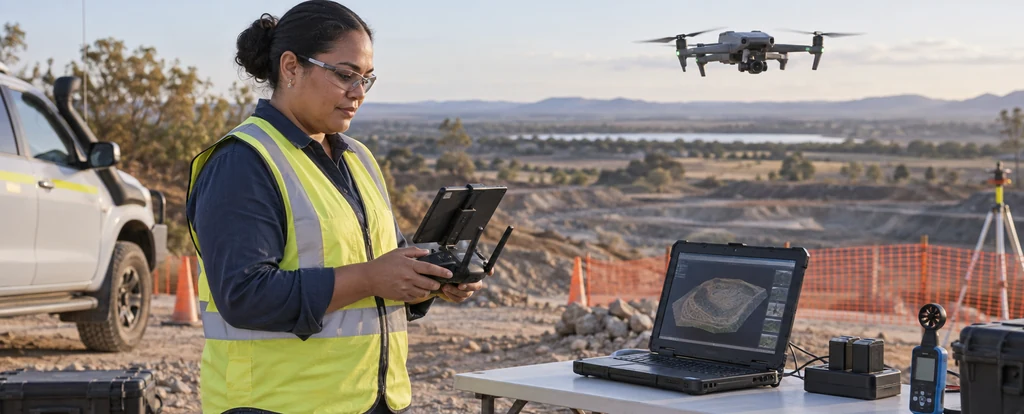
Drone pilots fly remotely piloted aircraft to collect aerial imagery and data for surveying, inspection, agriculture and construction.
- Median salary*
- $80,600
3.9%vs last year, before tax
- People employed*
- 2,200
0.0%vs last year
- Projected growth*
- +22%
to 2035
- AI exposure*
- Moderate
- automation risk
- Average hours*
- 42/wk
+2h vs all jobs
- Shortage status*
- Not in shortage
national
Most drone pilots work for a business that holds a Remote Operator's Certificate from CASA, flying over mine sites, farms, construction projects and powerlines, often with a second person keeping the aircraft in sight. The job is not the same as flying crewed aircraft: the licence is a short course rather than years of flight hours, and a good part of the day goes on planning flights and processing the imagery afterwards. Pilots work for survey firms, inspection companies, large farms and mining contractors, and many move between them as projects start and finish.
How much do drone pilots earn?
The median full-time salary for a drone pilot is $80,600 per annum, before tax, up $16,700 since 2018.
Pay moves with the sector and the arrangement: mining, construction and utility inspection work usually pays more than real estate photography or small farm jobs, and remote or fly-in fly-out rosters add site allowances on top. Sole operators set their own rates but carry the aircraft, insurance, repairs and cancelled days themselves, so the headline rate for a single inspection job says less than a year of steady work does.
What does a drone pilot do day to day?
The list below is what fills most weeks; the exact mix shifts with seniority and whatever stage the current work is at.
- Planning flights around airspace approvals, weather and the hazards on site
- Flying remotely piloted aircraft to capture imagery, video and sensor readings
- Keeping the aircraft in sight and watching battery, signal and wind during a flight
- Processing imagery into maps, models and reports with photogrammetry software
- Maintaining aircraft, batteries and sensors and filing the flight records CASA requires
What skills do drone pilots need?
Employers look for operations management, field inspection and testing, plant and equipment operation, backed by DJI Pilot fluency and strong safety and compliance awareness.
Specialist skills
- Operations management
- Field inspection and testing
- Plant and equipment operation
- Regulatory compliance
- Surveying and geospatial work
- Data analysis
Software and tools
- DJI Pilot
- DroneDeploy
- Pix4Dmapper
- ArcGIS Pro
- QGroundControl
General skills
- Safety and compliance awareness
- Attention to detail
Is the job growing?
About 2,200 people work as drone pilots in Australia, and employment is projected to grow 22% over the decade to 2035. That's very strong growth. Few roles in Australia are expanding this fast, and it points to solid demand for years to come.
How do you become a drone pilot?
Here's the path most drone pilots take, step by step.
- 1Get a Remote Pilot Licence (RePL)
The licence is issued by CASA and delivered through an approved training provider, usually as a course of about a week covering airspace, weather, radio and flight, and ending in a practical flight test.
- 2Add the endorsements your work needs
A RePL is issued for categories of aircraft and for specific endorsements, so night flying, beyond visual line of sight work and chemical spraying each need extra training before you can be paid for them.
- 3Learn the processing side
Employers generally want someone who can turn imagery into a deliverable, so training in photogrammetry tools such as Pix4Dmapper or DroneDeploy, and in GIS software such as ArcGIS Pro, counts for as much as flight hours.
- 4Work under a Remote Operator's Certificate
Commercial work has to be done under a ReOC, which most people get by joining an operator that already holds one. Getting your own means writing operational procedures, holding insurance and gaining CASA approval before you can take on clients.
- 5Build an industry specialism
Survey, crop mapping, thermal inspection and mine site volumetrics each use different sensors, standards and clients, and that specialism is usually what an operator is hiring for.
Ready to apply as a drone pilot?
Whether you're working toward becoming a drone pilot or already are one and want a hand with the next step (sharpening your resume for ATS screening, tightening your cover letter, or knowing what you'll actually be asked at interview), here are examples grounded in this specific role, not generic templates.
What jobs can a drone pilot move to?
Moving into ROV Pilot typically comes with the biggest pay rise, worth $54,600 a year more on average.
| Move to | Typical pay change | Overlap | Retraining |
|---|---|---|---|
| ROV Pilot A drone pilot brings remote control and sensor skills to remotely operated vehicle piloting, with extra training for underwater operations. | +$54,600 | 44% | reskill |
| Non-destructive Testing Technician A drone pilot brings asset inspection and sensor skills to non-destructive testing, with substantial study in testing methods. | +$20,800 | 44% | reskill |
| Aerodrome Reporting Officer A drone pilot brings aviation safety awareness and inspection habits to aerodrome reporting, with a short course in aerodrome operations. | +$10,400 | 50% | short course |
| Transport Operations Inspector A drone pilot brings inspection and compliance experience to transport operations enforcement, with a short course in transport regulations. | +$7,800 | 48% | short course |
Moves are chosen from Jobs and Skills Australia's Data on Occupation Mobility, which follows income tax records between 2011-12 and 2020-21, together with entry requirements and skill overlap. A known move is one people were seen making in that data. Pay change compares median full-time pay for the two roles.
Who works as a drone pilot?
The typical drone pilot is 35 years old; 90% are men, 68% work full-time, and full-timers average 42 hours a week.
- 35
- Median age
- 10%
- Female share
- 68%
- Full-time
- +2h
- vs all-jobs avg
What's it like being a drone pilot?
The work moves between the field and the desk: a flying day can start early for calm air and finish with hours of processing back at the office. Drone pilots often work alone or in a pair, travel to sites that may be remote, and handle the aircraft, the client and the paperwork themselves. It suits someone who likes practical problem solving and accepts that the flying is only one part of the job.
What people like
- No two sites are the same. A stockpile, an orchard, a roof and a substation all need different flight paths, sensors and settings, so the work rarely settles into a routine.
- You can see what the data is for. The imagery becomes a volume calculation, a crop map or a fault report that someone else acts on, so the processing hours have a visible purpose.
- Plenty of time outdoors and self-directed. Once the flight plan and approvals are in place, you are the person on site making the calls on weather, position and safety.
- Skills that carry across industries. Surveying, mining, agriculture and utilities use much the same aircraft and processing tools, so a pilot can change sector without starting again.
What people find hard
- Weather can cancel a day you have already travelled for. Wind, rain and low cloud all stop flights, and a job booked weeks ahead can be pushed back more than once.
- Flying is a small part of the day. Flight planning, permissions, battery management and record keeping take up more time than the flights themselves on most jobs.
- The compliance load is constant. Every commercial flight sits inside CASA rules, and operators expect accurate logs, incident reports and maintenance records to go with it.
- Work often runs project to project. Client budgets and seasonal demand mean some pilots string together contracts before they find a steady role with one operator.
Based on our synthesis of professional-body surveys and public accounts of the role, not first-person verified reviews.
Which industries employ drone pilots?
Professional, Scientific and Technical Services employs the largest share of drone pilots, followed by Construction.
Top employing industries
- 1Professional, Scientific and Technical Services
- 2Construction
- 3Agriculture, Forestry and Fishing
- 4Mining
- 5Electricity, Gas, Water and Waste Services
Ranked by employment share; the source doesn't publish an exact percentage per industry.
| Bachelor degree | 38% | |
|---|---|---|
| Diploma / Advanced Diploma | 24% | |
| Certificate III/IV | 20% | |
| Postgraduate | 10% | |
| Other | 8% |
Will AI replace drone pilots?
Drone piloting sits at a moderate level of exposure: the analysis side of the job, turning imagery into maps, models and inspection reports, is already heavily software-driven and becoming more so. The flying and the site work around it stay hands-on, because an aircraft has to be positioned, watched and recovered in real conditions, and clients often want a person on site deciding what is worth capturing.
Share of typical working time by exposure level
- Flying the aircraft on siteThe aircraft still needs a pilot on the controls within visual line of sight, ready to react to a gust, a bird or someone walking into the flight path.30%low
- Processing imagery into maps and modelsPhotogrammetry tools such as Pix4Dmapper and DroneDeploy align the images and build the model largely on their own, so the pilot's work becomes setting parameters and checking the output.30%high
- Flight planning and airspace checksSoftware draws the route and flags restricted airspace, but someone still has to read the site, check the forecast and confirm the approvals before take-off.25%moderate
- Maintenance, batteries and flight recordsApps log flights and battery cycles, but physical checks, firmware updates and the record keeping CASA expects still take time each week.15%moderate
Common questions about becoming a drone pilot
Straight answers to the questions people ask most.
How much do drone pilots earn?
Full-time drone pilots earn a median of $80,600 per year before tax. What you actually take home depends on the sector, the endorsements you hold and whether you fly for an operator or run your own business.
How do you become a drone pilot?
You need a Remote Pilot Licence from CASA, which most people get through an approved training provider in about a week of theory and practical flying. Commercial work also has to be done under a Remote Operator's Certificate, either your employer's or your own.
Are drone pilots in demand?
Drone pilots are currently not in shortage, and employment is projected to grow 22% over the decade to 2035. The work sits mainly in surveying and technical services, construction, mining, agriculture and utility inspection, so pairing the licence with skills in one of those areas is what makes you useful to an operator.
Will AI replace drone pilots?
It will not replace the flying, but it is taking over a growing share of the processing. Flight planning, photogrammetry and image analysis software already handle much of what a drone pilot once did by hand, while the aircraft still has to be positioned, watched and kept clear of people and obstacles on site.
What can a drone pilot move into?
Remotely operated vehicle work is a common next step, using the same sensor and control skills but needing substantial retraining for underwater operations. Aerodrome reporting and transport operations inspection draw on the same inspection and compliance habits with a short course behind them, and some drone pilots build their own operation instead, which is often where earnings grow.
Do you need a degree to be a drone pilot?
No. The licence is the entry requirement, and plenty of drone pilots come from a trade or technical background. Bachelor degree is the most common qualification in the current workforce, at 38%, and it tends to appear in survey, geospatial and engineering roles rather than in flying alone.
Related roles
- ROV Pilot
- Aerodrome Reporting Officer
- Non-destructive Testing Technician
- Transport Operations Inspector
- Airport Ground Crew
- Weighbridge Operator
Not sure this is you? Take the career quiz and get a ranked shortlist of roles that fit how you like to work.