Home Manufacturing & Production
Electroplater
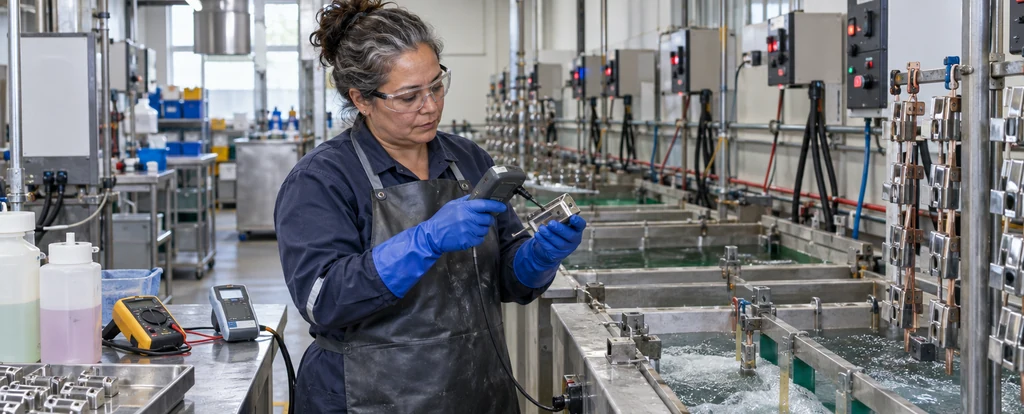
Electroplaters use electrical current and chemical baths to deposit a thin metal coating on a part, which protects it from corrosion or gives it a particular finish.
- Median salary*
- $70,200
4.2%vs last year, before tax
- People employed
- 470
6.0%vs last year
- Projected growth
- +4.8%
to 2035
- AI exposure*
- Moderate
- automation risk
- Average hours
- 40/wk
matches all-jobs average
- Shortage status
- In shortage
national
Electroplaters work in plating shops and finishing departments, usually the last stage before a part leaves the factory. They prepare and mask components, hang them on racks or load them into barrels, then pass current through a chemical bath so a thin layer of nickel, zinc, chrome or another metal bonds to the surface. The nearest trade is metal polishing, which takes material off rather than adding it, and the two often sit in the same workshop.
How much do electroplaters earn?
The median full-time salary for an electroplater is $70,200 per annum, before tax, up $14,800 since 2018.
Pay follows the manufacturing award or an enterprise agreement, so the base rate depends on the shop you work in. Shift work, overtime and penalty rates move the figure more here than in many trades, and plating shops serving defence, aerospace and medical customers usually pay above general engineering. Extra licences and qualifications, such as a forklift licence or confined space training, can add to the rate as well.
What does an electroplater do day to day?
The list below is what fills most weeks; the exact mix shifts with seniority and whatever stage the current work is at.
- Cleaning, degreasing and pickling parts before plating
- Setting up and operating plating baths and rectifiers
- Monitoring chemical concentrations, current and voltage
- Testing coating thickness, adhesion and surface appearance
- Maintaining anodes, filters, ventilation and safety equipment
What skills do electroplaters need?
Employers look for plant and equipment operation, regulatory compliance, process improvement, backed by Rectifiers fluency and strong attention to detail.
Specialist skills
- Plant and equipment operation
- Regulatory compliance
- Process improvement
- Laboratory analysis
Software and tools
- Rectifiers
- Plating baths
- Coating thickness gauges
- pH meters
- Multimeters
General skills
- Attention to detail
- Problem solving
- Safety and compliance awareness
Is the job growing?
About 470 people work as electroplaters in Australia, and employment is projected to grow 4.8% over the decade to 2035. That's modest growth: demand is steady rather than booming.
How do you become an electroplater?
Here's the path most electroplaters take, step by step.
- 1Start on the floor as a production worker or trade assistant
Plating shops hire people without formal qualifications and train them on masking, jigging and loading racks. It is the usual way in, and it lets you find out whether the chemistry side of the work interests you.
- 2Complete a traineeship or a Certificate III in Engineering
Many employers put staff through a traineeship leading to a Certificate III in Engineering, which covers measurement, chemical handling, finishing processes and quality checks. It typically takes two to three years part time while you keep working, and some shops cover the cost.
- 3Learn bath chemistry and process control
The core skill is holding solutions at the right concentration, temperature and current density, then reading the finish when something drifts. Employers look for someone who can run a line unsupervised ahead of someone with a particular certificate.
- 4Pick up the supporting licences and qualifications
A forklift licence, confined space training and chemical handling qualifications are common requirements in plating shops and small jobbing works. They are short courses, usually a day or two each.
- 5Specialise into defence, aerospace or medical plating
These customers plate to tight specifications with heavier testing and documentation, and they pay more for people who can hold to them. Getting in usually means a few years on general plating first.
Ready to apply as an electroplater?
Whether you're working toward becoming an electroplater or already are one and want a hand with the next step (sharpening your resume for ATS screening, tightening your cover letter, or knowing what you'll actually be asked at interview), here are examples grounded in this specific role, not generic templates.
What jobs can an electroplater move to?
Moving into Water Treatment Operator typically comes with the biggest pay rise, worth $26,000 a year more on average.
| Move to | Typical pay change | Overlap | Retraining |
|---|---|---|---|
| Water Treatment Operator Electroplaters run chemical baths and monitor dosing, so becoming a water treatment operator builds on this with a short course. | +$26,000 | 54% | short course |
| Metal Fabricator Electroplaters bring metal handling and finishing skills, but metal fabrication requires a new apprenticeship to learn structural fabrication and welding.Known move | +$17,600 | 7% | requalify |
| Welder Electroplaters understand metal preparation and surface protection, but welding requires a separate apprenticeship to gain fabrication and joining qualifications. | +$17,600 | 7% | requalify |
| Sheet Metal Worker Electroplaters know metal finishing and corrosion protection, while sheet metal work requires an apprenticeship in forming and assembling sheet metal products. | +$1,600 | 7% | requalify |
Moves are chosen from Jobs and Skills Australia's Data on Occupation Mobility, which follows income tax records between 2011-12 and 2020-21, together with entry requirements and skill overlap. A known move is one people were seen making in that data. Pay change compares median full-time pay for the two roles.
Who works as an electroplater?
The typical electroplater is 46 years old; 98% are men, 90% work full-time, and full-timers average 40 hours a week.
- 46
- Median age
- 2%
- Female share
- 90%
- Full-time
- +0h
- vs all-jobs avg
What's it like being an electroplater?
Electroplating runs to a rhythm of batches: parts come in dirty, get jigged, travel through the line and come out finished, and much of the day goes on keeping the baths within their limits. The work rewards patience and a methodical streak, because a drifting pH or the wrong current density only shows up in the finish hours later. It suits people who like a hands-on process they can measure and improve, and who don't mind chemical handling and protective gear.
What people like
- A finish you can see and measure. Coating thickness gauges and a visual check tell you straight away whether the batch is right, so the feedback loop is short.
- The process makes sense once you know it. Current, temperature and concentration behave predictably, and learning how they interact turns a mysterious bath into something you can control.
- Small teams with broad responsibility. Most plating shops are small, so the same person often covers racking, bath maintenance, waste treatment and quality records, which builds a wide set of skills.
- A wide variety of parts. One week might be hydraulic rams for mining equipment, the next restoration work on car trim, and each job brings its own masking and jigging problem.
What people find hard
- Chemicals and protective gear every day. The baths use acids, caustics and, in some shops, cyanide-based solutions, so gloves, aprons, eye protection and fume extraction are part of every shift.
- Heat, fumes and standing. Plating lines are warm and damp, ventilation is constant, and you are on your feet at the tank for most of the day.
- Repetitive batch work. High-volume runs mean the same racks of the same small parts, hour after hour, with the same checks at each pass.
- A small industry with clustered jobs. The workforce is tiny, so vacancies concentrate in the industrial suburbs of the larger cities and a move often means changing suburb or town.
Based on our synthesis of professional-body surveys and public accounts of the role, not first-person verified reviews.
Which industries employ electroplaters?
Manufacturing employs the largest share of electroplaters.
Top employing industries
- 1Manufacturing
Ranked by employment share; the source doesn't publish an exact percentage per industry.
| Year 12 or below | 53.9% | |
|---|---|---|
| Certificate III/IV | 29.1% | |
| Bachelor degree | 5.8% | |
| Diploma / Advanced Diploma | 4.3% | |
| Postgraduate | 1.3% |
Will AI replace electroplaters?
Electroplating sits at moderate exposure: automatic lines, dosing controllers and digital gauges already run much of the routine work, and that trend continues. What keeps it from higher exposure is the physical handling of parts and the troubleshooting when a coating fails, which need someone standing at the tank.
Share of typical working time by exposure level
- Preparing, masking and jigging partsHanging awkward components on racks and masking off the areas that must not be coated is fiddly handling work that robots only take over on high-volume lines.30%low
- Running the plating line (rectifiers, barrels and racks)Programmable rectifiers and automatic lines control current and timing, but someone still loads the line, spots a bad contact and stops a part from burning.25%moderate
- Controlling bath chemistry and waste treatmentAutomatic dosing keeps concentrations close to target, yet sampling, titrations and deciding what to add still need a person who knows how the bath behaves.25%moderate
- Recording process data and checking coating qualityCoating thickness gauges log readings straight into quality systems, and the traceability paperwork that defence and aerospace jobs demand is largely automated.20%high
Moves least exposed to AI
These career moves from electroplater work are rated low for AI exposure:
- Metal Fabricator
Some skill overlap (7%), requalify to get there, and a low automation-risk profile.
- Welder
Some skill overlap (7%), requalify to get there, and a low automation-risk profile.
Common questions about becoming an electroplater
Straight answers to the questions people ask most.
How much do electroplaters earn?
Full-time electroplaters earn a median of $70,200 per year before tax. That is a midpoint across all employers, and shift loadings, overtime and the sector you work in can move it either way, so treat it as a guide rather than an offer.
How do you become an electroplater?
Most people start on the floor as a production worker or trade assistant and learn the baths on the job, and many employers then put them through a traineeship or Certificate III in Engineering. For 54% of electroplaters, Year 12 or below is their highest qualification, so formal study is not the usual way in. Basic chemistry and steady hands matter more at the start than credentials.
Are electroplaters in demand?
Electroplaters are currently in shortage nationally, and employment is projected to grow 4.8% over the decade to 2035. The occupation is small, so a few shops opening or closing lines shifts the picture quickly; check vacancies in your area rather than relying on the national figure alone.
Will AI or automation replace electroplaters?
Automatic lines, dosing controllers and digital thickness gauges already handle much of the routine work, and that trend continues. What stays with people is jigging and masking awkward parts, judging a finish by eye, and working out why a coating failed an adhesion test. Expect the job to lean further towards setting up, monitoring and troubleshooting rather than standing at a bath dipping parts.
What jobs can electroplaters move into?
Water treatment is a related move, because monitoring and dosing chemicals carries over directly and a short course covers the rest of the training; pay there is $26,000 more. Metal fabrication, welding and sheet metal work are also options, but each needs a new apprenticeship since the forming and joining skills are separate, and welders earn $17,600 more. Metal polishers come into electroplating from the other direction, bringing surface preparation experience with them.
Is electroplating dangerous?
The baths use acids, caustics and, in some shops, cyanide-based solutions, so the job runs on gloves, aprons, eye protection, fume extraction and strict handling procedures. Plating shops are inspected on chemical storage, ventilation and waste treatment, and problems usually trace back to a step being skipped rather than to the process itself. Following the procedures is a core part of the work, not an add-on.
Related roles
Not sure this is you? Take the career quiz and get a ranked shortlist of roles that fit how you like to work.