Endodontist
Endodontists diagnose and treat disease inside the tooth, saving teeth that would otherwise be extracted.
- Median salary*
- $166,400
4.4%vs last year, before tax
- People employed*
- 450
12.5%vs last year
- Projected growth
- +35.8%
to 2035
- AI exposure*
- Low
- automation risk
- Average hours*
- 38/wk
−2h vs all jobs
- Shortage status
- In shortage
national
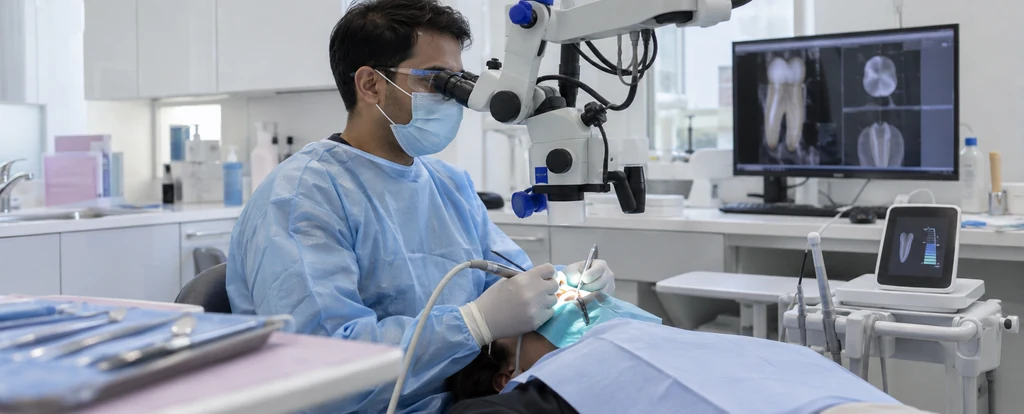
Endodontists are dental specialists who work almost entirely on the pulp and roots of teeth, mostly on referral from general dentists. Their patients often arrive in pain, and much of the job is deciding whether a tooth can be saved and then saving it. Most work in private specialist practices, using a microscope and cone beam CT to see canals far too fine for the naked eye.
How much do endodontists earn?
The median full-time salary for an endodontist is $166,400 per annum, before tax, up $35,200 since 2018.
How the practice is set up matters more than the median suggests. Principals who own a private specialist practice generally earn more than salaried associates, and public dental services usually pay less again. A caseload weighted towards complex microsurgery and retreatments pays better than one filled with routine root canals, and session rates and referral volume shift the figure further.
What does an endodontist do day to day?
The list below is what fills most weeks; the exact mix shifts with seniority and whatever stage the current work is at.
- Examining patients referred with persistent pain or a failing root canal, and working out whether the tooth can be saved
- Cleaning, shaping and sealing root canal systems, usually under a dental operating microscope
- Performing endodontic microsurgery such as apicoectomies when a root canal alone won't settle the problem
- Reading cone beam CT scans and periapical radiographs to map canal anatomy before treatment
- Managing dental trauma and urgent cases, then writing a report back to the dentist who referred the patient
What skills do endodontists need?
Employers look for patient care and support, clinical assessment and treatment, infection control and hygiene, backed by Dental operating microscope fluency and strong attention to detail.
Specialist skills
- Patient care and support
- Clinical assessment and treatment
- Infection control and hygiene
- Health education and advice
Software and tools
- Dental operating microscope
- Cone beam computed tomography (CBCT) systems
- Rotary endodontic systems
- Electronic apex locator
- Dental practice management software
General skills
- Attention to detail
- Problem solving
- Written communication
Is the job growing?
About 450 people work as endodontists in Australia, and employment is projected to grow 35.8% over the decade to 2035. That's very strong growth. Few roles in Australia are expanding this fast, and it points to solid demand for years to come.
How do you become an endodontist?
Here's the path most endodontists take, step by step.
- 1Complete a dental degree
An accredited Bachelor of Dental Surgery or Doctor of Dental Medicine takes five years of undergraduate study, or four years as a graduate entry course. Endodontics comes afterwards, so the degree itself is general dentistry.
- 2Register and work as a dentist
Registration with the Dental Board of Australia through AHPRA is required before you can treat patients. Most future endodontists spend a few years in general practice first, which builds the case volume and the referral relationships that later work depends on.
- 3Finish specialist training
A Doctor of Clinical Dentistry in endodontics is a three-year full-time program at an Australian university, combining coursework with supervised clinical work. Dentists trained overseas have their qualifications assessed by the Australian Dental Council before specialist registration.
- 4Apply for specialist registration
Endodontics is a recognised speciality, so you apply to AHPRA for specialist registration rather than general registration. Only then can you practise and advertise as an endodontist.
- 5Build a referral practice
Endodontists rely on general dentists sending them work, so the early years go into meeting local practitioners, taking urgent cases and earning a reputation for the difficult ones. Many later become partners or owners of the practice they joined.
Ready to apply as an endodontist?
Whether you're working toward becoming an endodontist or already are one and want a hand with the next step (sharpening your resume for ATS screening, tightening your cover letter, or knowing what you'll actually be asked at interview), here are examples grounded in this specific role, not generic templates.
What jobs can an endodontist move to?
Moving into Dentist typically comes with the biggest pay rise, worth $1,700 a year more on average.
| Move to | Typical pay change | Overlap | Retraining |
|---|---|---|---|
| Dentist An endodontist brings advanced endodontic skills and complex case experience to general dental practice, though adaptation to broader care is needed.Known move | +$1,700 | 57% | requalify |
Moves are chosen from Jobs and Skills Australia's Data on Occupation Mobility, which follows income tax records between 2011-12 and 2020-21, together with entry requirements and skill overlap. A known move is one people were seen making in that data. Pay change compares median full-time pay for the two roles.
Who works as an endodontist?
The typical endodontist is 43 years old; 70% are men, 78% work full-time, and full-timers average 38 hours a week.
- 43
- Median age
- 30%
- Female share
- 78%
- Full-time
- −2h
- vs all-jobs avg
What's it like being an endodontist?
The work is narrow in a good way: most of the week is root canal treatment, done at a level of magnification and precision general dentistry rarely calls for. Appointments are booked ahead and usually run to time, so the rhythm is steadier than a general practice day, though trauma cases and failed retreatments interrupt it. It suits someone who likes fine technical work with a clear finish line and can stay calm with a patient who is frightened and sore.
What people like
- Saving teeth that were booked for extraction. Patients usually arrive as a last resort before the tooth comes out, so the result is easy to see: it stays.
- Work at microscope level. Canals a fraction of a millimetre wide are the daily subject, and the technology rewards patience and a steady hand.
- A filtered caseload. Because referrals come through general dentists, almost everything on the list is genuinely complex endodontic work rather than a check-up.
- A bookable day. Treatment is planned in advance and appointment lengths are predictable, which makes the working week easier to control than in general dental practice.
What people find hard
- Patients arrive anxious and in pain. Most referrals come with acute pain or a history of treatment that hasn't worked, and part of the appointment goes into managing fear.
- A long road in. Specialist registration follows a dental degree plus three years of doctoral study, so the earnings arrive later than they do for a general dentist.
- Anatomy that won't cooperate. Calcified, sharply curved or previously treated canals can defeat even a careful attempt, and retreating another dentist's work is common.
- Depth instead of variety. If you like working across the whole mouth, endodontics offers one narrow area in great detail rather than a broad mix.
Based on our synthesis of professional-body surveys and public accounts of the role, not first-person verified reviews.
Which industries employ endodontists?
Private dental practices employs the largest share of endodontists, followed by Specialist endodontic practices.
Top employing industries
- 1Private dental practices
- 2Specialist endodontic practices
- 3Public dental health services
- 4Dental hospitals and clinics
- 5Tertiary education and research
Ranked by employment share; the source doesn't publish an exact percentage per industry.
| Bachelor degree | 52% | |
|---|---|---|
| Postgraduate | 26% | |
| Diploma / Advanced Diploma | 13% | |
| Other | 9% |
Will AI replace endodontists?
Endodontic work has very little exposure to AI. The core of the job is manual microsurgery inside a tooth, done through a microscope with rotary instruments and an apex locator, and no current system can do that. Software changes the edges instead: cone beam CT volumes can be segmented and viewed in three dimensions, imaging is read on screen, and practice systems draft the letters and recalls around each case.
Share of typical working time by exposure level
- Root canal treatmentCleaning, shaping and sealing canals is hands-on work under the microscope, and the feel of the file inside the canal is the dentist's own.45%low
- Endodontic microsurgeryAn apicoectomy works in a field a few millimetres across, with the operator's hands inside the patient's mouth for the whole procedure.25%low
- Diagnosing pulp and periapical diseaseCBCT scans are digital and software can flag likely pathology, but the diagnosis still rests on pulp tests, the patient's history and how the tooth responds.20%moderate
- Records, referrals and planning notesClinical notes, letters back to the referring dentist and recall reminders are the parts most exposed, and practice software already drafts much of this.10%high
Common questions about becoming an endodontist
Straight answers to the questions people ask most.
How much does an endodontist earn?
Endodontists earn a median of $166,400 per year before tax. Where you work moves that figure: practice owners and those with a heavy microsurgery caseload tend to sit above it, while salaried associates and public dental roles often sit below.
How do you become an endodontist?
You complete a dental degree, register with AHPRA and work as a general dentist, then finish a Doctor of Clinical Dentistry in endodontics and apply for specialist registration. From the first year of university, the path usually takes the better part of a decade.
Are endodontists in demand in Australia?
Endodontists are currently in shortage nationally, and employment is projected to grow 35.8% over the decade to 2035. The workforce is small, at about 450 people, so a handful of new practices or retirements can shift the numbers noticeably in one city.
Will AI replace endodontists?
The hands-on treatment is very unlikely to be automated. Root canal work is done through a microscope with instruments the dentist controls directly, and software mostly helps at the edges, reading scans and drafting the records around a case.
What can an endodontist do next?
Some return to general dentistry, where pay is $1,700 more and the work covers the whole mouth instead of one part of it. Many stay in the speciality and become owners or partners of the practice they work in, which is often where earnings grow.
Do endodontists work long hours?
Average full-time hours are 38 a week, and 78% of endodontists work full time. Dental trauma and patients in acute pain are the main reasons a day runs late, so some practices hold slots open for urgent referrals.
Specialisation of
Related roles
Not sure this is you? Take the career quiz and get a ranked shortlist of roles that fit how you like to work.