Farrier
Farriers trim and shoe horses' hooves, keeping the animal sound enough to work, ride or compete.
- Median salary*
- $65,000
3.8%vs last year, before tax
- People employed
- 1,000
0.0%vs last year
- Projected growth
- +4.8%
to 2035
- AI exposure*
- Low
- automation risk
- Average hours
- 45/wk
+5h vs all jobs
- Shortage status
- In shortage
national
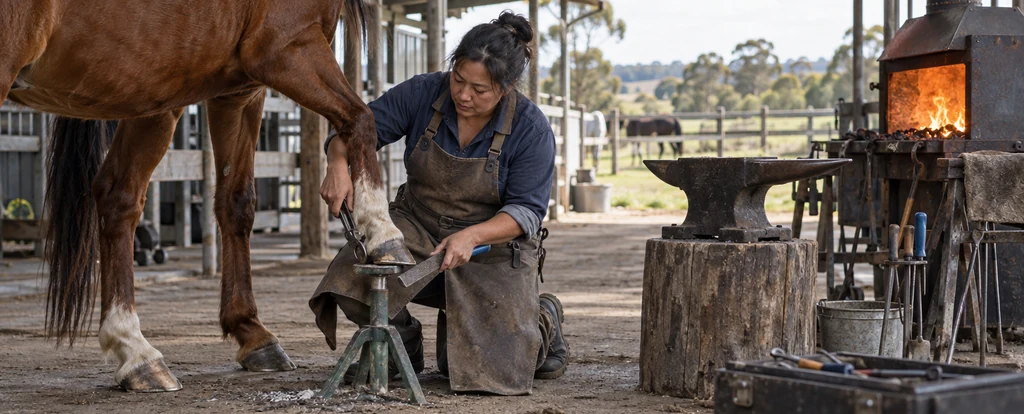
Many farriers are self-employed, working out of a ute with a mobile forge and driving between stables, farms and racetracks. The trade combines blacksmithing with animal handling: you shape and fit the shoe yourself, then nail it on while the horse stands on three legs. A farrier usually works alone, though the job sits alongside the horse's owner, trainer and vet.
How much do farriers earn?
The median full-time salary for a farrier is $65,000 per annum, before tax, up $13,500 since 2018.
Pay depends on how you work: a farrier running their own round sets their own fees and keeps what's left after fuel, tools and insurance, while an employee farrier trades that for a regular wage. Trimming only is quicker per horse but earns less than a full shoeing, and racehorses and performance horses usually attract a higher fee than pleasure horses.
What does a farrier do day to day?
The list below is what fills most weeks; the exact mix shifts with seniority and whatever stage the current work is at.
- Trimming and balancing hooves so the horse stands evenly
- Measuring hooves and shaping shoes to fit each one
- Forging or modifying shoes at the anvil or in a mobile forge
- Nailing shoes on and watching the horse trot out afterwards
- Spotting cracks, lameness and other hoof problems, and advising owners on what to do next
What skills do farriers need?
Employers look for animal care and handling, hand and power tool work, craft and handmade production, backed by Forge fluency and strong physical stamina and dexterity.
Specialist skills
- Animal care and handling
- Hand and power tool work
- Craft and handmade production
Software and tools
- Forge
- Anvil
- Hoof nippers
- Farrier's rasp
- Hoof knife
General skills
- Physical stamina and dexterity
- Problem solving
- Attention to detail
- Client relationships and advisory
Is the job growing?
About 1,000 people work as farriers in Australia, and employment is projected to grow 4.8% over the decade to 2035. That's modest growth: demand is steady rather than booming.
How do you become a farrier?
Here's the path most farriers take, step by step.
- 1Get comfortable handling horses
Spend time around horses at a stable, racing yard or pony club before you approach the trade. You need the confidence to pick up a hoof and read when a horse is about to pull away, and a farrier is unlikely to take on someone who hasn't.
- 2Find a farrier to train under
Farriery is learned on the job, so approach working farriers in your area and ask about an apprenticeship or trainee arrangement. The trade is small enough that a recommendation from a vet, trainer or stable often opens the door.
- 3Complete a Certificate III in Farriery
The qualification is delivered by a small number of registered training providers, usually in block release while you work, and covers anatomy, forging and shoeing technique. The practical hours you log with your supervising farrier count as much as the coursework.
- 4Set up your own kit and round
Working independently means your own ute, forge, tools and public liability insurance. Building a round takes time, so many farriers keep working for someone else while their client list grows.
Ready to apply as a farrier?
Whether you're working toward becoming a farrier or already are one and want a hand with the next step (sharpening your resume for ATS screening, tightening your cover letter, or knowing what you'll actually be asked at interview), here are examples grounded in this specific role, not generic templates.
What jobs can a farrier move to?
Moving into Orthotic and Prosthetic Technician typically comes with the biggest pay rise, worth $7,800 a year more on average.
| Move to | Typical pay change | Overlap | Retraining |
|---|---|---|---|
| Orthotic and Prosthetic Technician Farrier's custom fitting and hand tool skills suit orthotic and prosthetic technician work, with substantial retraining. | +$7,800 | 44% | reskill |
| Wool Classer Farrier's rural and animal handling experience can lead to wool classing, with a short course in wool quality. | +$7,800 | 53% | short course |
| Metal Polisher Farrier's metal shaping and finishing skills transfer to polishing metal components, with a short course covering polishing techniques. | +$0 | 53% | short course |
| Shearer Farrier's animal handling and manual tool skills transfer to shearing, with a short course in shearing technique. | −$500 | 53% | short course |
| Horse Trainer Farrier's horse handling and anatomy knowledge support moving into horse training, with retraining in training methods. | −$5,200 | 33% | reskill |
Moves are chosen from Jobs and Skills Australia's Data on Occupation Mobility, which follows income tax records between 2011-12 and 2020-21, together with entry requirements and skill overlap. A known move is one people were seen making in that data. Pay change compares median full-time pay for the two roles.
Who works as a farrier?
The typical farrier is 42 years old; 92% are men, 66% work full-time, and full-timers average 45 hours a week.
- 42
- Median age
- 8%
- Female share
- 66%
- Full-time
- +5h
- vs all-jobs avg
What's it like being a farrier?
The work has a steady rhythm: a horse needs trimming or shoeing every few weeks, so a farrier builds a round of regular clients and drives between them. Days are physical and often start early, with the horse's weight on your back and arms while you work and the weather changing around you. It suits someone who likes working with their hands and animals, is comfortable being self-employed and does not mind the travel.
What people like
- You see the result straight away. A horse that came out sore usually trots sound once the shoe is on, so feedback on your work arrives within the hour.
- Hands-on craft. Forging and fitting shoes is skilled manual work, and no two hooves are the same shape, so there is always something to solve.
- Being your own boss. Many farriers run their own round and decide which horses and which areas they take on.
- Repeat clients. Hooves keep growing, so the same horses need you every few weeks, which makes for a dependable round rather than a constant hunt for work.
What people find hard
- The physical toll. You spend hours bent over, holding a horse's leg against its weight, and back, shoulder and knee problems are common in the trade.
- Difficult horses and owners. A frightened or untrained horse can lean, pull or kick, and a rushed job on a badly handled animal is where injuries happen.
- Unpaid travel and admin. The drive between properties, quoting and invoicing all happen outside the time you bill for.
- Weather and no sick days. Most of the work is outdoors in heat, rain and mud, and when you are self-employed a missed day means rescheduling a whole round of clients.
Based on our synthesis of professional-body surveys and public accounts of the role, not first-person verified reviews.
Which industries employ farriers?
Agriculture, Forestry and Fishing employs the largest share of farriers, followed by Arts and Recreation Services.
Top employing industries
- 1Agriculture, Forestry and Fishing
- 2Arts and Recreation Services
Ranked by employment share; the source doesn't publish an exact percentage per industry.
| Certificate III/IV | 61% | |
|---|---|---|
| Year 12 or below | 26.3% | |
| Diploma / Advanced Diploma | 5% | |
| Bachelor degree | 3.3% | |
| Postgraduate | 0.3% |
Will AI replace farriers?
Farriery is a hands-on trade with low exposure to AI. The core of the job is holding, trimming and shoeing a live horse, which needs strength, feel and quick judgement that no current machine provides. Technology sits around the edges: booking and invoicing apps, hoof-mapping software, and vets' gait sensors and X-rays that inform a shoeing plan.
Share of typical working time by exposure level
- Trimming and balancing hoovesYou feel the balance change under your hands as you take the hoof down, and adjust with each stroke of the rasp.35%low
- Nailing shoes on and checking soundnessNail placement depends on the hoof wall in front of you, and you watch the horse trot out to see whether the job has worked.25%low
- Forging and fitting shoesPower hammers, plasma cutters and pre-made blanks speed up shaping, but the final fit is still worked by hand against the hoof.20%moderate
- Assessing hoof health and advising ownersA vet's X-rays and gait sensors add information, but the farrier reads the hoof in front of them and decides what to do next.20%low
Common questions about becoming a farrier
Straight answers to the questions people ask most.
How much do farriers earn in Australia?
Farriers earn a median of $65,000 per year before tax. What you take home depends on how many horses you do in a week, whether you trim or shoe, and whether you run your own business or work for another farrier.
How do you become a farrier?
You learn on the job, usually by finding a working farrier who will take you on, and combining that with a Certificate III in Farriery. Handling horses confidently comes first, so time at a stable, racing yard or pony club helps before you approach anyone. There is no national licence for farriers, so the training and hours you complete are what owners and stables judge you on.
Are farriers in demand in Australia?
Farriers are currently in shortage nationally, and employment is projected to grow 4.8% over the decade to 2035. It is a small trade, with about 1,000 people working as farriers nationally, and because hooves keep growing the same horses need attention every few weeks.
Will AI or robots replace farriers?
Very little of this job can be automated, because trimming and nailing a shoe onto a live horse needs hands-on feel, strength and split-second judgement as the animal reacts. Technology shows up in the office side, through booking and invoicing apps and hoof-mapping software, and vets increasingly use gait sensors and X-rays that help a farrier plan a shoeing job. None of it replaces the person holding the hoof.
What can a farrier move into later?
Many farriers stay in the trade and run their own business, which is usually where earnings grow. Custom fitting and hand tool skills transfer to work as an orthotic and prosthetic technician, where pay is $7,800 more, or to metal polishing, which uses the same shaping and finishing skills and pays about the same. With extra training, horse training, shearing and wool classing are also open.
How many hours do farriers work?
Farriers average about 45 hours a week in full-time work, though the day is shaped by travel between properties rather than a fixed site. Many start early to fit horses in before the heat of the day, and invoicing or ordering supplies often happens in the evening.
Related roles
Not sure this is you? Take the career quiz and get a ranked shortlist of roles that fit how you like to work.