Prosthetist and Orthotist
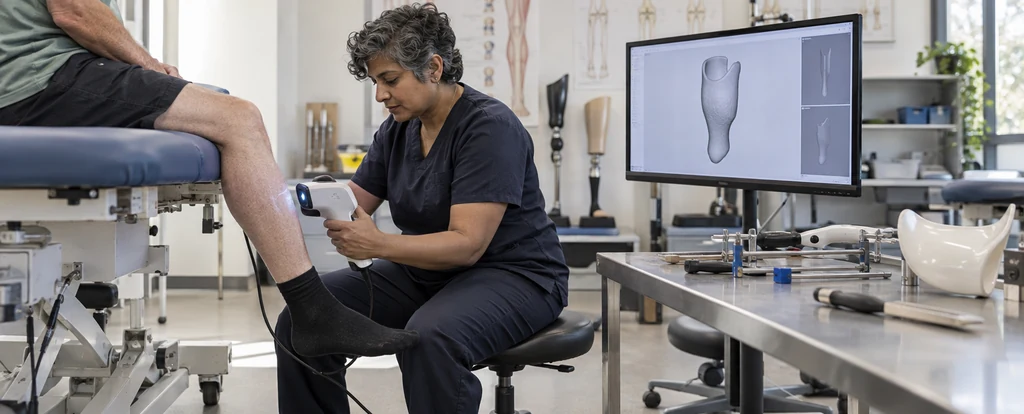
Prosthetists and orthotists assess patients, then design and fit artificial limbs, braces and supports that help them move and manage daily life.
- Median salary*
- $100,000
3.7%vs last year, before tax
- People employed
- 550
10.0%vs last year
- Projected growth
- +27%
to 2035
- AI exposure*
- Moderate
- automation risk
- Average hours
- 40/wk
matches all-jobs average
- Shortage status
- Not in shortage
national
They work in hospital rehabilitation units, private practices and workshops, where clinical assessment sits alongside casting, CAD design and hands-on fabrication. Prosthetists fit artificial limbs and orthotists fit braces, splints and supports, and many practitioners train in both. The work is unusual in combining patient care with making things, and much of it happens in small teams.
How much do prosthetist and orthotists earn?
The median full-time salary for a prosthetist and orthotist is $100,000 per annum, before tax, up $20,700 since 2018.
Public hospital roles are paid under state health awards, which set increments by years of experience, so pay climbs steadily rather than jumping. In private practice it depends on the mix of clinical work, fabrication and management the business does. Practitioners who go on to own a clinic or workshop often earn more than salaried clinicians, though that comes with the cost of running a small business.
What does a prosthetist and orthotist do day to day?
The list below is what fills most weeks; the exact mix shifts with seniority and whatever stage the current work is at.
- Assessing patients' mobility, limb condition and goals to work out what a device needs to do
- Casting, scanning and measuring limbs and torsos to capture an accurate shape
- Designing and fabricating prostheses and orthoses using CAD/CAM software, 3D printing and hand techniques
- Fitting, aligning and adjusting devices, then reviewing comfort, function and skin health at follow-up
- Explaining wear schedules, care and skin checks to patients, families and carers
What skills do prosthetist and orthotists need?
Employers look for patient care and support, clinical assessment and treatment, rehabilitation and therapy, backed by Rodin4D CAD/CAM fluency and strong written communication.
Specialist skills
- Patient care and support
- Clinical assessment and treatment
- Rehabilitation and therapy
- Health education and advice
- Craft and handmade production
Software and tools
- Rodin4D CAD/CAM
- Omega Tracer
- Insignia scanning and carving system
- 3D printing and additive manufacturing software
General skills
- Written communication
- Attention to detail
- Problem solving
Is the job growing?
About 550 people work as prosthetist and orthotists in Australia, and employment is projected to grow 27% over the decade to 2035. That's very strong growth. Few roles in Australia are expanding this fast, and it points to solid demand for years to come.
How do you become a prosthetist and orthotist?
Here's the path most prosthetist and orthotists take, step by step.
- 1Complete an accredited degree
The usual route is a Bachelor of Prosthetics and Orthotics, which takes about four years and combines anatomy, biomechanics and materials with clinical and workshop training. Only a small number of Australian universities offer an accredited program, so many students move interstate to study.
- 2Or take a graduate-entry master's
If you already hold a health, science or engineering degree, a two-year master's in prosthetics and orthotics is the faster way in. About 40% of the people now working in the role hold a postgraduate qualification.
- 3Finish your supervised clinical placements
Accredited programs include placements in hospitals, rehabilitation services and private clinics, where you assess, cast and fit patients under supervision. Those hours are what employers look at when you graduate, and they are where you start building fitting judgement.
- 4Join the professional body
The Australian Orthotic Prosthetic Association is the professional body for the field: it accredits the university programs and expects members to keep up continuing professional development. Most employers expect membership.
- 5Start in a hospital, rehabilitation or private service
First roles are usually salaried positions in a hospital rehabilitation unit, a specialist service or a private orthotic and prosthetic practice, often with structured supervision in the first year. This is where much of the practical judgement about materials, alignment and patient tolerance is built.
Ready to apply as a prosthetist and orthotist?
Whether you're working toward becoming a prosthetist and orthotist or already are one and want a hand with the next step (sharpening your resume for ATS screening, tightening your cover letter, or knowing what you'll actually be asked at interview), here are examples grounded in this specific role, not generic templates.
What jobs can a prosthetist and orthotist move to?
We don't list lateral moves for prosthetist and orthotists: leaving means a full new qualification rather than a career move, and the realistic routes in are covered under how to become one.
Who works as a prosthetist and orthotist?
The typical prosthetist and orthotist is 37 years old; 52% are women, 77% work full-time, and full-timers average 40 hours a week.
- 37
- Median age
- 52%
- Female share
- 77%
- Full-time
- +0h
- vs all-jobs avg
What's it like being a prosthetist and orthotist?
The week moves between clinic and workshop: patient reviews and fittings in one block, then casting, carving or adjusting devices in another, and a fitting can run over when a limb changes shape. Progress is often gradual, measured in someone walking further or returning to work rather than in a single fix, and caseloads range from children with scoliosis to adults managing diabetes-related foot problems. It suits someone who likes solving practical problems with their hands and can work at the pace a body heals.
What people like
- You see the result in how someone moves. A patient who could barely manage stairs walks out of a fitting steadier, and that change is usually visible within weeks rather than years.
- The work combines clinic and workshop. A day can move from a hospital appointment to carving a mould or adjusting a CAD file, so the job rarely sits entirely at a desk.
- Patients stay with you. Devices need review, repair and replacement, so you get to know people over years and follow how a limb or a child's spine changes.
- Cases are genuinely varied. A week might take in a child with scoliosis, an adult returning to work after limb loss and an older patient whose foot needs offloading.
What people find hard
- Not every outcome is a good one. Some patients have progressive conditions or injuries that a device can support but not fix, and the work involves those conversations.
- Fittings take as long as they take. A limb changes shape as it heals, so a device that fitted well in March may need remaking by June, and that work cannot be rushed.
- Funding shapes what you can offer. Device choice often depends on what a funding scheme will approve or what a patient can pay, which is hard when a better option exists.
- The workshop side is physical. Casting, grinding and finishing devices means standing for long stretches and working with plaster, resins and dust, even in clinics that have moved to digital design.
Based on our synthesis of professional-body surveys and public accounts of the role, not first-person verified reviews.
Which industries employ prosthetist and orthotists?
Health Care and Social Assistance employs the largest share of prosthetist and orthotists, followed by Manufacturing.
Top employing industries
- 1Health Care and Social Assistance
- 2Manufacturing
Ranked by employment share; the source doesn't publish an exact percentage per industry.
| Bachelor degree | 42.6% | |
|---|---|---|
| Postgraduate | 40% | |
| Diploma / Advanced Diploma | 8.7% | |
| Year 12 or below | 4.1% | |
| Certificate III/IV | 3.6% |
Will AI replace prosthetist and orthotists?
Design and fabrication have moved substantially onto computers, while the clinical side still needs hands and judgement. Scanning, CAD/CAM and 3D printing have changed how a device is made, but someone still has to assess the patient, decide what the device needs to do and adjust it until it works.
Share of typical working time by exposure level
- Fitting, aligning and following up with patientsA device that looks right on screen can rub, slip or throw off a gait, and working that out needs the patient in front of you.35%low
- Assessing gait, limb condition and patient goalsDeciding what a device must do still rests on watching a patient walk, measuring range of motion and talking through what they need it for.25%moderate
- Casting, scanning and capturing limb shapeHand-held scanners and digital shape capture have replaced plaster casts in many clinics, so measuring is quicker and the file is easy to store and adjust.20%high
- Designing and fabricating devicesCAD software and 3D printing now carry much of the carving and shaping once done by hand, though a printed shell still needs finishing and alignment.20%high
Common questions about becoming a prosthetist and orthotist
Straight answers to the questions people ask most.
How much do prosthetists and orthotists earn?
Full-time prosthetists and orthotists earn a median of $100,000 per year before tax. Public hospital pay follows state health awards with yearly increments, while private practice pay depends on the mix of clinical work, fabrication and management, and running your own clinic can lift it further. Treat it as a guide rather than a starting salary.
How do you become a prosthetist or orthotist?
You complete an accredited degree, usually the four-year Bachelor of Prosthetics and Orthotics, or a two-year master's if you already hold a health, science or engineering degree. Accredited programs include supervised clinical placements. Graduates typically join the Australian Orthotic Prosthetic Association and keep up continuing professional development.
Are prosthetists and orthotists in demand?
Prosthetists and orthotists are currently not in shortage, and about 550 people work in the role nationally. Employment is projected to grow 27% over the decade to 2035. Because the workforce is small, vacancies come up in small numbers, so being open to moving for a first role widens your options.
Will AI replace prosthetists and orthotists?
Parts of the job have already shifted onto computers, but the clinical side has not. Scanning, shape capture and CAD design are increasingly automated, so a device often begins on screen rather than in plaster, though someone still has to judge what the patient needs. 3D printing speeds up fabrication, but a printed shell still needs finishing, alignment and adjustment on a real body.
Can you move into prosthetics and orthotics from a related role?
Physiotherapists move across most easily, with 71% of the skills overlapping, and median pay here is $1,800 more; the move still calls for a graduate qualification in prosthetics and orthotics. Orthotic and prosthetic technicians bring hands-on fabrication and fitting skills, and can expect to earn $27,200 more here than in technician work. Pedorthists make a similar move on the strength of footwear and orthotic fitting experience.
What is the difference between a prosthetist and an orthotist?
A prosthetist designs and fits artificial limbs, while an orthotist designs and fits braces, splints and other devices that support or correct part of the body. Many Australian practitioners are trained in both, which is why the titles are usually paired.
Related roles
- Orthotic and Prosthetic Technician
- Pedorthist
- Physiotherapist
- Audiometrist
- Myotherapist
- Exercise Physiologist
Not sure this is you? Take the career quiz and get a ranked shortlist of roles that fit how you like to work.