Home Manufacturing & Production
Fibreglass Laminator
Fibreglass laminators build composite parts by laying glass reinforcement and resin into moulds, producing boat hulls, vehicle panels, tanks and similar components.
- Median salary*
- $65,000
3.8%vs last year, before tax
- People employed
- 830
3.8%vs last year
- Projected growth
- +5.1%
to 2035
- AI exposure*
- Low
- automation risk
- Average hours
- 42/wk
+2h vs all jobs
- Shortage status
- Not in shortage
national
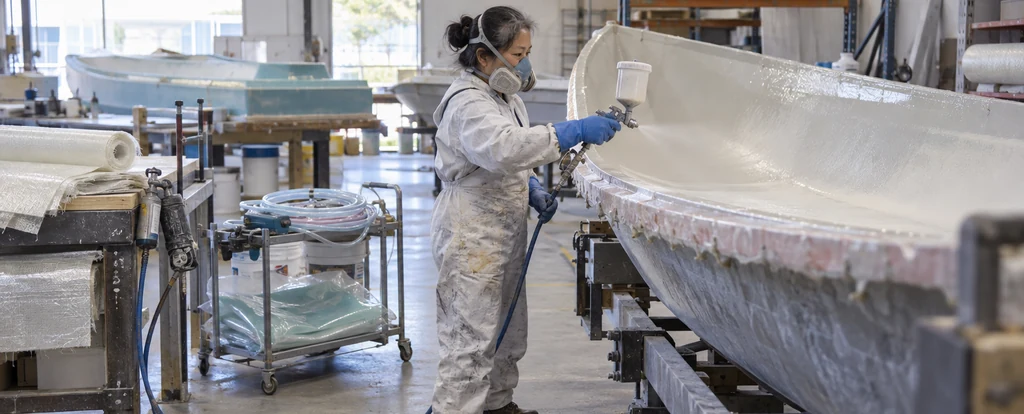
Fibreglass laminators work in workshops and factory bays, building parts from a mould rather than assembling components that arrive ready made. The job combines hand skills with resin chemistry: you mix catalysed resin, wet out the glass, consolidate the laminate, then trim and finish the cured part. Boat builders, caravan and truck body manufacturers and industrial moulders are the main employers, and because the trade is small, laminators often work in the same tight team on a run of identical parts.
How much do fibreglass laminators earn?
The median full-time salary for a fibreglass laminator is $65,000 per annum, before tax, up $13,400 since 2018.
Pay varies with the sector and the employer, because boatyards, caravan and truck body builders and industrial moulders set their own rates under awards or enterprise agreements. Skills that lift pay include resin infusion, vacuum bagging, gelcoat spraying and the ability to work from drawings without close supervision. Casual and contract work is common in smaller workshops, and casual rates usually include a loading instead of paid leave.
What does a fibreglass laminator do day to day?
The list below is what fills most weeks; the exact mix shifts with seniority and whatever stage the current work is at.
- Applying release agent and gelcoat to a prepared mould
- Cutting glass mat, cloth and core material to the pattern
- Laying up laminate by hand and rolling out air bubbles so the part bonds and stays strong
- Running chopper guns, resin infusion and vacuum bagging equipment
- Trimming, sanding, fairing and repairing cured parts
What skills do fibreglass laminators need?
Employers look for fabrication and finishing, hand and power tool work, craft and handmade production, backed by Resin infusion equipment fluency and strong safety and compliance awareness.
Specialist skills
- Fabrication and finishing
- Hand and power tool work
- Craft and handmade production
- Plant and equipment operation
Software and tools
- Resin infusion equipment
- Gelcoat spray gun
- Chopper gun
- Vacuum bagging kit
- Powered cutting and sanding tools
General skills
- Safety and compliance awareness
- Attention to detail
- Problem solving
Is the job growing?
About 830 people work as fibreglass laminators in Australia, and employment is projected to grow 5.1% over the decade to 2035. That's modest growth: demand is steady rather than booming.
How do you become a fibreglass laminator?
Here's the path most fibreglass laminators take, step by step.
- 1Start as a trade assistant in a composites workshop
Most laminators learn on the job, so the usual entry is a labouring or trade assistant role preparing moulds, cutting glass and watching experienced hands lay up. It is paid work from the first day and no prior qualification is needed.
- 2Cover the safety basics
Resins, styrene, catalysts and sanding dust all need managing, so employers put new starters through respirator fitting, ventilation and chemical handling training. A White Card is required before you work on a construction site.
- 3Add a certificate III or a traineeship
A certificate III in polymer processing (PMB30121), or a composites traineeship with a manufacturer, covers mould preparation, lay-up, resin infusion and finishing while you keep working. TAFE colleges and some industry trainers also run short courses in vacuum bagging and gelcoat repair.
- 4Build a specialty
Infusion work, gelcoat spraying, plug and mould making and structural repair each take time to learn, and they make you more useful on bigger jobs. Training on specific resin systems is often provided by the suppliers who make them.
Ready to apply as a fibreglass laminator?
Whether you're working toward becoming a fibreglass laminator or already are one and want a hand with the next step (sharpening your resume for ATS screening, tightening your cover letter, or knowing what you'll actually be asked at interview), here are examples grounded in this specific role, not generic templates.
What jobs can a fibreglass laminator move to?
Moving into Machine Operator typically comes with the biggest pay rise, worth $15,800 a year more on average.
| Move to | Typical pay change | Overlap | Retraining |
|---|---|---|---|
| Machine Operator Fibreglass laminators can apply mould preparation and material handling to machine operation, with substantial retraining to run production machinery. | +$15,800 | 25% | reskill |
| Process Worker Fibreglass laminators bring moulding and resin handling skills to process work, though the move needs substantial retraining for production processes.Known move | +$14,000 | 29% | reskill |
| Plastics Fabricator Fibreglass laminators already work with plastics, moulds and finishing, so a short course bridges into plastics fabrication. | +$3,600 | 54% | short course |
Moves are chosen from Jobs and Skills Australia's Data on Occupation Mobility, which follows income tax records between 2011-12 and 2020-21, together with entry requirements and skill overlap. A known move is one people were seen making in that data. Pay change compares median full-time pay for the two roles.
Who works as a fibreglass laminator?
The typical fibreglass laminator is 42 years old; 94% are men, 84% work full-time, and full-timers average 42 hours a week.
- 42
- Median age
- 6%
- Female share
- 84%
- Full-time
- +2h
- vs all-jobs avg
What's it like being a fibreglass laminator?
The rhythm of the job is set by the mould and the resin: you lay up before the mix starts to gel, then wait out the cure before the part can be trimmed and finished. Most days are physical, spent standing, bending over moulds, sanding and lifting in a workshop that smells of styrene and dust. Full-time hours average 42 a week, and the work suits someone who likes using their hands, can stay careful with safety gear in a hot shed, and takes pride in a part coming out of the mould clean.
What people like
- You see the finished part. A hull, panel or tank comes out of the mould and it is unmistakably your work, which is different from a job where the output disappears into a larger machine.
- Hand skills build up quickly. Lay-up, gelcoat spraying and fairing all reward practice, and the improvement shows in the finish within months rather than years.
- The product keeps changing. One month might be a run of boat hulls, the next a set of tanks or custom panels, so the shapes, moulds and materials shift around.
- The skills cross industries. Composites turn up in marine, transport, construction and renewable energy manufacturing, so the trade travels and includes repair work on boats, caravans and panels.
What people find hard
- Resins and solvents are hard on the body. Styrene, catalyst and sanding dust all carry health risks, and some people develop a sensitivity to uncured resin that ends their time in the trade, which is why extraction and correctly fitted PPE matter every shift.
- The work is physical. You stand and bend over moulds for most of a shift, lift materials and work in heat, especially in workshops that are not airconditioned over summer.
- Long runs get repetitive. When a boatyard is building ten of the same hull, the lay-up is much the same each day, and variety arrives only when a new mould comes in.
- You cannot rush a cure. Deadlines are set by resin chemistry rather than the schedule, so an uncured part cannot be trimmed on time, and jobs running late push into overtime.
Based on our synthesis of professional-body surveys and public accounts of the role, not first-person verified reviews.
Which industries employ fibreglass laminators?
Manufacturing employs the largest share of fibreglass laminators, followed by Construction.
Top employing industries
- 1Manufacturing
- 2Construction
Ranked by employment share; the source doesn't publish an exact percentage per industry.
| Year 12 or below | 61.8% | |
|---|---|---|
| Certificate III/IV | 26% | |
| Diploma / Advanced Diploma | 4.5% | |
| Bachelor degree | 2.4% | |
| Postgraduate | 0.5% |
Will AI replace fibreglass laminators?
Fibreglass laminating has low exposure to AI and automation because the core of the job is hands-on work with materials that differ from part to part. CNC cutting tables and digital patterns have taken over some marking out, and high-volume plants use resin infusion and robotic gelcoat spraying, but laying up, consolidating and finishing a laminate still depends on watching resin wet out and feeling for air trapped under the glass.
Share of typical working time by exposure level
- Laying up and consolidating laminateWetting out glass, rolling out air and setting up a vacuum bag depend on feel and on watching how the resin behaves, which robots manage only in high-volume plants making the same part repeatedly.35%low
- Trimming, fairing and finishing partsGrinding, sanding, gelcoat repair and colour matching stay manual, because every hull, panel and repair has its own shape and defects to work around.30%low
- Reading drawings and planning a lay-upCAD files and digital laminate schedules have replaced much of the paperwork, but you still work out the ply order and how much resin the job will take.20%moderate
- Cutting glass mat, cloth and core to the patternCNC cutting tables now cut most production plies from a digital pattern, though offcuts, prototypes and one-off repairs are still cut by hand.15%high
Common questions about becoming a fibreglass laminator
Straight answers to the questions people ask most.
How much do fibreglass laminators earn?
Fibreglass laminators earn $65,000 per year before tax. What you take home depends on the sector, your award or enterprise agreement and whether you work shifts, with resin infusion and gelcoat skills and supervisory duties pushing rates up.
How do you become a fibreglass laminator?
Most people start as a trade assistant or labourer in a composites workshop and learn mould preparation, lay-up and finishing on the job. A certificate III in polymer processing (PMB30121) or a traineeship with a manufacturer adds formal training, and short courses in vacuum bagging and resin infusion build on that.
Are fibreglass laminators in demand?
Fibreglass laminators are currently not in shortage. Employment is projected to grow 5.1% over the decade to 2035, and with about 830 people in the trade, most openings come from replacing those who leave rather than from new positions.
Will AI or automation replace fibreglass laminators?
Automation has made inroads in parts of the job: CNC cutting tables now cut glass and core from digital patterns, and high-volume plants use resin infusion and robotic gelcoat spraying. The lay-up, consolidation, trimming and repair work stays manual, because most production is low-volume and every mould and repair is slightly different.
What other jobs can fibreglass laminators move into?
Fibreglass laminators already work with moulds, resins and finishing, so a short course in plastics fabrication covers the differences, and pay for plastics fabricators $3,600 more. Process work and machine operation are bigger steps that need substantial retraining, because those roles are about production lines and machinery rather than hand lay-up. Experienced laminators also set up small businesses doing boat, caravan and panel repairs.
Is fibreglass laminating dangerous?
The main risks are chemical: styrene in resin, catalyst, solvents and sanding dust, which is why respirators, gloves and extraction systems are standard on the job. Some people develop a sensitivity to uncured resin and have to leave the trade, so good work practices from the start matter.
Related roles
Not sure this is you? Take the career quiz and get a ranked shortlist of roles that fit how you like to work.