Garage Door Technician
Garage door technicians install, service and repair garage doors and the automatic openers that run them.
- Median salary*
- $73,800
4.2%vs last year, before tax
- People employed
- 1,500
0.0%vs last year
- Projected growth*
- +3.5%
to 2035
- AI exposure*
- Low
- automation risk
- Average hours*
- 40/wk
matches all-jobs average
- Shortage status*
- Not in shortage
national
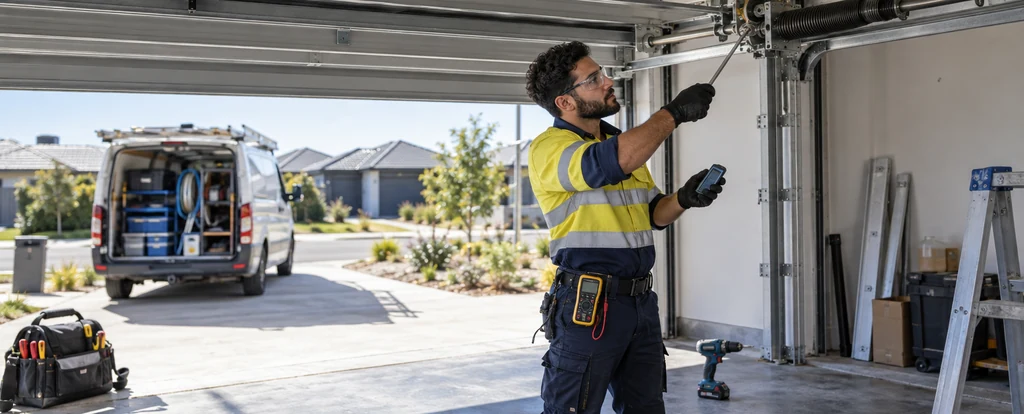
Most of the work happens at the customer's place, whether that is a door that has come off its tracks, a spring that has let go or a new opener to fit. The role sits across mechanics and electrics, so a fault that looks like a failing motor can turn out to be a bent track or a safety sensor knocked out of line. Many technicians work alone from a van, with the office handling bookings and quotes.
How much do garage door technicians earn?
The median full-time salary for a garage door technician is $73,800 per annum, before tax, up $15,500 since 2018.
How you are employed shapes your pay more than anything else: wages with a door company are usually set by the award or an enterprise agreement, while subcontractors and owner-operators bill per job. Breakdown and after-hours callouts often attract penalty rates, which can lift a week considerably. Specialising in commercial roller doors and shutters, or holding manufacturer accreditation, opens up higher-value work than routine residential servicing.
What does a garage door technician do day to day?
The list below is what fills most weeks; the exact mix shifts with seniority and whatever stage the current work is at.
- Installing sectional, roller and tilt doors, including tracks and hardware
- Servicing and adjusting springs, cables, rollers and hinges
- Diagnosing and repairing faulty motors, remotes and safety sensors
- Programming openers and testing the safety reverse settings
- Talking customers through repair, maintenance and replacement options
What skills do garage door technicians need?
Employers look for hand and power tool work, installation and maintenance, worksite safety management, backed by ServiceM8 fluency and strong problem solving.
Specialist skills
- Hand and power tool work
- Installation and maintenance
- Worksite safety management
- Plant and equipment operation
- Building codes and standards
Software and tools
- ServiceM8
- Merlin MyQ
- Chamberlain MyQ
- Multimeter
- Power tools
General skills
- Problem solving
- Customer service
- Attention to detail
Is the job growing?
About 1,500 people work as garage door technicians in Australia, and employment is projected to grow 3.5% over the decade to 2035. That's modest growth: demand is steady rather than booming.
How do you become a garage door technician?
Here's the path most garage door technicians take, step by step.
- 1Start with a door company
The usual entry is an installer's assistant or labouring job with a garage door business, where you learn on real jobs while earning. These roles are rarely advertised, so it is worth contacting manufacturers and installers directly.
- 2Complete a certificate III or IV
A traineeship combines paid work with study, and it is the qualification most people in the trade hold: 34% of the current workforce has completed Certificate III/IV. TAFE and private providers also offer trade certificates in carpentry, engineering or electrotechnology that cover tool work and site safety.
- 3Add electrical and product training
Fixed electrical wiring has to be done or checked by a licensed electrician, and some technicians take a restricted electrical licence so they can disconnect and reconnect openers. Most opener brands also run their own installer accreditation, which builders and homeowners often ask about.
- 4Learn the safety and compliance side
Automatic doors have to meet Australian standards for force and reverse settings, and the technician is the one who tests and adjusts them on site. Getting this right is what separates a competent installer from someone who simply hangs a door, and it is usually learned under an experienced technician over a year or two.
Ready to apply as a garage door technician?
Whether you're working toward becoming a garage door technician or already are one and want a hand with the next step (sharpening your resume for ATS screening, tightening your cover letter, or knowing what you'll actually be asked at interview), here are examples grounded in this specific role, not generic templates.
What jobs can a garage door technician move to?
Moving into Irrigation Technician typically comes with the biggest pay rise, worth $1,600 a year more on average.
| Move to | Typical pay change | Overlap | Retraining |
|---|---|---|---|
| Irrigation Technician Brings mechanical and electrical skills for installing automated systems, which transfer to irrigation controllers and pumps, with a short course covering plumbing and horticulture specifics. | +$1,600 | 71% | short course |
Moves are chosen from Jobs and Skills Australia's Data on Occupation Mobility, which follows income tax records between 2011-12 and 2020-21, together with entry requirements and skill overlap. A known move is one people were seen making in that data. Pay change compares median full-time pay for the two roles.
Who works as a garage door technician?
The typical garage door technician is 41 years old; 98% are men, 73% work full-time, and full-timers average 40 hours a week.
- 41
- Median age
- 2%
- Female share
- 73%
- Full-time
- +0h
- vs all-jobs avg
What's it like being a garage door technician?
The job moves between customers rather than through a shift: most technicians drive from one address to the next, see several jobs a day and leave each one with a door that opens and closes properly. It suits someone who enjoys working out a physical problem, is comfortable working alone and doesn't mind the body taking some punishment. Experience builds quickly because the same faults come up again and again, in slightly different forms.
What people like
- You see the result before you leave. A door that would not open in the morning is running smoothly by the afternoon, and the customer is usually there to see it happen.
- No two faults are quite the same. One job is a snapped cable, the next a sensor that trips on a hot day, which stops the work settling into a routine.
- A fair amount of independence. Most technicians work from their own van with the office handling bookings, so you set the pace between jobs and decide how a repair is done.
- You get to know your patch. Local homeowners, property managers and builders tend to call the same technician back, so the round builds a familiar set of faces over a few years.
What people find hard
- Heavy panels and tight spaces. A sectional door panel is awkward to lift and most garages are low, cluttered or packed with stored belongings that have to be moved first.
- Springs and cables are genuinely dangerous. Torsion springs and tensioned cables store a lot of energy, and a mistake can cause serious injury, so the work is done slowly and with the right tools.
- Weather and after-hours callouts. A door that will not close leaves a house open, so some jobs cannot wait, and that can mean a callout in the rain or on a weekend.
- Quotes get compared on price alone. A properly fitted door with correct safety settings can cost more than a quick fix from a general handyman, and homeowners don't always see the difference.
Based on our synthesis of professional-body surveys and public accounts of the role, not first-person verified reviews.
Which industries employ garage door technicians?
Building Installation Services employs the largest share of garage door technicians, followed by Residential Building Construction.
Top employing industries
- 1Building Installation Services
- 2Residential Building Construction
- 3Other Construction Services
- 4Manufacturing
- 5Retail Trade
Ranked by employment share; the source doesn't publish an exact percentage per industry.
| Certificate III/IV | 34% | |
|---|---|---|
| Diploma / Advanced Diploma | 26% | |
| Bachelor degree | 20% | |
| Year 12 or below | 20% |
Will AI replace garage door technicians?
AI exposure for this job is low, because nearly all of it involves hands on a door that has come off its tracks, a spring that has snapped or an opener that needs its settings adjusted. Connected openers such as Merlin MyQ and Chamberlain MyQ, and job apps like ServiceM8, change how faults are reported, jobs are scheduled and quotes are written, but none of them lifts a door into place. Expect the admin side to keep getting faster while the repair itself stays manual.
Share of typical working time by exposure level
- Installing doors, tracks and hardwareA door has to sit square in an opening that is often not square itself, which is measured, adjusted and checked by eye rather than calculated.35%low
- Replacing springs, cables and rollersA torsion spring holds enough stored energy to cause serious injury, so it is wound and released by hand with specific tools and a fixed sequence.25%low
- Diagnosing faults and testing safety settingsFault codes and opener apps point towards a failed sensor or a strained motor, but the reverse and force settings still have to be tested on the door itself.20%moderate
- Quoting, scheduling and customer adviceBooking, invoicing and follow-up messages are already automated in platforms like ServiceM8, and AI is starting to draft quotes and job notes from photos.20%high
Common questions about becoming a garage door technician
Straight answers to the questions people ask most.
How much do garage door technicians earn?
Garage door technicians earn a median of $73,800 per year before tax when working full time. Where you sit around that figure depends on whether you are an employee or a subcontractor, how much after-hours callout work you take on and whether you specialise in commercial doors. Subcontractors quote per job, so their income varies more from month to month than a wage does.
How do you become a garage door technician?
Most people start as an installer's assistant or labourer with a door company and learn the work on the job while completing a traineeship. A certificate III in a related trade covers the tool work and safety basics, and manufacturer training on the main opener brands follows once you are working. There is no single national qualification that employers insist on, so a start with a good company matters more than which course you choose.
Are garage door technicians in demand?
Garage door technicians are currently not in shortage, and employment is projected to grow 3.5% over the decade to 2035. Much of the work is repairs, servicing and replacement rather than new installations, which keeps a baseline of jobs even when residential building slows. Openers that connect to a phone also give technicians new systems to install, service and troubleshoot.
Will AI replace garage door technicians?
Exposure to AI in this job is low, because the core of it is physical: fitting a door into an opening, replacing springs and adjusting tracks by hand. What is changing is the admin around the work, with scheduling and quoting software and connected openers that log faults and send alerts. Those tools narrow down a diagnosis, but someone still has to test the door's reverse and force settings on site.
What can a garage door technician move into?
The mechanical and electrical skills transfer to irrigation technician work, where controllers and pumps need the same kind of fault-finding, and that move comes with a pay difference of about $1,600 more. Roofers and sign installers often come the other way into garage door work, because mounting fixtures, sealing openings and working safely on building exteriors overlap closely. Many experienced technicians eventually start their own installation and repair business, working alone or with one helper, and that is often where earnings grow.
Do you need a licence to install and repair garage doors?
There is no national licence for garage door work itself, but fixed electrical wiring must be done or checked by a licensed electrician, and what a non-electrician may connect varies by state. On construction sites you will usually need a White Card before you can start, and some job sites add their own inductions. Common sense, the right tools and a careful sequence are what keep spring and cable work safe.
Related roles
- Irrigation Technician
- Sign Installer
- Insulation Installer
- Roofer
- Air Conditioning Technician
- Mechanical Services Plumber
Not sure this is you? Take the career quiz and get a ranked shortlist of roles that fit how you like to work.