Nut Grower
Nut growers manage orchards of almonds, macadamias, walnuts, pecans and hazelnuts, and the crop they harvest goes on to snack packs, baking and export.
- Median salary*
- $72,800
3.6%vs last year, before tax
- People employed
- 680
2.9%vs last year
- Projected growth*
- +8%
to 2035
- AI exposure*
- Low
- automation risk
- Average hours*
- 46/wk
+6h vs all jobs
- Shortage status*
- Not in shortage
national
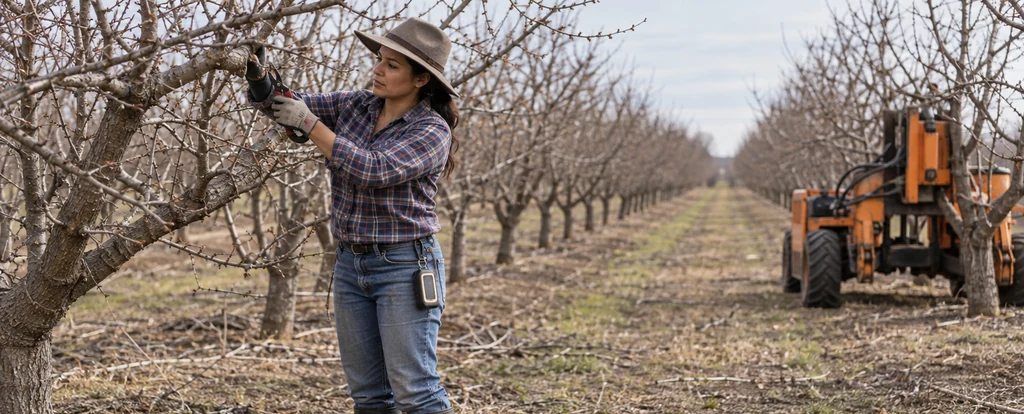
Nut growing happens on orchards in regional areas, and the year follows a cycle from winter pruning through pollination and irrigation to a harvest that runs for a few intense weeks. Where an orchardist may work across several fruit crops, a nut grower specialises in tree nuts and usually carries the whole operation, from variety choice through to drying and grading. Almonds, macadamias, walnuts, pecans and hazelnuts all grow on trees, so the skills carry across species even when the machinery differs.
How much do nut growers earn?
The median full-time salary for a nut grower is $72,800 per annum, before tax, up $15,500 since 2018.
Earnings in nut growing swing with the season and the crop. Full-time management roles on an established orchard are the steadiest, while harvest work is often casual and short. What you take home also depends on whether you are an employee or own the orchard, since returns to owners move with nut prices, water costs and the size of the crop.
What does a nut grower do day to day?
The list below is what fills most weeks; the exact mix shifts with seniority and whatever stage the current work is at.
- Pruning trees through winter to shape the canopy and set up the next season's crop
- Running irrigation and fertigation schedules through the growing season, often from a controller and soil moisture readings
- Walking the rows to check for pests, disease and nutrient problems, and deciding when to spray
- Operating shakers, harvesters and tractors at harvest and getting the crop to the drying floor quickly
- Drying, grading and storing nuts, then organising transport to processors or buyers
What skills do nut growers need?
Employers look for operations management, plant and equipment operation, field inspection and testing, backed by Agrimaster fluency and strong physical stamina and dexterity.
Specialist skills
- Operations management
- Plant and equipment operation
- Field inspection and testing
- Worksite safety management
- Inventory management
- Process improvement
Software and tools
- Agrimaster
- Trimble Ag
- John Deere Operations Center
- Netafim irrigation controllers
- Orchard Rite harvest shakers
General skills
- Physical stamina and dexterity
Is the job growing?
About 680 people work as nut growers in Australia, and employment is projected to grow 8% over the decade to 2035. That's modest growth: demand is steady rather than booming.
How do you become a nut grower?
Here's the path most nut growers take, step by step.
- 1Start with orchard work
Formal entry requirements are minimal, and a season of harvest or farmhand work is a common way in. It gives you machinery hours, pruning practice and the spraying experience employers ask about.
- 2Complete a Certificate III in Horticulture
The certificate covers crop production, soils, irrigation and pest management, and can be studied part time while you work. It is widely recognised for orchard production roles and gives structure to what you learn on the job.
- 3Get the licences and qualifications the work requires
Spraying usually needs a chemical user accreditation such as ChemCert, and a forklift licence and driver's licence are standard because orchards sit away from town. Machinery competency is usually picked up on the job.
- 4Study further for management and agronomy
A Diploma of Horticulture or a bachelor degree in agriculture or horticulture opens orchard management and agronomy roles. Around 38% of people working as nut growers hold a bachelor degree.
Ready to apply as a nut grower?
Whether you're working toward becoming a nut grower or already are one and want a hand with the next step (sharpening your resume for ATS screening, tightening your cover letter, or knowing what you'll actually be asked at interview), here are examples grounded in this specific role, not generic templates.
What jobs can a nut grower move to?
Moving into Grain Grower typically comes with the biggest pay rise, worth $10,400 a year more on average.
| Move to | Typical pay change | Overlap | Retraining |
|---|---|---|---|
| Grain Grower Broadacre cropping machinery and soil knowledge help, but grain growing requires substantial retraining in large scale cereal production. | +$10,400 | 34% | reskill |
| Orchardist Tree crop pruning, irrigation and harvest experience carries across to orchard work, with a short course covering fruit specific production. | +$0 | 54% | short course |
| Vegetable Grower Soil preparation, irrigation and pest management skills transfer to vegetable production, with a short course on vegetable crop requirements. | +$0 | 57% | short course |
| Turf Grower Soil, irrigation and machinery skills support turf production, though a short course covers turf specific establishment and maintenance. | −$5,200 | 62% | short course |
| Flower Grower Plant propagation, crop care and harvest timing knowledge transfer to flower growing, needing little extra training for production roles. | −$7,800 | 62% | minimal |
Moves are chosen from Jobs and Skills Australia's Data on Occupation Mobility, which follows income tax records between 2011-12 and 2020-21, together with entry requirements and skill overlap. A known move is one people were seen making in that data. Pay change compares median full-time pay for the two roles.
Who works as a nut grower?
The typical nut grower is 52 years old; 76% are men, 78% work full-time, and full-timers average 46 hours a week.
- 52
- Median age
- 24%
- Female share
- 78%
- Full-time
- +6h
- vs all-jobs avg
What's it like being a nut grower?
The job has a clear yearly rhythm: dormant pruning in winter, pollination and irrigation through spring and summer, then harvest in autumn. Much of the work is spent outdoors on machinery or on foot among the trees, and the decisions are practical ones about water, pests and timing. It suits someone who likes seeing a long project through and is comfortable with weather and distance from town shaping the day.
What people like
- Working through a full growing cycle. You prune a tree in winter and watch the crop come off it months later. Few jobs give you that long a view of your own work.
- Machinery and hands-on problem solving. Shakers, harvesters, irrigation controllers and spray gear all need someone who can set them up, adjust them and fix what breaks mid-season.
- Independence on the orchard. Once you know the block, you decide when to irrigate, spray or start harvest, with little supervision between visits from an agronomist.
- Work that keeps you moving. Days are spent on your feet, on a tractor or walking rows, which suits people who would rather not be at a desk.
What people find hard
- Harvest compresses into a few weeks. Nut crops ripen close together and the window to get them off the trees is short, so harvest days run long and wet weather can force the schedule.
- Weather, water and prices are outside your control. Frost at flowering, a dry season or a drop in nut prices affects the year's return no matter how well the orchard was managed.
- Distance and isolation. Orchards are in regional growing areas, so the job usually means a long drive to services, schools and anything resembling a city.
- Physical wear over the season. Pruning, spraying and machinery work are hard on the shoulders, back and hands, and very little of it can be done sitting down.
Based on our synthesis of professional-body surveys and public accounts of the role, not first-person verified reviews.
Which industries employ nut growers?
Tree nut growing employs the largest share of nut growers, followed by Horticulture.
Top employing industries
- 1Tree nut growing
- 2Horticulture
- 3Agriculture support services
- 4Food product manufacturing
Ranked by employment share; the source doesn't publish an exact percentage per industry.
| Bachelor degree | 38% | |
|---|---|---|
| Diploma / Advanced Diploma | 24% | |
| Certificate III/IV | 20% | |
| Postgraduate | 10% | |
| Other | 8% |
Will AI replace nut growers?
Nut growing has low exposure to AI and automation. The work is defined by trees, soil, weather and machinery in the field, and the calls about when to irrigate, spray or start harvest come from looking at the orchard. Orchard software, soil moisture probes and satellite imagery already handle scheduling and record keeping, which changes the paperwork more than it changes who does the pruning.
Share of typical working time by exposure level
- Harvest and machinery operationRunning shakers, harvesters and tractors across an orchard still depends on a person judging ground conditions, tree size and how the nuts are coming off.40%low
- Pruning, planting and tree trainingShaping a canopy by hand decides next season's crop, and no machine reads a tree the way an experienced pruner does.35%low
- Pest, disease and nutrition monitoringImagery and orchard software flag problem blocks, but someone still walks the rows to confirm what is happening and decide on a spray.15%moderate
- Irrigation scheduling, spray records and complianceControllers and farm software now log water use, spray diaries and harvest data automatically, cutting the record-keeping side of the job.10%moderate
Common questions about becoming a nut grower
Straight answers to the questions people ask most.
How much do nut growers earn?
Nut growers earn a median of $72,800 per year before tax, based on full-time workers. What you actually earn depends on the season, the size of the orchard and whether you work for an owner or run the operation yourself.
How do you become a nut grower?
Most people start on an orchard and learn the crop from the ground up, since there is no licence or registration required. A Certificate III in Horticulture (AHC30722) fills in the soil, irrigation and pest management knowledge, and a chemical user accreditation is usually needed before you can spray.
Are nut growers in demand?
Nut growers are currently not in shortage, and employment in the occupation is projected to grow 8% over the decade to 2035 over the decade to 2035. About 680 people work as nut growers in Australia, so openings are limited and spread across the growing regions rather than concentrated in the cities.
Will AI replace nut growers?
Nut growing has low exposure to AI and automation, because the work depends on trees, soil, weather and machinery handled in the field. Orchard software and sensors already help with irrigation scheduling, spray diaries and yield mapping, and imaging tools are improving how pests are spotted, but they inform decisions that are still made by walking the rows.
What can nut growers move into?
Tree crop skills carry across to orchardist and vegetable grower work, where pay is about the same and about the same respectively, because pruning, irrigation and harvest experience transfers with a short course. Grain growing is a larger step that needs substantial retraining, though it pays $10,400 more. Many nut growers eventually run or buy into an orchard of their own, which is often where earnings grow.
What is a typical week for a nut grower?
Full-time nut growers average around 46 hours a week, and the load is uneven across the year. Winter is heavy with pruning, spring and summer with irrigation and spraying, and harvest weeks run considerably longer than the average.
Related roles
Not sure this is you? Take the career quiz and get a ranked shortlist of roles that fit how you like to work.