Operating Theatre Technician
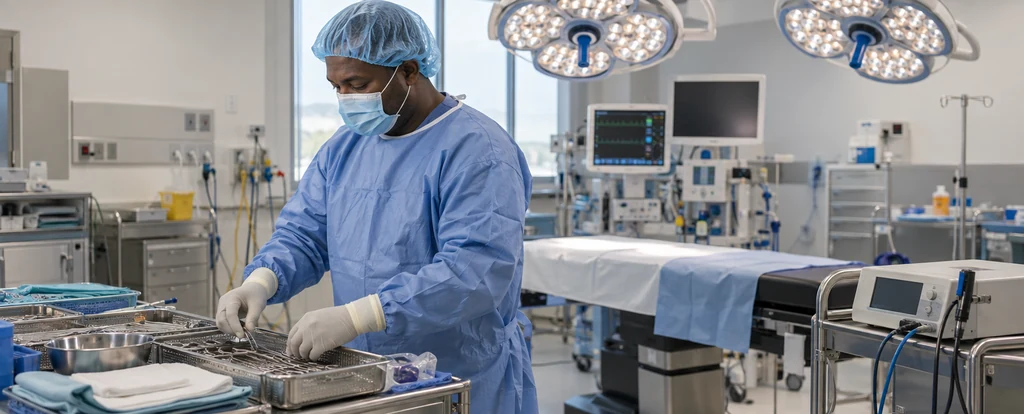
Operating theatre technicians prepare the theatre, instruments and equipment for surgery, then support the clinical team through each operation and the clean-up that follows.
- Median salary*
- $80,600
3.6%vs last year, before tax
- People employed
- 1,400
0.0%vs last year
- Projected growth
- +17.4%
to 2035
- AI exposure*
- Low
- automation risk
- Average hours
- 41/wk
+1h vs all jobs
- Shortage status
- Not in shortage
national
Operating theatre technicians work in hospital theatres and day surgery units, setting up the room, instruments and equipment and keeping the surgical list moving between cases. The role overlaps with anaesthetic technicians, who specialise in anaesthesia equipment and work closely with the anaesthetist, while theatre technicians cover the wider setup, the sterile field and instrument flow. Public and private hospitals are the main employers, and the work runs to a list of scheduled cases rather than a standard office day.
How much do operating theatre technicians earn?
The median full-time salary for an operating theatre technician is $80,600 per annum, before tax, up $17,200 since 2018.
Where you work shapes the figure most: public hospital technicians are usually covered by a state enterprise agreement with shift, weekend and on-call loadings, while private day surgery facilities set their own rates. Your certificate level, years of experience and how much on-call and overtime you take on all move pay as well. Because much of the work happens outside standard hours, penalty rates can add a meaningful amount to base pay.
What does an operating theatre technician do day to day?
The list below is what fills most weeks; the exact mix shifts with seniority and whatever stage the current work is at.
- Setting up the theatre before a list, checking the operating table, lights, diathermy and suction are working
- Laying out trolleys and sterile fields with the instrument sets each procedure needs
- Positioning and transferring patients onto the table and helping move them to recovery afterwards
- Passing instruments and equipment to the surgical team and clearing used items as each case finishes
- Cleaning down and restocking theatres between cases so the next patient can come in on schedule
What skills do operating theatre technicians need?
Employers look for patient care and support, infection control and hygiene, plant and equipment operation, backed by ORMIS fluency and strong safety and compliance awareness.
Specialist skills
- Patient care and support
- Infection control and hygiene
- Plant and equipment operation
Software and tools
- ORMIS
- SurgiNet
- SteriTrack
- patient monitoring systems
- electrosurgical units
General skills
- Safety and compliance awareness
- Attention to detail
- Written communication
- Physical stamina and dexterity
Is the job growing?
About 1,400 people work as operating theatre technicians in Australia, and employment is projected to grow 17.4% over the decade to 2035. That's healthy, above-average growth, and the role should stay in solid demand.
How do you become an operating theatre technician?
Here's the path most operating theatre technicians take, step by step.
- 1Complete a Certificate III or IV
A Certificate III in Health Services Assistance (HLT33115) with an operating theatre specialisation, or a Certificate III in Sterilisation Services (HLT37015), gives you the technical base employers look for. TAFE and some private providers deliver these, usually over six to twelve months.
- 2Start in a hospital support role
Many technicians work as a theatre orderly or assistant in nursing while they study, which is where sterile field habits, patient handling and equipment routines are learned. It also puts you inside the hospital when technician vacancies come up.
- 3Apply for technician vacancies
Hospital networks and day surgery groups advertise these roles themselves, and shortlisting usually comes down to your certificate, your hospital experience and your availability for shifts and on-call.
- 4Clear the pre-employment checks
Expect a police check, a working with children check where the setting requires it, and vaccination evidence. These are conditions of entry rather than qualifications, and hospitals will tell you which apply.
- 5Build experience across specialties
Technicians are trained across orthopaedics, cardiac, neuro and endoscopy lists, and the more theatre types you can cover, the more shifts you can be rostered onto.
Ready to apply as an operating theatre technician?
Whether you're working toward becoming an operating theatre technician or already are one and want a hand with the next step (sharpening your resume for ATS screening, tightening your cover letter, or knowing what you'll actually be asked at interview), here are examples grounded in this specific role, not generic templates.
What jobs can an operating theatre technician move to?
Moving into Cardiac Technician typically comes with the biggest pay rise, worth $6,800 a year more on average.
| Move to | Typical pay change | Overlap | Retraining |
|---|---|---|---|
| Cardiac Technician Cardiac technicians use similar monitoring and procedural support skills, but operating theatre technicians need further study in diagnostic cardiac testing. | +$6,800 | 65% | reskill |
| Anaesthetic Technician Operating theatre technicians build on their sterile field and surgical support skills, though becoming an anaesthetic technician requires further diploma study. | +$0 | 86% | reskill |
| Respiratory and Sleep Technician Respiratory and sleep technicians draw on shared hospital technical skills, though operating theatre technicians must complete additional diploma study. | −$500 | 58% | reskill |
| Dialysis Technician Dialysis technicians share the same hospital technical base, so operating theatre technicians can move across with minimal additional training. | −$10,400 | 86% | minimal |
Moves are chosen from Jobs and Skills Australia's Data on Occupation Mobility, which follows income tax records between 2011-12 and 2020-21, together with entry requirements and skill overlap. A known move is one people were seen making in that data. Pay change compares median full-time pay for the two roles.
Who works as an operating theatre technician?
The typical operating theatre technician is 47 years old; 76% are men, 70% work full-time, and full-timers average 41 hours a week.
- 47
- Median age
- 24%
- Female share
- 70%
- Full-time
- +1h
- vs all-jobs avg
What's it like being an operating theatre technician?
The job runs to the rhythm of the surgical list: a burst of preparation, a case, a turnover, then the next patient. Pressure comes from the schedule, because a delayed case pushes every case after it, and the team depends on you knowing the instruments and the equipment before anyone asks. It suits people who like practical work with a clear finish line and are comfortable in a room where the stakes are high but the roles are well defined.
What people like
- Every case has a visible end. You set up, you support the operation, you turn the room over, and the list is done. The work is physical and immediate rather than something that sits in a queue.
- A tightly scripted team. Surgeons, anaesthetists and nurses each know their part, and so do you. Most of the communication is short and practical, which suits people who prefer getting on with the task.
- Skills that carry across procedures. Learning the instrument sets and equipment for orthopaedics, cardiac or endoscopy work makes you more useful across the theatre complex and opens up more of the roster.
- Rosters you can plan around. Hospital rosters are published in advance, and the loadings that come with evenings, weekends and on-call mean the pattern has some compensation built in.
What people find hard
- A late list puts everyone under pressure. When an emergency case is added or a procedure runs long, the turnover between cases speeds up and there is little room to catch your breath.
- Physically heavy work. You are on your feet for most of a shift, lifting instrument trays, moving patients and pushing equipment, and that adds up over a long list.
- Evenings, weekends and on-call. Theatres run outside business hours, including emergency surgery overnight, so a social life takes some planning around the roster.
- Some procedures are confronting. Blood, trauma and serious illness are part of the job, and not every case has a straightforward outcome. New technicians usually find the first few months the hardest.
Based on our synthesis of professional-body surveys and public accounts of the role, not first-person verified reviews.
Which industries employ operating theatre technicians?
Health Care and Social Assistance employs the largest share of operating theatre technicians.
Top employing industries
- 1Health Care and Social Assistance
Ranked by employment share; the source doesn't publish an exact percentage per industry.
| Certificate III/IV | 47.2% | |
|---|---|---|
| Year 12 or below | 15.5% | |
| Bachelor degree | 14.5% | |
| Diploma / Advanced Diploma | 12.3% | |
| Postgraduate | 4% |
Will AI replace operating theatre technicians?
Operating theatre technicians sit at low exposure to AI, because the core of the job is physical and sterile: someone has to set up the table, lay out the instruments, pass them during a case and turn the room over afterwards. Theatre management systems such as ORMIS and SurgiNet, and tracking systems like SteriTrack, have already automated much of the scheduling and instrument record-keeping around that work. Robotic platforms change who handles some instruments, but they still need a trained person to prepare, position and support the case.
Share of typical working time by exposure level
- Setting up theatres and sterile fieldsChecking the table, lights, diathermy and suction and laying out the right instrument sets is hands-on work in a sterile field that machines cannot take over.30%low
- Sterilising and tracking instrumentsSystems like SteriTrack already log every set through the steriliser, so the recording side is automated while loading, checking and releasing sets stays manual.25%moderate
- Positioning and transferring patientsMoving a patient safely onto the table needs hands, an eye on their condition and coordination with the nursing team.25%low
- Supporting the team during proceduresPassing instruments, managing diathermy leads and responding to the surgeon mid-case depends on reading the room as it happens.20%low
Common questions about becoming an operating theatre technician
Straight answers to the questions people ask most.
How much does an operating theatre technician earn?
Operating theatre technicians earn $80,600 per year before tax at the median. Public hospital enterprise agreements and private facility rates differ, and shift penalties, weekend loadings and on-call usually add to the base figure.
How do I become an operating theatre technician?
Most people complete a Certificate III in Health Services Assistance (HLT33115) with an operating theatre specialisation, or a Certificate III in Sterilisation Services (HLT37015), then apply to a hospital or day surgery network. Starting as a theatre orderly or assistant in nursing while you study is a common route in, because it gives you hospital experience and an internal reference. No national registration applies to the role itself.
Are operating theatre technicians in demand?
Operating theatre technicians are currently not in shortage, and employment is projected to grow 17.4% over the decade to 2035. The work is concentrated in hospital theatres and day surgery units, so it pays to watch the career pages of the large hospital networks as well as the job boards, and to be available for shift and on-call work.
Will AI replace operating theatre technicians?
Automation reaches the job only lightly, because someone has to physically set up a sterile field, pass instruments and move patients. Theatre management systems such as ORMIS and SurgiNet and instrument tracking systems like SteriTrack now handle much of the scheduling and traceability that used to be paperwork. Robotic surgery changes who holds some instruments during a procedure, but the theatre still needs a technician in the room.
What can an operating theatre technician move into?
Anaesthetic technician draws on the same sterile field and surgical support skills, though moving across requires further diploma study. Dialysis technician uses the same hospital technical base with minimal extra training, and the pay is $10,400 less. Cardiac technician pays $6,800 more and shares monitoring and procedural support skills, but needs additional study in diagnostic cardiac testing.
Do operating theatre technicians work shifts?
Yes, theatres are rostered across early, late and weekend shifts, with on-call for emergency surgery. Full-time technicians work an average of 41 hours a week, and 70% of the workforce works full time, with part-time and casual roles also common in day surgery units.
Related roles
- Anaesthetic Technician
- Dialysis Technician
- Cardiac Technician
- Respiratory and Sleep Technician
- Hospital Orderly
- Assistant in Nursing
Not sure this is you? Take the career quiz and get a ranked shortlist of roles that fit how you like to work.