Oral Pathologist
Oral pathologists are dental specialists who diagnose disease of the mouth, jaws and salivary glands from tissue samples, and their reports guide the treatment a dentist or surgeon plans next.
- Median salary*
- $197,600
3.6%vs last year, before tax
- People employed*
- 60
40.0%vs last year
- Projected growth
- +35.8%
to 2035
- AI exposure*
- Moderate
- automation risk
- Average hours*
- 42/wk
+2h vs all jobs
- Shortage status
- In shortage
national
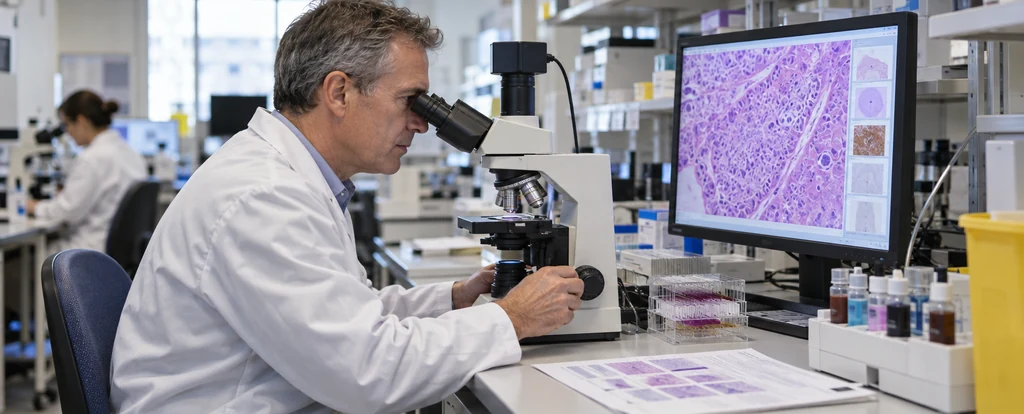
Oral pathologists work in hospital pathology departments, university dental schools and diagnostic laboratories rather than at the dental chair, and their patients arrive as specimens: a biopsy, a cyst, a section of jaw. They are the specialists dentists and maxillofacial surgeons turn to when a lesion needs a name, which separates them from anatomical pathologists who cover the rest of the body. The workforce is small, about 60 people nationally, so most work in a handful of teaching hospitals and laboratories.
How much do oral pathologists earn?
The median full-time salary for an oral pathologist is $197,600 per annum, before tax, up $42,100 since 2018.
Most oral pathologists are employed in public hospital or university pathology services, so pay follows the relevant state or territory specialist award or enterprise agreement and moves with years of service and on-call duties. Private diagnostic laboratories and expert opinion work are negotiated differently, and academic appointments often sit below hospital pay. Part-time and combined clinical and academic roles are common in a field this small, which is worth checking when you compare a full-time figure against what people actually take home.
What does an oral pathologist do day to day?
The list below is what fills most weeks; the exact mix shifts with seniority and whatever stage the current work is at.
- Examining biopsy and excision specimens under the microscope, working from the slides and the clinical history to reach a diagnosis
- Writing reports that tell the referring dentist or surgeon what the lesion is and what it means for treatment
- Ordering and interpreting immunohistochemical and molecular tests to subtype tumours such as squamous cell carcinoma and salivary gland lesions
- Taking frozen section calls from theatre during an operation, when the surgeon needs an answer within minutes
- Presenting cases at head and neck multidisciplinary meetings and supervising pathology registrars and dental students
What skills do oral pathologists need?
Employers look for laboratory analysis, clinical assessment and treatment, teaching and instruction, backed by Light microscopes fluency and strong attention to detail.
Specialist skills
- Laboratory analysis
- Clinical assessment and treatment
- Teaching and instruction
Software and tools
- Light microscopes
- Digital pathology software
- Laboratory Information Management Systems (LIMS)
- Immunohistochemistry stains
General skills
- Attention to detail
- Problem solving
- Written communication
Is the job growing?
About 60 people work as oral pathologists in Australia, and employment is projected to grow 35.8% over the decade to 2035. That's very strong growth. Few roles in Australia are expanding this fast, and it points to solid demand for years to come.
How do you become an oral pathologist?
Here's the path most oral pathologists take, step by step.
- 1Complete a dentistry degree
Registration as a dentist comes first, so the entry point is an accredited dental degree, usually five years undergraduate or four years for graduate entry at a university dental school. Many oral pathologists spend several years in clinical dentistry before specialising.
- 2Register with the Dental Board of Australia
Registration through AHPRA is required to practise as a dentist, and you need general registration before you can enter a specialist training program.
- 3Complete specialist training in oral pathology
This is normally a Doctor of Clinical Dentistry in oral pathology, about three years of supervised diagnostic reporting and coursework in a university dental school or hospital pathology department. A research pathway, such as a master's or PhD alongside supervised reporting, is the alternative for people already working in a laboratory.
- 4Apply for specialist registration
Specialist registration with AHPRA as an oral pathologist follows the recognised qualification and is what allows you to report independently. Combining the qualification with an academic appointment is common, because hospitals and dental schools hold most of the positions.
Ready to apply as an oral pathologist?
Whether you're working toward becoming an oral pathologist or already are one and want a hand with the next step (sharpening your resume for ATS screening, tightening your cover letter, or knowing what you'll actually be asked at interview), here are examples grounded in this specific role, not generic templates.
What jobs can an oral pathologist move to?
We don't list lateral moves for oral pathologists: leaving means a full new qualification rather than a career move, and the realistic routes in are covered under how to become one.
Who works as an oral pathologist?
The typical oral pathologist is 52 years old; 55% are men, 85% work full-time, and full-timers average 42 hours a week.
- 52
- Median age
- 45%
- Female share
- 85%
- Full-time
- +2h
- vs all-jobs avg
What's it like being an oral pathologist?
The work is laboratory based and case by case: a tray of slides, a clinical history, and a question from a surgeon that needs an answer. Days are quiet and largely self-directed, punctuated by frozen section calls from theatre and multidisciplinary meetings where the diagnosis gets discussed with the treating team. It suits someone who likes the puzzle of naming a disease more than the rhythm of treating patients face to face.
What people like
- The diagnosis is the whole job. You spend your day on the question of what a lesion is, and a clear answer changes what happens to the patient, often within days.
- A narrow area with plenty of variety. The mouth and jaws produce everything from harmless cysts to aggressive cancers and salivary gland tumours, so the case mix stays wide even though the anatomy is specific.
- A small specialty where people know each other. With a workforce this size, the surgeons, oncologists and dentists you work with become familiar names, and multidisciplinary meetings run on those relationships.
- No practice to run. Hospital and university pathology has on-call and frozen section duties, but the daily rhythm is steadier than clinical dentistry, with no appointment book, staffing or overheads to manage.
What people find hard
- Long stretches alone at the microscope. Much of the week is solitary desk work, and people who need company or constant movement find that part difficult.
- Few positions, in few places. Jobs cluster in capital city teaching hospitals and university dental schools, so taking one often means relocating or waiting for a vacancy to open.
- Specimens that cannot answer the question. A small or badly handled biopsy sometimes supports only a report that the sample is not diagnostic, and asking for another means the patient waits longer for a plan.
- The weight of a cancer diagnosis. Your report can turn a routine appointment into urgent surgery, and errors have real consequences for how quickly and how well someone is treated.
Based on our synthesis of professional-body surveys and public accounts of the role, not first-person verified reviews.
Which industries employ oral pathologists?
Hospitals employs the largest share of oral pathologists, followed by Diagnostic laboratories.
Top employing industries
- 1Hospitals
- 2Diagnostic laboratories
- 3Universities
- 4Dental practices
- 5Government health services
Ranked by employment share; the source doesn't publish an exact percentage per industry.
| Bachelor degree | 52% | |
|---|---|---|
| Postgraduate | 26% | |
| Diploma / Advanced Diploma | 13% | |
| Other | 9% |
Will AI replace oral pathologists?
Oral pathology is moderately exposed: digital pathology scanners, whole-slide imaging and image analysis software are now established in laboratories, and they help screen slides, flag suspicious regions and measure stains more consistently. What they do not do is sign out a diagnosis, and matching what the microscope shows against the clinical history and the surgeon's question still takes a pathologist. The laboratory reporting side of the job is the most exposed, while frozen section work and teaching are not.
Share of typical working time by exposure level
- Reading and reporting biopsy specimensAlgorithms can prioritise slides and outline regions of interest, but the diagnostic call on a squamous cell carcinoma or a cyst is written and signed by the pathologist.35%moderate
- Selecting and interpreting immunohistochemistry and molecular testsSoftware helps quantify stains and variant calls, while deciding which markers will separate two similar tumours remains a judgement built on the case.25%moderate
- Frozen section calls from theatreA surgeon waiting mid-operation needs an answer in minutes from a small, imperfect sample, which leaves little room for automated reporting.20%low
- Teaching, supervising and multidisciplinary meetingsExplaining a diagnosis to registrars, dental students and the treating team depends on the pathologist's reading of the case and the conversation around it.20%low
Common questions about becoming an oral pathologist
Straight answers to the questions people ask most.
How much do oral pathologists earn?
Oral pathologists earn a median of $197,600 per year before tax, based on full-time workers. In public hospitals and universities, pay follows the relevant specialist award or enterprise agreement, so it moves with years of service and on-call duties, while private laboratory and expert opinion work is negotiated case by case.
How do you become an oral pathologist?
You qualify as a dentist first, register with the Dental Board of Australia through AHPRA, and then complete specialist training in oral pathology, usually a Doctor of Clinical Dentistry over about three years. Specialist registration is what allows you to report diagnoses independently, and the whole path takes roughly eight to ten years after school.
Are oral pathologists in demand?
Oral pathologists are currently in shortage nationally, and employment in the role is projected to grow 35.8% over the decade to 2035. The workforce is small, so that projection describes a few positions rather than a wave of hiring, and openings sit mainly in hospital pathology departments and university dental schools.
Will AI change oral pathology?
Digital pathology and image analysis tools already sit alongside the microscope, highlighting regions of interest on whole-slide images and helping quantify stains more consistently, and this is a moderately exposed specialty. Signing out a diagnosis, weighing what the slides show against the clinical history and the surgeon's question, still sits with the pathologist.
What careers can an oral pathologist move into?
The transition into this role runs from dentistry: dentists already hold the clinical dental training and patient care experience, then complete specialist oral pathology training, which is a requalification rather than a short course. Median full-time pay for oral pathologists is $29,500 more than for dentists. Within the specialty, people tend to add an academic post, research or laboratory leadership rather than move out of diagnostics.
Do oral pathologists see patients?
Most of the work is on specimens rather than people, so a typical week has little chair-side contact. Some run clinics for patients with oral lesions, particularly in dental schools and hospital oral medicine departments, and teaching and multidisciplinary meetings add a clinical side to the role.
Specialisation of
Related roles
- Dentist
- Forensic Odontologist
- Medical Laboratory Scientist
- Perfusionist
- Oral and Maxillofacial Surgeon
- Radiographer
Not sure this is you? Take the career quiz and get a ranked shortlist of roles that fit how you like to work.