Home Manufacturing & Production
Precision Instrument Maker
Precision instrument makers build, calibrate and repair the fine measuring and control instruments that keep manufacturing, medicine and research accurate.
- Median salary*
- $78,000
4.1%vs last year, before tax
- People employed
- 1,700
0.0%vs last year
- Projected growth
- +8%
to 2035
- AI exposure*
- Moderate
- automation risk
- Average hours
- 40/wk
matches all-jobs average
- Shortage status
- In shortage
national
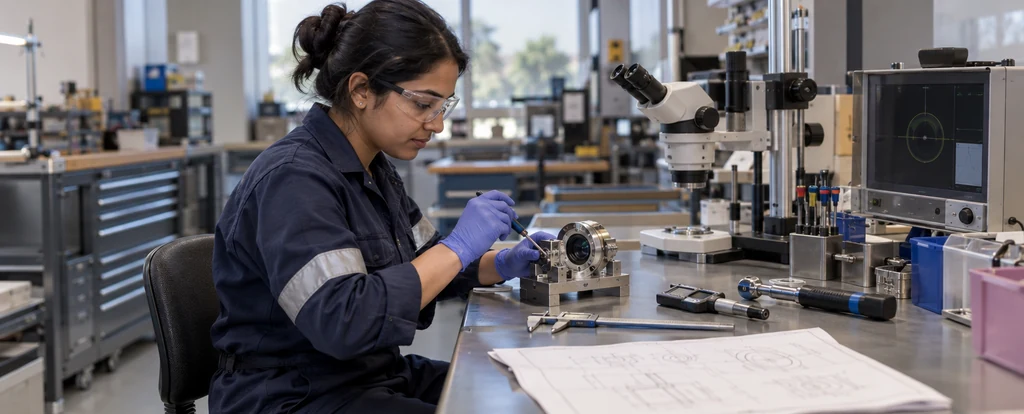
Precision instrument makers build and maintain gauges, optical equipment, medical devices and control sensors, working to tolerances far tighter than general machining allows. They machine and hand fit small components, then test each instrument against reference standards before it goes back into service. The work sits closer to measurement than to general metalwork, which is what separates it from a toolmaker or a fitter and turner, and most of these jobs are in small workshops or calibration laboratories attached to manufacturers, hospitals and research organisations.
How much do precision instrument makers earn?
The median full-time salary for a precision instrument maker is $78,000 per annum, before tax, up $16,300 since 2018.
Pay moves with the sector and with the certification behind you: calibration laboratories, medical device makers and defence contractors usually pay more than general manufacturing, and a recognised calibration qualification or a restricted electrical licence can lift your rate. Overtime and on-call allowances for breakdown work add to the base in larger plants.
What does a precision instrument maker do day to day?
The list below is what fills most weeks; the exact mix shifts with seniority and whatever stage the current work is at.
- Machining and hand fitting small components to tolerances measured in fractions of a millimetre
- Assembling optical, mechanical and electronic sub-assemblies into a finished instrument
- Calibrating instruments against reference standards and adjusting them until they read correctly
- Diagnosing faults and repairing or replacing worn parts, often on equipment a customer needs back in service quickly
- Reading engineering drawings and recording test and service results so each instrument keeps a traceable calibration history
What skills do precision instrument makers need?
Employers look for installation and maintenance, fabrication and finishing, engineering design and analysis, backed by SolidWorks fluency and strong attention to detail.
Specialist skills
- Installation and maintenance
- Fabrication and finishing
- Engineering design and analysis
- CAD and technical drawing
- Plant and equipment operation
Software and tools
- SolidWorks
- AutoCAD
- PC-DMIS
- Fluke MET/CAL
- LabVIEW
General skills
- Attention to detail
- Problem solving
Is the job growing?
About 1,700 people work as precision instrument makers in Australia, and employment is projected to grow 8% over the decade to 2035. That's modest growth: demand is steady rather than booming.
How do you become a precision instrument maker?
Here's the path most precision instrument makers take, step by step.
- 1Finish Year 12 with maths and physics, or an equivalent
Apprenticeships in this trade are competitive and employers look for solid maths, because much of the work involves reading drawings, calculating tolerances and interpreting measurement results.
- 2Start a Certificate III in Engineering (Mechanical Trade) apprenticeship with instrument-making work
This is the standard entry route and usually takes about four years. You are paid while you train, splitting your time between a workshop and TAFE, and you finish with a nationally recognised trade qualification.
- 3Get as much measurement and calibration time as you can
Micrometers, verniers, height gauges and coordinate measuring machines are the tools that define this trade. Ask to work alongside whoever does the calibration, because that experience is what separates an instrument maker from a general machinist.
- 4Add a diploma or degree if you want laboratory, design or testing work
A Diploma of Engineering or a bachelor degree in instrumentation, electronics or mechanical engineering opens up roles in calibration laboratories, quality and product development, where the work is more analytical and usually better paid.
- 5Check the licensing rules where you work before touching electrical parts
Instrument work often crosses into electrical and electronic systems, and doing that work for pay generally requires a restricted electrical licence or an electrician's licence. The requirements differ between states and territories, so confirm them with the local regulator.
Ready to apply as a precision instrument maker?
Whether you're working toward becoming a precision instrument maker or already are one and want a hand with the next step (sharpening your resume for ATS screening, tightening your cover letter, or knowing what you'll actually be asked at interview), here are examples grounded in this specific role, not generic templates.
What jobs can a precision instrument maker move to?
Moving into Mechanical Engineering Technician typically comes with the biggest pay rise, worth $15,600 a year more on average.
| Move to | Typical pay change | Overlap | Retraining |
|---|---|---|---|
| Mechanical Engineering Technician A mechanical engineering technician applies instrument knowledge to testing, design support and technical documentation. | +$15,600 | 48% | reskill |
| Electrical Engineering Technician An electrical engineering technician uses control and measurement experience to support electrical systems and instrumentation. | +$13,500 | 38% | reskill |
| Fitter A fitter carries mechanical assembly, alignment and fault-finding skills into plant and machinery work. | +$13,000 | 42% | reskill |
| Fitter and Turner A fitter and turner uses the lathe, milling and assembly skills central to instrument making. | +$7,800 | 42% | reskill |
| Toolmaker A toolmaker draws on the same precision fitting, machining and measurement skills used to build fine instruments. | −$13,000 | 61% | reskill |
Moves are chosen from Jobs and Skills Australia's Data on Occupation Mobility, which follows income tax records between 2011-12 and 2020-21, together with entry requirements and skill overlap. A known move is one people were seen making in that data. Pay change compares median full-time pay for the two roles.
Who works as a precision instrument maker?
The typical precision instrument maker is 47 years old; 93% are men, 82% work full-time, and full-timers average 40 hours a week.
- 47
- Median age
- 7%
- Female share
- 82%
- Full-time
- +0h
- vs all-jobs avg
What's it like being a precision instrument maker?
The job is bench-based and quiet, built around measurement, patience and a tolerance for repetition. Instruments arrive as a fault to chase or a batch to bring back into specification, and the satisfaction comes from a final reading that lands inside the allowance. It suits people who like fine mechanical work and are comfortable spending long stretches on one small assembly.
What people like
- You can see whether the work is right. A calibrated instrument either reads correctly against the reference standard or it doesn't, so the day ends with evidence rather than opinion.
- The tolerances make the work absorbing. Fitting parts to fractions of a millimetre demands full attention, which many people find is what makes the hours pass quickly.
- No two instruments are quite the same. A week might cover an optical instrument, a pressure gauge and a control sensor, each with its own quirks and its own repair approach.
- The skills transfer across industries. Manufacturing, hospitals, defence and research all need instruments kept in specification, so experience built in one sector carries into another.
What people find hard
- Faults with no documentation. Older instruments often arrive with no drawings or service history, so you reverse-engineer how they work before you can repair them, which can take longer than the fix itself.
- Pressure when a production line is waiting. Urgent breakdown work means working to someone else's deadline, and a slow diagnosis on a critical instrument is noticed quickly.
- Bench work is solitary. Most of the day is spent at your own bench with your own set of instruments, which suits some people and wears on others.
- Runs of the same instrument get repetitive. Calibrating a batch of identical units is steady, careful work with little variety, and the attention required doesn't drop just because you have done it before.
Based on our synthesis of professional-body surveys and public accounts of the role, not first-person verified reviews.
Which industries employ precision instrument makers?
Other Services employs the largest share of precision instrument makers, followed by Wholesale Trade.
Top employing industries
- 1Other Services
- 2Wholesale Trade
- 3Health Care and Social Assistance
Ranked by employment share; the source doesn't publish an exact percentage per industry.
| Certificate III/IV | 39.3% | |
|---|---|---|
| Year 12 or below | 19.3% | |
| Bachelor degree | 16.7% | |
| Diploma / Advanced Diploma | 15.9% | |
| Postgraduate | 6% |
Will AI replace precision instrument makers?
This is a moderately exposed trade. Design work, measurement and record-keeping have moved steadily onto software such as CAD, coordinate measuring machines and calibration management systems, which has cut the time those tasks take. The physical side stays stubbornly manual: fitting small components, judging a worn part and adjusting an instrument until it reads true against a reference standard are still done by hand.
Share of typical working time by exposure level
- Machining and hand fitting componentsCNC machining and CAM programming take care of the rough shaping, but lapping, fitting and final adjustment of a small assembly to tolerance is still done at the bench.30%moderate
- Calibrating against reference standardsAutomated calibration benches and software such as MET/CAL run the comparison and log the result, though deciding what to adjust and by how much remains a judgement call.25%moderate
- Diagnosing faults and repairing or replacing partsWorking out why a pressure gauge drifts or an optical instrument loses focus means handling the hardware, checking wear and testing a hypothesis that no diagnostic tool has framed for you.25%low
- Reading drawings and recording test resultsCAD models, digital service records and automated test reports have largely replaced paper drawings and handwritten calibration sheets, which changes how the documentation is produced rather than how the instrument is fixed.20%high
Common questions about becoming a precision instrument maker
Straight answers to the questions people ask most.
How much do precision instrument makers earn?
The median is $78,000 per year before tax for full-time workers. Pay varies with the sector you work in, the certification you hold and how much overtime or on-call work is available, so treat the median as a guide rather than a ceiling.
How do you become a precision instrument maker?
The usual route is a Certificate III in Engineering (Mechanical Trade) apprenticeship with instrument-making work, which takes about four years and is paid. Strong maths and physics at school help you get one, and a diploma or degree opens up laboratory and design roles later.
Are precision instrument makers in demand?
Precision instrument makers are currently in shortage nationally, and employment is projected to grow 8% over the decade to 2035 over the decade to 2035. The workforce is small, so openings come mainly from experienced people retiring or leaving the trade rather than from new positions being created.
Will AI and automation replace precision instrument makers?
Not the hands-on half of the job. CAD, coordinate measuring machines, automated calibration software and digital service records speed up design, measurement and documentation considerably, but the software still depends on a person to fit components, judge a worn part and adjust an instrument until it reads true against the reference standard.
Where can precision instrument makers move to?
Toolmaking uses the same precision fitting, machining and measurement, though it pays $13,000 less, while a move into mechanical engineering technician work pays $15,600 more and shifts you towards testing, design support and documentation. Fitting and turning is another option at $7,800 more, and all three draw on skills you already have rather than starting again.
Do precision instrument makers need a licence?
Not for the mechanical trade itself, but any work on the electrical or electronic side usually requires a restricted electrical licence or an electrician's licence. Requirements differ between states and territories, so check with your local regulator before taking on that part of a job.
Related roles
- Toolmaker
- Mechanical Engineering Technician
- Fitter and Turner
- Fitter
- Electrical Engineering Technician
- Metal Trades Assistant
Not sure this is you? Take the career quiz and get a ranked shortlist of roles that fit how you like to work.