Scaffolder
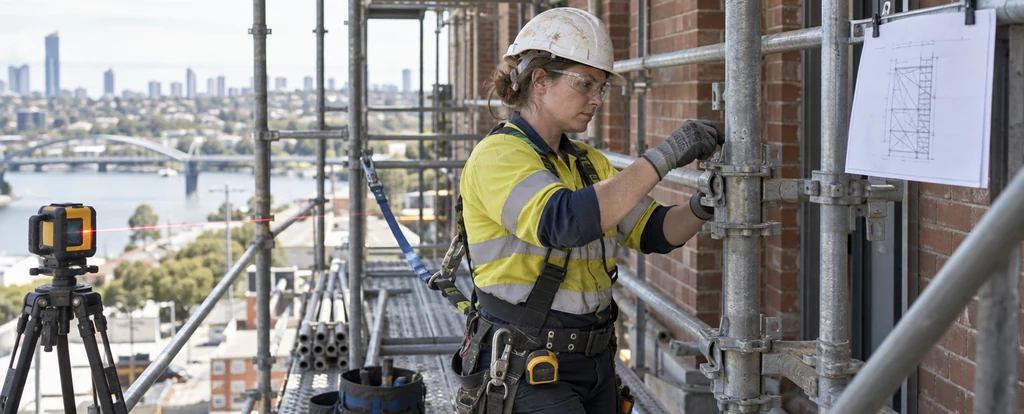
Scaffolders build the temporary platforms, towers and walkways that let other trades work safely at height.
- Median salary*
- $91,000
4.4%vs last year, before tax
- People employed
- 8,300
1.2%vs last year
- Projected growth
- +4.6%
to 2035
- AI exposure*
- Low
- automation risk
- Average hours
- 47/wk
+7h vs all jobs
- Shortage status
- In shortage
national
Scaffolders work on commercial and residential building sites, industrial shutdowns, mines and major events, often for a specialist scaffolding contractor that supplies the gear and the crew. The job sits close to rigging and crane work, but the scaffold is what gives everyone else somewhere safe to stand and load. In Australia you need a high risk work licence for each scaffold class you build, and most people start with the basic class before adding the intermediate and advanced ones.
How much do scaffolders earn?
The median full-time salary for a scaffolder is $91,000 per annum, before tax, up $19,200 since 2018.
What you earn moves with the licence classes you hold, because intermediate and advanced scaffolders can build more complex structures and attract higher rates. Mining, shutdown and large civil projects usually pay above general residential building, and overtime, site allowances and enterprise agreements lift the total further. The figure above covers full-time workers, so it sits well clear of what a casual on a small job takes home.
What does a scaffolder do day to day?
The list below is what fills most weeks; the exact mix shifts with seniority and whatever stage the current work is at.
- Erecting modular scaffolds around buildings, plant and structures
- Dismantling scaffolds once the work above is finished
- Inspecting finished scaffolds and signing them over for handover
- Reading scaffold plans and setting out the layout on site
- Working at height to fit planks, guard rails, ties and bracing
What skills do scaffolders need?
Employers look for worksite safety management, hand and power tool work, reading plans and specifications, backed by Scaffold Designer fluency and strong physical stamina and dexterity.
Specialist skills
- Worksite safety management
- Hand and power tool work
- Reading plans and specifications
- Building codes and standards
- Plant and equipment operation
- Installation and maintenance
Software and tools
- Scaffold Designer
- AutoCAD
- Laser levels
- Kwikstage scaffolding systems
- Layher Allround
General skills
- Physical stamina and dexterity
- Problem solving
Is the job growing?
About 8,300 people work as scaffolders in Australia, and employment is projected to grow 4.6% over the decade to 2035. That's modest growth: demand is steady rather than booming.
How do you become a scaffolder?
Here's the path most scaffolders take, step by step.
- 1Get a White Card
Complete general construction induction training before you set foot on a site, in any state or territory. It is a short course, usually a day, and every employer will ask for it.
- 2Do the basic scaffolding course and licence
Enrol with a registered training organisation for a basic scaffolding course or the Certificate III in Scaffolding (CPC30920), which includes the assessment for the SB high risk work licence. You need to be 18, and the licence itself is issued by the work health and safety regulator in your state or territory.
- 3Build hours on site
Start as a crew member passing gear, marking out and learning to read the drawings under an experienced scaffolder. Most employers want a year or two of site work before they put you in charge of your own section.
- 4Add the intermediate and advanced classes
The SI and SA licence classes let you build the larger, hung and cantilevered scaffolds that pay better and appear on more complex projects. Each class needs its own training and assessment.
- 5Take on leading hand work
Experienced scaffolders run small crews, do the pre-start checks and deal with the site supervisor, which is the usual route into supervision. A certificate IV in building or leadership helps if you want to go further.
Ready to apply as a scaffolder?
Whether you're working toward becoming a scaffolder or already are one and want a hand with the next step (sharpening your resume for ATS screening, tightening your cover letter, or knowing what you'll actually be asked at interview), here are examples grounded in this specific role, not generic templates.
What jobs can a scaffolder move to?
Moving into Crane Operator typically comes with the biggest pay rise, worth $86,400 a year more on average.
| Move to | Typical pay change | Overlap | Retraining |
|---|---|---|---|
| Crane Operator Crane operation shares rigging and load handling skills, but a separate high risk work licence and training are required.Known move | +$86,400 | 43% | reskill |
| Concreter Concreting uses construction site skills and hand tools, so moving across needs only a short concrete ticket.Known move | +$23,900 | 81% | short course |
| Rigger Scaffolders already work at height with rigging gear, so moving into rigging needs only a short high risk work licence.Known move | +$2,600 | 59% | short course |
| Carpenter Carpentry shares construction site awareness and tool skills, but the trade requires a full apprenticeship to be recognised.Known move | +$500 | 44% | requalify |
| Site Supervisor Supervising scaffolds and site teams builds on trade experience, though formal supervisory training and a certificate are needed.Known move | −$5,200 | 24% | reskill |
Moves are chosen from Jobs and Skills Australia's Data on Occupation Mobility, which follows income tax records between 2011-12 and 2020-21, together with entry requirements and skill overlap. A known move is one people were seen making in that data. Pay change compares median full-time pay for the two roles.
Who works as a scaffolder?
The typical scaffolder is 33 years old; 99% are men, 80% work full-time, and full-timers average 47 hours a week.
- 33
- Median age
- 1%
- Female share
- 80%
- Full-time
- +7h
- vs all-jobs avg
What's it like being a scaffolder?
Scaffolding is outdoor, physical shift work with an early start and a long week, which is why full-time scaffolders average around 47 hours. The rhythm comes from the build: a crew raises a structure over a few days, other trades use it, then the crew comes back and pulls it down. People who like working with their hands in a tight team and can handle weather, heights and heavy gear tend to get on well with it.
What people like
- You can see what you built. At the end of a shift there is a finished scaffold standing in front of you, and it is the reason the concreters, bricklayers and glaziers can do their jobs.
- The crew is close knit. You work within arm's reach of the same people all day, passing gear and tying off for each other, so the team tends to look after its own.
- The licence gets you working quickly. A White Card plus a basic scaffolding course and licence can have you on site within months, rather than the years an apprenticeship takes.
- The setting changes. Scaffolders move between housing estates, city towers, mines and event builds, so the site and the view are rarely the same two jobs running.
What people find hard
- Weather runs the day. High wind stops a lift, heavy rain makes planks and ladders unsafe, and a hot day on a west-facing facade is punishing work.
- The physical toll adds up. Carrying standards and planks, climbing all day and long weeks wear on shoulders, knees and backs, and most scaffolders feel it by their forties.
- You wait on other trades. A scaffold often cannot come down until the trade above it finishes, so crews are frequently held up by delays that have nothing to do with them.
- Early starts and long travel. Crews are usually on site before the other trades, and the work can be an hour or more away from home depending on where the projects are.
Based on our synthesis of professional-body surveys and public accounts of the role, not first-person verified reviews.
Which industries employ scaffolders?
Construction employs the largest share of scaffolders, followed by Mining.
Top employing industries
- 1Construction
- 2Mining
Ranked by employment share; the source doesn't publish an exact percentage per industry.
| Year 12 or below | 54.1% | |
|---|---|---|
| Certificate III/IV | 34.5% | |
| Diploma / Advanced Diploma | 3% | |
| Bachelor degree | 2.3% | |
| Postgraduate | 0.5% |
Will AI replace scaffolders?
Scaffolding is a low-exposure job. The work is physical, happens at height and is shaped by wind, ground conditions and the building in front of you, and none of that is going to be automated on a live site in the near term. Design software, BIM models and laser levels have changed how scaffolds are planned and set out, but the structure still has to be erected, tied off and inspected by a licensed person.
Share of typical working time by exposure level
- Erecting and dismantling scaffoldsLifting standards, planks and guard rails into place and tying them off is hands-on work that no current machine does on a working site.45%low
- Inspecting scaffolds and signing them overA scaffolder walks the finished structure, checks ties, bracing and toe boards, and hands it to the next trade, which is a licensed judgement call.25%low
- Reading plans and setting outScaffold design software and BIM models increasingly generate the layout and material list, so the scaffolder reads a drawing rather than working the whole thing out from scratch.15%moderate
- Site records and compliance paperworkDigital pre-start forms, photo records and QR-coded scaffold tags are already replacing paper, and this side of the job will keep automating.15%high
Common questions about becoming a scaffolder
Straight answers to the questions people ask most.
How much does a scaffolder earn?
Full-time scaffolders earn a median of $91,000 per annum, before tax. What you actually take home depends on the licence classes you hold, the sector you work in and how much overtime and site allowance you pick up, so mining, shutdown and large civil work can pay well above that median.
How do you become a scaffolder?
You need a White Card for site access and a high risk work licence for the scaffold class you build. Most people complete a basic scaffolding course or the Certificate III in Scaffolding (CPC30920) with a registered training organisation, then learn the trade on site as part of a crew over a year or two.
Are scaffolders in demand?
Scaffolders are currently in shortage nationally, and employment is projected to grow 4.6% over the decade to 2035. For someone entering the trade, that means steady work across building, infrastructure and mining, with the strongest interest from employers in people who hold more than the basic licence class.
Will AI or automation replace scaffolders?
Scaffolding has little exposure to AI, because the job is physical work at height that has to be built, tied and checked on a live site. Design software and BIM models have changed how scaffolds are planned, laid out and costed, and that planning work is where automation bites, not on the structure itself.
What can a scaffolder move into?
Scaffolders who move into rigging take their working at height and load handling skills with them, and it pays $2,600 more. Crane operation pays $86,400 more but needs its own high risk work licence and real training time, while site supervision pays $5,200 less and calls for supervisory training and a certificate. Experienced scaffolders also start their own scaffolding business, which is often where earnings grow.
Related roles
Not sure this is you? Take the career quiz and get a ranked shortlist of roles that fit how you like to work.