Sculptor
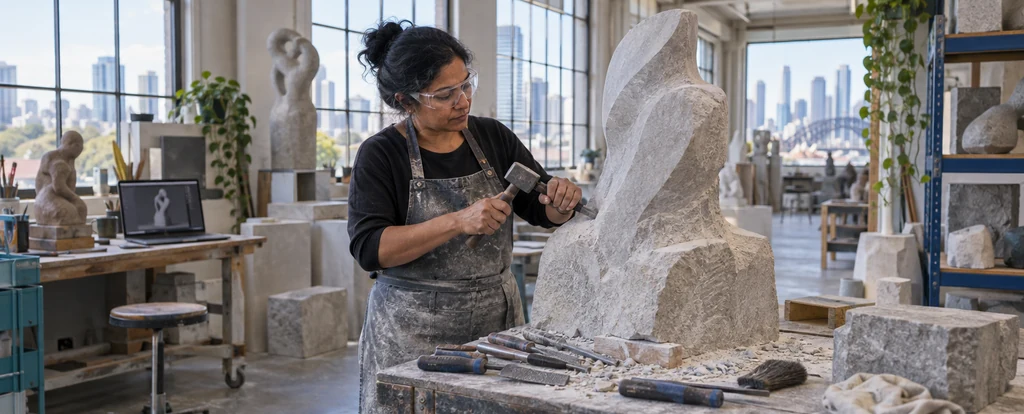
Sculptors make three-dimensional work in materials such as stone, metal, clay and wood, for commissions, exhibitions and public spaces.
- Median salary*
- $59,800
4.4%vs last year, before tax
- People employed
- 630
5.0%vs last year
- Projected growth
- +11.8%
to 2035
- AI exposure*
- Low
- automation risk
- Average hours
- 45/wk
+5h vs all jobs
- Shortage status
- Not in shortage
national
Sculptors work in studios, fabricators' workshops and foundries, carving, welding, moulding or assembling pieces that often have to stand on their own outdoors. The role sits close to visual art and ceramic practice, and what separates it is scale and material: a work might be cut from a block of marble, cast in bronze or built from steel and found objects. Most sculptors are self-employed, so commissions, gallery exhibitions and teaching income usually run alongside each other.
How much do sculptors earn?
The median full-time salary for a sculptor is $59,800 per annum, before tax, up $12,600 since 2018.
Sculpture income arrives in lumps rather than weekly, because most work is quoted per commission or paid on sale of a finished piece. Public art commissions usually come through competitive processes with long lead times, so sculptors commonly balance the studio with teaching, foundry or fabrication work and public art maintenance. Materials, casting, transport and studio rent come out of the fee before anything reaches you, which is why a quoted price can look healthy and leave little behind.
What does a sculptor do day to day?
The list below is what fills most weeks; the exact mix shifts with seniority and whatever stage the current work is at.
- Designing a form and testing it in maquettes or 3D models before committing to a material
- Carving stone or wood, welding metal or modelling clay by hand
- Making moulds and casting in plaster, resin or bronze, often at a foundry
- Quoting a commission and working to a client's brief, site and deadline
- Installing finished work on site, including rigging, fixing and final surface work
What skills do sculptors need?
Employers look for craft and handmade production, visual design, creative software production, backed by Blender fluency and strong attention to detail.
Specialist skills
- Craft and handmade production
- Visual design
- Creative software production
- Project management
Software and tools
- Blender
- ZBrush
- AutoCAD
- SketchUp
- Rhino 3D
General skills
- Attention to detail
- Problem solving
- Client relationships and advisory
Is the job growing?
About 630 people work as sculptors in Australia, and employment is projected to grow 11.8% over the decade to 2035. That's healthy, above-average growth, and the role should stay in solid demand.
How do you become a sculptor?
Here's the path most sculptors take, step by step.
- 1Study sculpture or visual arts
A Bachelor of Fine Arts with a sculpture major is the usual route and takes three years full time. TAFE's Certificate IV or Advanced Diploma of Visual Arts (CUA60725) is a shorter, cheaper way in, and a welding or fabrication qualification helps if you want to work in metal.
- 2Build a body of work
Sculptors are judged on what they have made, not on their transcript. Exhibiting small pieces, entering sculpture prizes and documenting how each work was made builds the portfolio that galleries, councils and private clients look at.
- 3Work alongside established makers
Assisting a sculptor, working in a foundry or fabricating for public art projects pays while you learn mould making, casting, rigging and how a large commission actually gets delivered.
- 4Learn the business side
Quoting, contracts, insurance, transport and site approvals decide whether a commission makes money. Councils and state arts bodies publish their public art processes, and their selection panels are the main route to large permanent works.
- 5Consider postgraduate study if you want to teach
An honours or master's degree opens teaching in universities and TAFE, which is one of the steadier ways sculptors support a studio practice.
Ready to apply as a sculptor?
Whether you're working toward becoming a sculptor or already are one and want a hand with the next step (sharpening your resume for ATS screening, tightening your cover letter, or knowing what you'll actually be asked at interview), here are examples grounded in this specific role, not generic templates.
What jobs can a sculptor move to?
Moving into Jewellery Designer typically comes with the biggest pay rise, worth $10,400 a year more on average.
| Move to | Typical pay change | Overlap | Retraining |
|---|---|---|---|
| Jewellery Designer Sculptors bring metalwork and form skills to jewellery design, but need study in gem setting and fine production. | +$10,400 | 58% | reskill |
| Costume Designer Sculptors bring three-dimensional design and making skills to costume design, requiring little extra training. | +$10,400 | 68% | minimal |
| Costume Maker Sculptors bring fabrication and sculptural detail to costume making, with a short course to learn garment construction. | +$5,200 | 76% | short course |
| Visual Artist Sculptors bring three-dimensional form and material knowledge to visual art practice, with a short course to broaden their media. | +$2,600 | 52% | short course |
| Ceramic Artist Sculptors bring modelling, carving and kiln knowledge to ceramic art, with a short course to adapt to clay. | +$0 | 58% | short course |
Moves are chosen from Jobs and Skills Australia's Data on Occupation Mobility, which follows income tax records between 2011-12 and 2020-21, together with entry requirements and skill overlap. A known move is one people were seen making in that data. Pay change compares median full-time pay for the two roles.
Who works as a sculptor?
The typical sculptor is 54 years old; 59% are men, 58% work full-time, and full-timers average 45 hours a week.
- 54
- Median age
- 41%
- Female share
- 58%
- Full-time
- +5h
- vs all-jobs avg
What's it like being a sculptor?
The work runs on long cycles, with weeks or months in the studio for a single piece, punctuated by exhibition deadlines, tender dates and installs. Days are physical and often solitary, with quoting, grant applications and client meetings filling the gaps between making. It suits people who like solving material problems by hand and can live with slow, uneven returns on that effort.
What people like
- Making something that outlasts you. A carved or cast piece can end up in a park, a hospital foyer or a collection, where people who never visit a gallery will see it for decades.
- A wide spread of materials and methods. Clay, wax, stone, steel, glass, foundry work and digital modelling all sit inside the one job, and each commission can call for a different set of them.
- Control over your own time. Self-employment means choosing which projects to take and when to work, even in the lean stretches between commissions.
- Public commissions reach an audience. Working with a council, architect or landscape designer puts the piece in front of people going about their day, which is a different satisfaction from a gallery show.
What people find hard
- Income is irregular. Commissions pay on milestones that can fall months after the work begins, and a public tender may take a year or more to settle, so cash flow needs managing.
- The physical toll. Stone and concrete dust, welding fumes, heavy lifting and power tools mean respiratory protection, safe handling and sometimes a high risk work licence for the equipment involved.
- Studio and material costs. Casting, stone, kiln time, transport and studio rent are paid before a work earns anything, and a piece that does not sell leaves those costs with you.
- Time away from making. Grant applications, marketing, condition reports for public works and client correspondence can take as many hours as the sculpture itself.
Based on our synthesis of professional-body surveys and public accounts of the role, not first-person verified reviews.
Which industries employ sculptors?
Arts and Recreation Services employs the largest share of sculptors, followed by Manufacturing.
Top employing industries
- 1Arts and Recreation Services
- 2Manufacturing
Ranked by employment share; the source doesn't publish an exact percentage per industry.
| Bachelor degree | 35.7% | |
|---|---|---|
| Year 12 or below | 16.9% | |
| Diploma / Advanced Diploma | 16.7% | |
| Certificate III/IV | 14% | |
| Postgraduate | 13.8% |
Will AI replace sculptors?
Sculpture has low exposure overall, because the job is the physical object: material is cut, welded, cast and finished by hand, and part of what a client pays for is that a person made it. Software has taken over the front end of the work, where 3D modelling in Blender or Rhino and rendered mock-ups have largely replaced physical maquettes for client approvals, and CNC or robotic milling can rough out a form in stone or foam. Someone still has to read the material, finish the surface and get the piece safely onto its plinth.
Share of typical working time by exposure level
- Carving, modelling and castingReading a fault line in stone or judging when a mould is ready to open is hand and eye work that machines do not take on.45%low
- Design, maquettes and client mock-upsBlender, Rhino or ZBrush can show a client a rotating model or the piece rendered onto the actual site before anything is cut or cast.20%moderate
- Quoting, grants, marketing and client adminDraft quotes, grant applications, condition reports and social media posts are exactly the written work AI drafts quickly, leaving the sculptor to check the scope and the numbers.20%high
- Installation and site workRigging, anchoring and finishing on site depend on what the ground, the light and the surrounding structures turn out to be doing that day.15%low
Common questions about becoming a sculptor
Straight answers to the questions people ask most.
How much do sculptors earn?
Sculptors earn a median of $59,800 per annum, before tax, when they work full time, though the figure covers a wide spread between established public artists and those just starting out. Because much of the income comes from commissions, sales and grants rather than a wage, a single year can look very different from the next.
How do you become a sculptor?
Most sculptors start with a fine arts degree or a TAFE visual arts qualification and then build a portfolio through exhibitions, prizes and small commissions. Practical skills in welding, mould making or casting are just as important as the art training, and many learn them by assisting an established maker or working in a foundry.
Are sculptors in demand?
Sculptors are currently not in shortage, and employment is projected to grow 11.8% over the decade to 2035. Almost all work comes through commissions, public art programs, galleries and private sales rather than advertised vacancies, so the practical question is who is funding sculpture where you want to live and work.
Will AI replace sculptors?
AI has little reach into the making itself, because the object a client pays for is cut, cast and finished by hand. It has changed the front end of the job: 3D modelling in Blender or Rhino and rendered mock-ups now do much of what physical maquettes used to, and CNC or robotic milling can rough out a form before a sculptor takes over.
What else can sculptors do?
The skills transfer to visual art practice, where artists earn $2,600 more and use the same exhibition and grant systems, and to ceramic art, where pay is about the same and the clay and kiln knowledge carries straight across. Costume design and costume making also draw on fabrication and sculptural detail, with costume designers earning $10,400 more. Running your own studio practice is the usual progression for sculptors, and commissions are often where earnings grow.
Do sculptors need a degree?
No, there is no registration or licence required to work as a sculptor, though the most common qualification among working sculptors is a Bachelor degree, held by 36% of them. Foundries, fabrication workshops and public art teams also hire on demonstrated skill and portfolio, so a strong body of work can outweigh the credential.
Related roles
Not sure this is you? Take the career quiz and get a ranked shortlist of roles that fit how you like to work.