Home Manufacturing & Production
Sewing Machine Mechanic
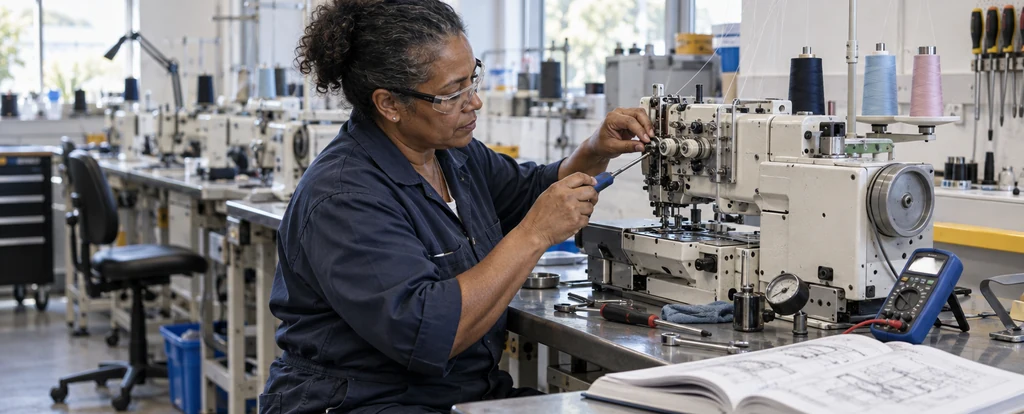
Sewing machine mechanics keep industrial and domestic sewing machines running, diagnosing faults, servicing equipment and getting production moving again.
- Median salary*
- $59,800
4.0%vs last year, before tax
- People employed
- 250
25.0%vs last year
- Projected growth
- +7.2%
to 2035
- AI exposure*
- Low
- automation risk
- Average hours
- 41/wk
+1h vs all jobs
- Shortage status
- In shortage
national
Most of the work happens in a workshop or on a factory floor, repairing everything from heavy industrial lockstitch machines to the domestic machine a customer has owned for decades. It sits between mechanical fitting and customer service, because you often find the fault by feel and sound before you confirm it against the manual, then explain what the repair will cost. Textile manufacturers, equipment dealers and retail service centres are the main employers, and many mechanics work alone or in a team of two or three.
How much do sewing machine mechanics earn?
The median full-time salary for a sewing machine mechanic is $59,800 per annum, before tax, up $12,500 since 2018.
Pay usually follows the manufacturing and related industries award, so a maintenance role inside a factory or a formal apprenticeship tends to set a firmer base than a small repair shop. Penalty rates and overtime matter where you are on call for breakdowns, and a specialisation in computerised industrial machines or an added electrical qualification can lift the rate. In a small workshop, earnings move with how busy the repair queue is.
What does a sewing machine mechanic do day to day?
The list below is what fills most weeks; the exact mix shifts with seniority and whatever stage the current work is at.
- Diagnosing mechanical and electrical faults on industrial and domestic machines
- Stripping, cleaning and lubricating machines on a servicing schedule
- Adjusting tension, timing and stitch length until the stitch is right
- Replacing worn parts such as needles, belts, gears and motors
- Testing a repaired machine on scrap fabric and writing up the parts used
What skills do sewing machine mechanics need?
Employers look for installation and maintenance, hand and power tool work, plant and equipment operation, backed by Screwdriver and spanner set fluency and strong attention to detail.
Specialist skills
- Installation and maintenance
- Hand and power tool work
- Plant and equipment operation
Software and tools
- Screwdriver and spanner set
- Multimeter
- Tension gauge
- Timing gauge
- Machine service manuals
General skills
- Attention to detail
- Problem solving
- Customer service
- Time and deadline management
Is the job growing?
About 250 people work as sewing machine mechanics in Australia, and employment is projected to grow 7.2% over the decade to 2035. That's modest growth: demand is steady rather than booming.
How do you become a sewing machine mechanic?
Here's the path most sewing machine mechanics take, step by step.
- 1Finish Year 12 or its equivalent, with maths and a technology subject where you can
There is no strict prerequisite, but the work runs on mechanical reasoning and a basic understanding of electrics, and subjects that build those make an apprenticeship easier to win.
- 2Take an apprenticeship, usually a Certificate III in Engineering (Mechanical Trade)
It runs about three to four years, is paid, and combines workshop time with TAFE. Equipment dealers, textile manufacturers and service companies are the employers who take on apprentices in this specialty, and some will train someone with existing mechanical experience without a formal trade.
- 3Learn the machine types you will actually see
Industrial lockstitch, overlock and coverstitch machines fail differently from domestic machines with electronic controls, and the computerised panels on newer industrial models add another layer. Most of that knowledge comes from the workshop and the service manuals rather than a course.
- 4Sort out where the electrical work stops
No licence is needed to repair the mechanical parts of a machine, but work on mains wiring and motors has to be done by a licensed electrician, and the rules differ between states. Some mechanics add an electrical qualification so they can finish those jobs themselves.
Ready to apply as a sewing machine mechanic?
Whether you're working toward becoming a sewing machine mechanic or already are one and want a hand with the next step (sharpening your resume for ATS screening, tightening your cover letter, or knowing what you'll actually be asked at interview), here are examples grounded in this specific role, not generic templates.
What jobs can a sewing machine mechanic move to?
Moving into Metal Machinist typically comes with the biggest pay rise, worth $75,700 a year more on average.
| Move to | Typical pay change | Overlap | Retraining |
|---|---|---|---|
| Metal Machinist Precision machining draws on the same fine adjustment and mechanical assembly skills, with formal training in machining operations. | +$75,700 | 36% | reskill |
| Fitter General fitting and machinery maintenance build directly on sewing machine repair skills, with further training in fitting and assembly. | +$31,200 | 50% | reskill |
| Fitter and Turner Machining and fitting work extends the precision repair background, requiring additional training in turning and milling. | +$26,000 | 50% | reskill |
| Precision Instrument Maker Making precision instruments uses similar fine mechanical adjustment and calibration skills, with further trade training. | +$18,200 | 36% | reskill |
| Saw Doctor Repairing and sharpening cutting tools uses the same precision, alignment and mechanical fault-finding skills, with additional trade training. | +$15,600 | 55% | reskill |
Moves are chosen from Jobs and Skills Australia's Data on Occupation Mobility, which follows income tax records between 2011-12 and 2020-21, together with entry requirements and skill overlap. A known move is one people were seen making in that data. Pay change compares median full-time pay for the two roles.
Who works as a sewing machine mechanic?
The typical sewing machine mechanic is 57 years old; 91% are men, 62% work full-time, and full-timers average 41 hours a week.
- 57
- Median age
- 9%
- Female share
- 62%
- Full-time
- +1h
- vs all-jobs avg
What's it like being a sewing machine mechanic?
The week is split between planned servicing and breakdowns that arrive without warning, so you need to be comfortable switching from a tidy workshop job to a machine sitting in the middle of a busy production floor. Much of the skill is in reading a machine quickly: what it sounds like, where it hesitates, which part has play in it. It suits someone who prefers working with their hands, likes a problem with a definite answer, and does not mind repeating a service routine between the interesting faults.
What people like
- Faults you can hear and feel. A machine that runs rough usually tells you where the problem is before you open it, and tracing a stitch fault down to one worn part is satisfying in a way that paperwork is not.
- Machines from every era. One week you might service a row of identical industrial machines, the next you are coaxing a 1970s domestic machine back to life for a customer who will not part with it.
- A small trade where good mechanics get known. Few people do this work, so dealers and factories tend to call the same mechanic when a machine stops, which builds steady relationships and repeat work.
- Jobs you can finish. Most repairs start and end in the same day, and the machine either sews properly or it does not, so you know when the work is done.
What people find hard
- Breakdowns set the timetable. When a production line stops, the call comes straight away and the machine has to come first, which pushes scheduled servicing back and can mean a late finish.
- Tight, fiddly spaces. Thread paths, tension assemblies and needle bars sit in small gaps, and plenty of repairs are done kneeling beside a machine rather than comfortably at a bench.
- Parts that are hard to source. Older domestic machines and imported industrial models can need a part that takes weeks to arrive, and the customer is waiting in the meantime.
- Routine servicing is genuinely routine. Cleaning, oiling and checking a fleet of identical machines is repetitive, and it fills a good share of the time between the more interesting breakdowns.
Based on our synthesis of professional-body surveys and public accounts of the role, not first-person verified reviews.
Which industries employ sewing machine mechanics?
Other Services employs the largest share of sewing machine mechanics, followed by Manufacturing.
Top employing industries
- 1Other Services
- 2Manufacturing
- 3Retail Trade
Ranked by employment share; the source doesn't publish an exact percentage per industry.
| Certificate III/IV | 51% | |
|---|---|---|
| Year 12 or below | 28.3% | |
| Diploma / Advanced Diploma | 10% | |
| Bachelor degree | 4.4% | |
| Postgraduate | 1.2% |
Will AI replace sewing machine mechanics?
This is a low-exposure job, because the core of it is physical: finding a fault means listening to a machine, feeling for play in a shaft and watching how the thread forms. Error codes on computerised industrial machines and digital service manuals make diagnosis faster and record-keeping tidier, but somebody still has to open the machine, replace the part and test the stitch. Automation in the job sits mostly in the paperwork around the repair, not in the repair itself.
Share of typical working time by exposure level
- Pulling a machine apart and replacing worn partsWorn gears, belts, motors and needle plates have to be removed and refitted by hand, often in a space too cramped for a tool to reach easily.35%low
- Fault diagnosis on a stopped machineError codes on computerised models narrow the search, but confirming the fault usually means running the machine and watching the stitch form.30%low
- Setting tension, timing and stitch qualityAuto-tension systems on newer machines handle part of this, though the final judgement on a stitch still comes from sewing a test seam and looking at it.20%moderate
- Service records, parts ordering and customer quotesBooking systems and parts databases already do much of this, and software can draft a quote from a standard service list for you to check.15%high
Common questions about becoming a sewing machine mechanic
Straight answers to the questions people ask most.
How much do sewing machine mechanics earn?
Sewing machine mechanics earn $59,800 per year before tax for full-time work. What moves that figure most is the setting: a factory maintenance role or an apprenticeship-trained position usually pays more steadily than a small repair shop, and overtime or on-call work for breakdowns adds to it.
How do you become a sewing machine mechanic?
Most people enter through a paid apprenticeship, often a Certificate III in Engineering (Mechanical Trade), while learning the specific machines on the job with a dealer, manufacturer or service company. There is no licence to work as a mechanic, but any repair touching mains wiring or a motor has to be done by a licensed electrician, and those rules vary by state.
Are sewing machine mechanics in demand?
Sewing machine mechanics are currently in shortage nationally, and employment is projected to grow 7.2% over the decade to 2035 over the decade to 2035. Because the occupation is small, vacancies are few and rarely advertised widely, so contacting equipment dealers, textile manufacturers and service companies directly is worth the effort.
Will AI or automation replace sewing machine mechanics?
This is a low-exposure job, because the core of it is physical: finding a fault means listening to a machine, feeling for play in a shaft and watching how the thread forms. Computerised industrial machines log error codes and stitch counts, which can point you toward the problem faster, and service software keeps parts lists and repair histories in order. None of that threads a needle or sets the timing.
What can a sewing machine mechanic move into?
Fitting and machining are the usual moves, since general fitting builds on the same fault-finding and precision adjustment, and the pay difference to fitter is $31,200 more with extra training in assembly. Saw doctoring uses similar alignment and sharpening skills on cutting tools, and precision instrument making applies fine adjustment work to smaller devices. Each of these needs further trade training, usually a Certificate III or a post-trade course.
Can you run your own sewing machine repair business?
Yes, and many experienced mechanics do, either from a shopfront or as a mobile service visiting factories and households. It is often where earnings grow, because you set your own service rates and can take on dealer warranty work. The trade-off is that income depends on keeping a customer base and carrying the cost of parts and tools yourself.
Related roles
Not sure this is you? Take the career quiz and get a ranked shortlist of roles that fit how you like to work.