Excavator Operator
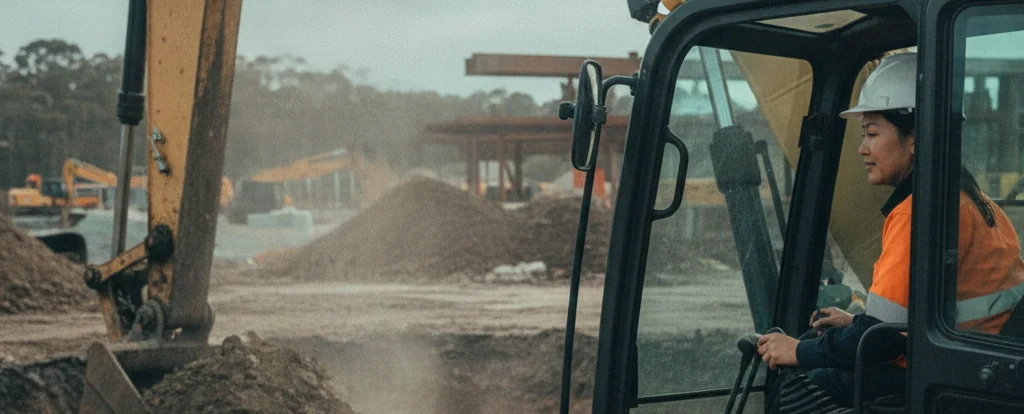
Excavator operators cut trenches, grade pads and load trucks, using a hydraulic machine to move earth and rock on construction, civil and mining sites.
- Median salary
- $98,800
4.6%vs last year, before tax
- People employed
- 10,600
1.0%vs last year
- Projected growth
- +4.3%
to 2035
- AI exposure*
- Moderate
- automation risk
- Average hours
- 47/wk
+7h vs all jobs
- Shortage status
- In shortage
national
Excavator operators work on civil, residential and mining sites, running machines from 20 to 50 tonnes to dig footings, trenches, foundations and haul roads. Excavator operation isn't covered by the national high risk work licensing that applies to cranes and forklifts, so employers ask for a machine competency unit and then verify your skills on the actual machine. Most operators work for a civil contractor, a subcontractor or a plant hire firm, moving between sites and machines as projects finish rather than staying with one employer for years.
How much do excavator operators earn?
The median full-time salary for an excavator operator is $98,800 per annum, before tax, up $21,000 since 2018.
Pay is set by the enterprise agreement or award that covers the project, so two operators on similar machines can be on different rates depending on who employs them. Mining and remote civil work generally pays more than suburban residential work, and machine size, competency level and shift allowances all shift the figure. Owner-operators set their own rates but carry machine finance, fuel and maintenance.
What does an excavator operator do day to day?
The list below is what fills most weeks; the exact mix shifts with seniority and whatever stage the current work is at.
- Reading site plans and survey pegs to set the exact depth and grade before the first cut
- Running pre-start checks on a machine that may be shared across a crew or hired in for the job
- Judging ground conditions through the controls to avoid buried services and unstable soil
- Working to GPS grading systems and laser levels to keep cuts within plan tolerance
- Coordinating with spotters and other machines over two-way radio as trucks queue for loads
What skills do excavator operators need?
Employers look for hand and power tool work, reading plans and specifications, plant and equipment operation, backed by Excavator (20 to 50 tonne) fluency and strong attention to detail.
Specialist skills
- Hand and power tool work
- Reading plans and specifications
- Plant and equipment operation
- Worksite safety management
- Spatial and interior design
Software and tools
- Excavator (20 to 50 tonne)
- GPS grading systems
- Two-way radio
- Laser level
- Site survey plans
General skills
- Attention to detail
- Problem solving
Is the job growing?
About 10,600 people work as excavator operators in Australia, and employment is projected to grow 4.3% over the decade to 2035. That's modest growth: demand is steady rather than booming.
How do you become an excavator operator?
Here's the path most excavator operators take, step by step.
- 1Get your White Card
General construction induction is required before you set foot on a construction site in every state and territory. It's a short course, and some registered training organisations bundle it with the machine units.
- 2Complete the excavator competency unit
RIIMPO320F Conduct civil construction excavator operations (RIIMPO320) is the standard unit, delivered by a registered training organisation over a few days to a few weeks. You learn on a machine, so it costs more than a classroom certificate, and some civil contractors put new labourers through it.
- 3Prove your competency on the employer's machine
Most sites require a verification of competency, a short assessment by a supervisor or assessor on the exact machine you'll run. Holding the certificate isn't enough on its own, because the verification is what gets you signed onto a site.
- 4Build seat time across machines and attachments
Employers hire on experience, so many operators start on a smaller machine or as a labourer and offsider before moving to a 30 tonne excavator. Buckets, hammers, grabs and tilt hitches all take practice, and variety keeps you working when one machine sits idle.
- 5Add what the work you want requires
A heavy vehicle licence opens up float and tipper work and is worth having early, while mine site jobs ask for a coal board medical and site inductions such as Standard 11 in Queensland. Extra units for dozers, skid steers or graders widen the jobs you can take.
Ready to apply as an excavator operator?
Whether you're working toward becoming an excavator operator or already are one and want a hand with the next step (sharpening your resume for ATS screening, tightening your cover letter, or knowing what you'll actually be asked at interview), here are examples grounded in this specific role, not generic templates.
What jobs can an excavator operator move to?
Moving into Miner typically comes with the biggest pay rise, worth $52,400 a year more on average.
| Move to | Typical pay change | Overlap | Retraining |
|---|---|---|---|
| Miner Excavator operators bring earthmoving skills to mining, with a short course for site-specific equipment.Known move | +$52,400 | 48% | short course |
| Earthmoving Plant Operator Excavator operators bring earthmoving skills to earthmoving plant operation, with a short course to cover different machinery.Known move | +$4,200 | 58% | short course |
| Truck Driver Excavator operators bring machinery experience to truck driving, requiring reskilling for heavy vehicle licences.Known move | +$3,100 | 8% | reskill |
| Site Supervisor Experienced excavator operators bring site knowledge to site supervision, requiring reskilling in coordination and safety.Known move | −$13,000 | 18% | reskill |
| Machine Operator Excavator operators bring machinery skills to machine operation, requiring reskilling for production equipment.Known move | −$18,000 | 33% | reskill |
Moves are chosen from Jobs and Skills Australia's Data on Occupation Mobility, which follows income tax records between 2011-12 and 2020-21, together with entry requirements and skill overlap. A known move is one people were seen making in that data. Pay change compares median full-time pay for the two roles.
Who works as an excavator operator?
The typical excavator operator is 43 years old; 99% are men, 86% work full-time, and full-timers average 47 hours a week.
- 43
- Median age
- 1%
- Female share
- 86%
- Full-time
- +7h
- vs all-jobs avg
What's it like being an excavator operator?
The job runs to a steady rhythm: an early start, a pre-start check, then long stretches in the seat working to a plan while trucks, labourers and other machines move around you. Production pressure is constant on civil and mining projects, and the careful work comes from digging close to people, services and edges where a wrong bucket costs time or damages something. Operators who enjoy it tend to like running their own machine well and seeing a cut come out to grade, and to be comfortable with early starts and days that stretch when a haul or a pour runs late.
What people like
- You own the machine for the day. Once you're in the seat, how the dig gets done is largely your call, which suits people who prefer working with their hands and judgement to chasing paperwork.
- The result is visible. A level pad, a clean batter or a trench cut to the pegs shows exactly what you did, and supervisors notice an operator who can hold grade.
- The work changes with the site. Different ground, machines and projects keep the job from repeating itself, and a subdivision, a road upgrade and a mine pit each ask for something different.
- Skills carry across the industry. The competency unit is recognised on civil, residential and mining work, so you can follow projects to where the jobs are.
What people find hard
- Early starts and long days. Most sites are running by 6 or 7am and the average full-time week is about 47 hours, before travel to a site that may be an hour from home.
- Dust, heat and mud. The cab is sealed and air conditioned, but you're still on site through summer heat and winter mud, and some of the work happens on the ground around the machine.
- Digging near services and people. Water, gas and power lines often run within a bucket's reach of the cut, so part of the day is slow, precise work with a spotter watching and no room for a misjudged swing.
- Roster work away from home. Mining and remote civil projects usually mean fly in, fly out or drive in, drive out rosters, which can be weeks away from family.
Based on our synthesis of professional-body surveys and public accounts of the role, not first-person verified reviews.
Which industries employ excavator operators?
Construction employs the largest share of excavator operators.
Top employing industries
- 1Construction
Ranked by employment share; the source doesn't publish an exact percentage per industry.
| Year 12 or below | 55.1% | |
|---|---|---|
| Certificate III/IV | 35.8% | |
| Diploma / Advanced Diploma | 2.7% | |
| Bachelor degree | 1.1% | |
| Postgraduate | 0.1% |
Will AI replace excavator operators?
Excavator operation sits in the middle: GPS and machine control systems now hold grade and reduce the setting out an operator does by hand, and some mine sites run semi-automated equipment on parts of the haul and load cycle. The machine still has to be driven around live services, people and uneven ground, so the judgement about where and how to dig stays with the operator in the seat.
Share of typical working time by exposure level
- Digging trenches, footings and bulk cutsReading the ground, loading the bucket and trimming to a peg line all come from seat time, and a machine control screen won't tell you the soil has turned to fill.40%low
- Working to GPS and laser grade controlTwo and three dimensional machine control holds the design grade on its own, which cuts out most of the stakes and grade checks an operator once did on foot.25%high
- Site communication, dockets and daily logsRadio calls with trucks, spotters and the supervisor are unchanged, but digital dockets and logbooks now record hours and loads automatically on many sites.20%moderate
- Pre-start checks and machine maintenanceDaily checks, greasing and fault reporting still need a walk around the machine, though telematics now flags some faults before the operator finds them.15%low
Common questions about becoming an excavator operator
Straight answers to the questions people ask most.
How much do excavator operators earn?
$98,800 per annum, before tax is the median for full-time excavator operators in Australia. What you actually earn depends on the enterprise agreement or award covering the project, the type of work and whether the job includes shift or site allowances, so treat the median as a middle point rather than a starting rate.
How do you become an excavator operator?
In most cases you start with a White Card, complete the excavator competency unit through a registered training organisation, then pass a verification of competency on the machine your employer runs. Experience counts for more than certificates alone, so many people get their first seat time by starting as a labourer or offsider on a civil crew.
Are excavator operators in demand in Australia?
Excavator operators are currently in shortage nationally, and employment across the occupation is projected to grow 4.3% over the decade to 2035. Demand follows the project pipeline in your area, so it's worth looking at what civil, road and mining work is underway or approved near where you live.
Will AI or automation replace excavator operators?
GPS and machine control have already changed the job, and some mine sites run semi-automated equipment, but an excavator still needs someone reading ground conditions and working around services, people and trucks. Automation does more of the measuring and less of the digging, so the practical effect so far is a shift in skills rather than fewer seats.
What can excavator operators move into?
Experienced operators often move into earthmoving plant operation, which pays $4,200 more and shares enough machinery skill that a short course covers the difference. Mine work pays $52,400 more and uses the same earthmoving skills on site rosters, while site supervision pays $13,000 less and needs reskilling in coordination and safety. Many operators eventually buy their own machine and quote for work as an owner-operator, which is often where earnings grow.
What are the hours like?
Full-time excavator operators average about 47 hours a week, and 86% work full time. Site work usually starts early, around 6 or 7am, and travel to a site outside your area adds to the day, while mining rosters trade longer blocks away for longer breaks at home.
Related roles
- Earthmoving Plant Operator
- Truck Driver
- Machine Operator
- Miner
- Site Supervisor
- Earthmoving Plant Operator
Not sure this is you? Take the career quiz and get a ranked shortlist of roles that fit how you like to work.