Wind Turbine Technician
Wind turbine technicians keep a wind farm's turbines generating, servicing and repairing them at height.
- Median salary*
- $85,800
4.1%vs last year, before tax
- People employed
- 2,200
0.0%vs last year
- Projected growth*
- +18%
to 2035
- AI exposure*
- Moderate
- automation risk
- Average hours*
- 40/wk
matches all-jobs average
- Shortage status*
- In shortage (regional)
national
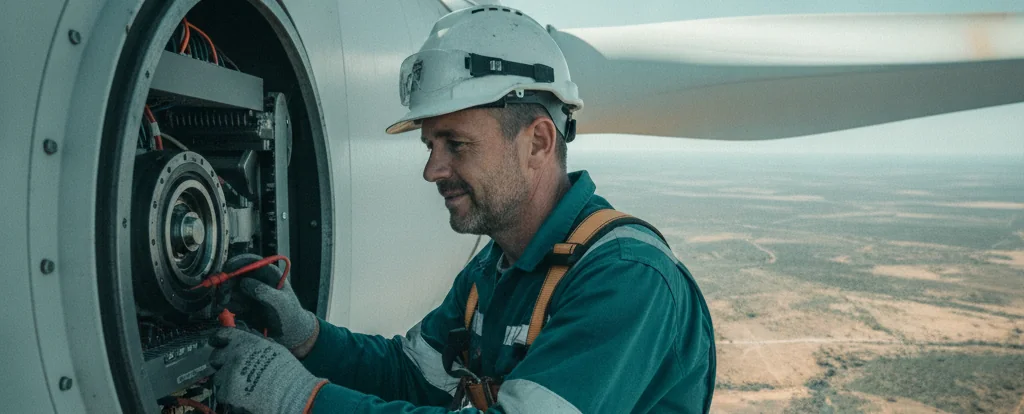
Wind turbine technicians work on utility-scale turbines at wind farms, and most of the job happens inside the nacelle, the housing at the top of the tower that holds the generator and gearbox. Reaching it means climbing an internal ladder or taking a service lift, and the work moves between mechanical servicing, electrical fault-finding and reading SCADA data from the control room. Most technicians work for a turbine manufacturer, a wind farm operator or a specialist maintenance contractor, and travelling between sites is part of the routine.
How much do wind turbine technicians earn?
The median full-time salary for a wind turbine technician is $85,800 per annum, before tax, up $18,000 since 2018.
What you take home depends heavily on the roster and the site. Enterprise agreements in the wind industry commonly add site, remote and travel allowances, and overtime, call-outs and night work lift pay above the base rate. An electrical licence and manufacturer training on more turbine platforms are the usual ways technicians move up the scale.
What does a wind turbine technician do day to day?
The list below is what fills most weeks; the exact mix shifts with seniority and whatever stage the current work is at.
- Climbing the internal ladder or taking the service lift up the tower to reach the nacelle
- Servicing gearboxes, hydraulics and blade pitch systems inside the nacelle
- Greasing, cleaning and inspecting components so faults are caught before they stop the turbine
- Working through fault alerts from SCADA by testing sensors, circuits and control software
- Travelling between remote wind farm sites and reworking the day's plan when wind makes a climb unsafe
What skills do wind turbine technicians need?
Employers look for hand and power tool work, installation and maintenance, worksite safety management, backed by Multimeter fluency and strong problem solving.
Specialist skills
- Hand and power tool work
- Installation and maintenance
- Worksite safety management
- Plant and equipment operation
- Data analysis
Software and tools
- Multimeter
- Thermal imaging camera
- Climbing harness and safety equipment
- Hydraulic pressure gauge
- SCADA monitoring software
General skills
- Problem solving
- Attention to detail
Is the job growing?
About 2,200 people work as wind turbine technicians in Australia, and employment is projected to grow 18% over the decade to 2035. That's healthy, above-average growth, and the role should stay in solid demand.
How do you become a wind turbine technician?
Here's the path most wind turbine technicians take, step by step.
- 1Build a trade or technical base
A Certificate III in Electrotechnology (Electrician), a mechanical trade or a Certificate IV in renewable energy gives you the fundamentals employers look for, and an apprenticeship is a common route because it pays while you learn.
- 2Add the safety and height qualifications
Working at heights is non-negotiable, and most employers ask for Global Wind Organisation (GWO) Basic Safety Training, which covers working at height, manual handling, fire awareness and first aid. A White Card is needed for construction-phase work, and confined space training is useful for the nacelle and hub.
- 3Get turbine-specific training
Turbine manufacturers train people on their own platforms, and new technicians often start on scheduled servicing alongside an experienced crew before moving into fault-finding. Some TAFE colleges and private providers run wind turbine courses that bundle the safety modules with the technical content.
- 4Consider an electrical licence
Much of the entry-level work is mechanical, but the electrical tasks have to be done by a licensed person, and the requirements differ between states, so check with the regulator where you plan to work. A restricted electrical licence is one path for people with a mechanical background.
- 5Specialise or take on a leading hand role
After a few years, technicians tend to specialise in blade repair, commissioning, high-voltage work or control systems. Those who stay on site often move into leading hand or site supervisor roles, running crews, permits and the daily plan.
Ready to apply as a wind turbine technician?
Whether you're working toward becoming a wind turbine technician or already are one and want a hand with the next step (sharpening your resume for ATS screening, tightening your cover letter, or knowing what you'll actually be asked at interview), here are examples grounded in this specific role, not generic templates.
What jobs can a wind turbine technician move to?
Moving into Conveyor Belt Splicer typically comes with the biggest pay rise, worth $33,800 a year more on average.
| Move to | Typical pay change | Overlap | Retraining |
|---|---|---|---|
| Conveyor Belt Splicer Wind turbine technicians bring mechanical maintenance, hydraulic and safety skills to conveyor belt splicing, needing a belt splicing ticket. | +$33,800 | 78% | short course |
| Telecommunications Cable Jointer Wind turbine technicians bring electrical and cable handling skills to telecommunications cable jointing, needing a short course in jointing techniques. | +$5,200 | 74% | short course |
Moves are chosen from Jobs and Skills Australia's Data on Occupation Mobility, which follows income tax records between 2011-12 and 2020-21, together with entry requirements and skill overlap. A known move is one people were seen making in that data. Pay change compares median full-time pay for the two roles.
Who works as a wind turbine technician?
The typical wind turbine technician is 49 years old; 97% are men, 94% work full-time, and full-timers average 40 hours a week.
- 49
- Median age
- 3%
- Female share
- 94%
- Full-time
- +0h
- vs all-jobs avg
What's it like being a wind turbine technician?
The job runs on a roster and bends around the weather, so a planned service can turn into fault-finding and a climb can be called off when the wind picks up. It suits people who are comfortable with heights, cramped spaces, physical work and long blocks of time away from home. Crews are small, the equipment is heavy, and the turbine does not come down to you.
What people like
- You can see a fault fixed. A gearbox that was throwing alarms runs clean at the end of the shift, and the turbine goes back on the grid.
- The setting is part of the appeal. Wind farms sit on ridgelines and along coastlines, and the view from the nacelle is a long way from a workshop.
- Small crews, your own jobs. A handful of technicians often covers a whole turbine, so you carry a job through rather than handing it on.
- Skills that carry across industries. The electrical, hydraulic and safety experience is wanted on mine sites, in energy networks and in construction.
What people find hard
- Weather sets the schedule. Wind above the safe climbing limit stops work, and a service can be pushed back a day or more, which usually means catching up later.
- Time away from home. Many sites are remote, so rosters mean living away for a week or more at a time and moving between wind farms.
- The workspace is tight. Inside the nacelle there is little room to move, and the job combines heights, confined spaces and heavy lifting.
- Plenty of cleaning and greasing. A large share of scheduled maintenance is repetitive: wiping down components, greasing bearings and checking bolts.
Based on our synthesis of professional-body surveys and public accounts of the role, not first-person verified reviews.
Which industries employ wind turbine technicians?
Electricity, Gas, Water and Waste Services employs the largest share of wind turbine technicians, followed by Manufacturing.
Top employing industries
- 1Electricity, Gas, Water and Waste Services
- 2Manufacturing
- 3Mining
- 4Construction
- 5Professional, Scientific and Technical Services
Ranked by employment share; the source doesn't publish an exact percentage per industry.
| Certificate III/IV | 34% | |
|---|---|---|
| Diploma / Advanced Diploma | 26% | |
| Bachelor degree | 20% | |
| Year 12 or below | 20% |
Will AI replace wind turbine technicians?
Automation reaches the diagnostic and reporting side of this job more than the physical work. SCADA software, drone blade imagery and condition monitoring pick up faults earlier and point to the likely cause, but someone still has to climb the tower, confirm the fault and repair it by hand. That keeps the overall exposure moderate.
Share of typical working time by exposure level
- Servicing gearboxes, hydraulics and pitch systemsTorque checks, oil changes and seal replacements are done by hand in a space built around the machine, not the person.30%low
- Climbing the tower and inspecting blades, bolts and componentsDrone imagery can flag a blade defect from the ground, but the repair and the close inspection still happen at height.30%low
- Reading SCADA alarms and fault historySoftware groups the alarms and shows what tripped first, but the cause still has to be confirmed inside the turbine.20%moderate
- Reporting work and ordering partsWork orders, parts lists and service records are increasingly generated and scheduled by the operator's maintenance system.20%high
Moves least exposed to AI
These career moves from wind turbine technician work are rated low for AI exposure:
- Conveyor Belt Splicer
High skill overlap (78%), short course to get there, and a low automation-risk profile.
- Telecommunications Cable Jointer
High skill overlap (74%), short course to get there, and a low automation-risk profile.
Common questions about becoming a wind turbine technician
Straight answers to the questions people ask most.
How much do wind turbine technicians earn?
$85,800 per year before tax for full-time work. What you take home depends on the roster and the site, and allowances for remote work, overtime and call-outs usually sit on top of the base rate. An electrical licence and training on more turbine platforms tend to lift it further.
How do you become a wind turbine technician?
Most people come in through a trade or a technical qualification, then add working-at-height and safety training before applying to a manufacturer, a wind farm operator or a maintenance contractor. A Certificate III in Electrotechnology or a mechanical trade is a common starting point, and wind-specific courses cover turbine systems as well as the safety modules.
Are wind turbine technicians in demand?
Wind turbine technicians are currently in shortage in regional areas, and employment is projected to grow 18% over the decade to 2035. That means the work is concentrated where the wind farms are, often outside the capital cities, so being able to relocate or work a roster helps.
Will AI replace wind turbine technicians?
Parts of the job are already automated: SCADA systems flag faults, drones photograph blades and work-order software schedules the jobs. The repairs themselves still need someone at the top of the tower with tools, and climbing a turbine is a long way from being automated.
What can wind turbine technicians move into?
The mechanical and hydraulic side of the job transfers to conveyor belt splicing on mine sites, which pays $33,800 more and needs a short course. Cable handling points the other way, towards telecommunications cable jointing, which pays $5,200 more. Electricians and cable jointers also move into turbine work, so the skills overlap in both directions.
Do you need an electrical licence to be a wind turbine technician?
Not to start, since a lot of the work is mechanical servicing, inspection and cleaning, but the electrical tasks are done by licensed people and employers value technicians who hold one. The requirements differ by state, so check with the regulator where you plan to work.
Related roles
- Conveyor Belt Splicer
- Telecommunications Cable Jointer
- Electrician
- Cable Jointer
- Powerline Worker
- Driller's Offsider
Not sure this is you? Take the career quiz and get a ranked shortlist of roles that fit how you like to work.